

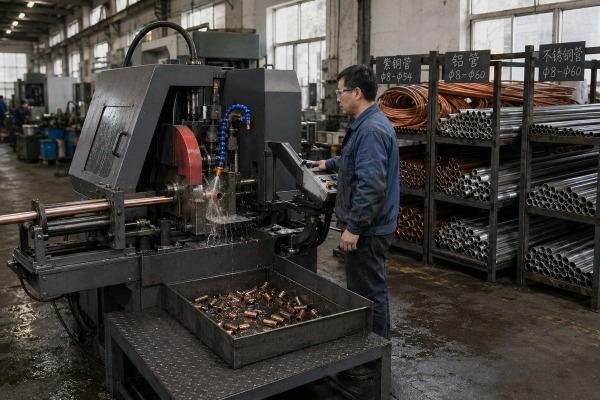
A fully automatic pipe cutting machine promises hands-off precision. Yet on our Wenzhou production line, one wrong material setting once turned a full shift of copper stock into scrap.
A fully automatic pipe cutting machine performs differently by material: soft non-ferrous metals like copper and aluminum cut fastest with the cleanest edges, carbon steel needs stronger clamping and slower feeds, stainless steel wears blades faster, and plastics require rotary blade tooling instead of metal-cutting setups.
That is the short answer. The longer answer is more useful. Below, I will walk through material switching, wall thickness, tooling choices, and hardness. Each section uses real data from our own machine testing.
During a QC audit last year, our team found that one machine cut aluminum perfectly but left burrs on stainless steel. The machine was fine. The stored parameters were not.
Yes, a well-configured fully automatic pipe cutting machine is reliable across stainless steel, aluminum, and copper, provided each material has its own stored parameter set. Reliability drops only when operators reuse one universal setting, because hardness, thermal conductivity, and burr behavior differ between the three metals.

That audit changed how we validate machines before shipping. Now, we never approve a multi-material machine based on one test material. Instead, we follow a fixed routine that I recommend to every buyer.
My personal method is simple. First, build a material test matrix before production begins. Second, keep the same test conditions for every material — same operator, same ambient temperature, same coolant flow. Third, record every material parameter without exception: alloy grade, diameter, wall thickness, and hardness. Fourth, compare the cutting precision 1 differences across the matrix. Fifth, compare the kerf quality on each cut face under magnification. This five-step routine exposes reliability gaps that a single demo cut will never show.
Here is a simplified version of the matrix we run on our own equipment:
| Material | Relative Ease of Cutting | Typical Risk | Key Adjustment |
|---|---|---|---|
| Copper | Easiest | Burr smearing, reflectivity on lasers | High feed, sharp blade, fiber laser only |
| Aluminum | Easy | Chip buildup, surface scratching | Moderate feed, strong coolant flow |
| Stainless steel | Hardest of the three | Blade wear, heat buildup | Low speed, high torque, frequent blade checks |
Copper and aluminum are soft and conduct heat away quickly, so they cut cleanly at high throughput. Many automatic machines are explicitly built for copper, aluminum, brass, and thin-wall conduit. Stainless steel tube processing is harder on tooling, so cycle times slow and blade wear resistance becomes the deciding factor. On CNC laser pipe cutting systems, copper and brass add another issue: reflectivity. These metals need fiber laser technology 2 or specific beam frequencies to cut safely. So yes, one machine can handle all three metals reliably. But it does so with three different recipes, not one.
There is a real trade-off we weigh on every project: cutting speed versus verticality. Push a thick-wall stainless tube too fast, and the cut face tilts and collects dross.
Yes, consistent precision is achievable across different wall thicknesses and materials when the machine adjusts feed rate, clamping force, and pass strategy per job. Thin walls need gentle hydraulic clamping to avoid deformation, while thick walls need multi-pass cycles or gas assistance to keep cuts vertical.

Wall thickness capacity is where machine specifications matter most, and where buyers get misled most often. A spec sheet may say "cuts stainless steel," but the thickness limit tells the real story.
Published capacities vary widely across machine classes. Here are representative figures from the current market:
| Machine Type | Diameter Range | Wall Thickness Capacity | Notes |
|---|---|---|---|
| Rotary automatic tube cutter | 1.5 mm – 22 mm | Lower limits for steel than copper/aluminum | Copper and aluminum get higher max diameter and wall limits |
| Laser pipe-processing system | Varies by model | Steel up to 10 mm, stainless 6 mm, aluminum 5 mm | Same machine, three different limits |
| Tube laser cutter (general class) | Varies | About 0.5 mm to 10 mm or more | Covers stainless, carbon steel 3, aluminum, copper, brass, titanium |
| Heavy industrial pipe cutter | 2 in – 48 in | Up to 5/8 in, or 1 in in XL configuration | Built for large-bore pipe work |
Notice the pattern. The same laser source cuts 10 mm of carbon steel but only 6 mm of stainless and 5 mm of aluminum. Cutting tolerance precision holds only inside those windows.
Thicker walls often require multi-pass cycles or high-pressure gas assistance to maintain verticality and minimize dross. Thin walls flip the problem: too much clamping force ovalizes the tube. A good hydraulic clamping system or self-centering chuck adapts pressure automatically. Advanced machines also apply material-specific kerf compensation algorithms that account for microscopic thermal expansion of different alloys during long, high-speed runs. In my own testing matrix, I always compare precision at the thinnest and thickest wall in the job mix — the middle usually takes care of itself.
A procurement manager in the United States once asked us over WhatsApp whether one blade set could handle his mixed orders of copper tube and PVC conduit. Our honest answer: no.
Yes, cutting plastic and metal pipes on the same machine usually requires different tooling. Metal pipes need TCT or HSS blades matched to hardness and density, while plastic and flexible tubing cut best with sharp rotary blades, lower clamping pressure, and reduced heat to prevent melting or delamination.

The market itself confirms this split. Flexible tubing and non-metal tubing form a separate product category, usually cut with rotary blade systems rather than pipe saws or laser cutters. Cast iron sits at the opposite extreme — fully automatic cast iron pipe cutters now exist as their own dedicated product class, which tells you it is not interchangeable with standard tube-cutting setups.
Blade selection is not a detail. It decides whether you get a burr-free finish or a rework pile. TCT (tungsten carbide tipped) blades resist wear on harder metals. HSS (high-speed steel 4) blades suit softer non-ferrous work at lower cost. The blade must match the material's density and hardness precisely, or thermal deformation ruins the edge.
| Pipe Material | Recommended Tooling | Coolant Approach | Common Failure If Mismatched |
|---|---|---|---|
| Carbon/stainless steel | TCT blade or cold saw technology | High-flow ferrous coolant | Blade chipping, blued edges |
| Copper, brass, aluminum | HSS or fine-tooth TCT | Non-ferrous lubricant, lighter flow | Material smearing, gummed teeth |
| PVC and rigid plastic | Sharp rotary blade, fine pitch | Minimal or air-only | Melted, welded-back kerf |
| Composite/multi-layer pipe | Hybrid cutting cycle | Balanced thermal control | Layer delamination |
Multi-layered and composite piping is the trickiest case. These need specialized hybrid cutting cycles that balance mechanical pressure against thermal energy to prevent delamination. Cooling and lubrication systems must also change between ferrous and non-ferrous work — flow rates and fluid types differ significantly. On the machines we build in Wenzhou, we design quick-change tooling stations and store coolant profiles in the smart PLC control, so a changeover takes minutes rather than an hour. If your job mix crosses the plastic-metal line daily, specify quick-change capability upfront. It pays for itself fast.
Early in our export business, we shipped a machine tuned for aluminum to a client who fed it stainless bar stock. The blades lasted days instead of months. Lesson learned: hardness rules everything downstream.
Material hardness directly slows cutting speed, accelerates tool wear, and lowers production efficiency. Harder materials like stainless steel demand lower cutting speeds and higher torque to protect edge integrity, significantly extending cycle time versus aluminum, while soft copper allows high throughput with minimal blade wear.

The material hardness rating of your pipe stock is the single best predictor of your real production cycle time. Here is how the chain of effects works, step by step:
This is where modern automation earns its price, and where the "universal machine versus dedicated machine" debate gets resolved in practice. Some buyers tell me a dedicated single-material machine will always beat a multi-material platform. That is true only for narrow, high-volume workloads. For mixed production, new adaptive features close the gap. AI-driven adaptive control systems can now sense material hardness variations in real time and automatically adjust feed rates and spindle speeds to optimize throughput and prevent tool failure. Acoustic emission monitoring goes further: sensors analyze the unique sound frequencies of each cut and detect material-specific blade wear patterns before they affect part quality. Automated loading systems calibrated for material friction coefficients and weight prevent surface scratching and hold length accuracy across batches. When we configure PLC-controlled machines for clients running mixed stainless and copper work, these adaptive features — not raw spindle power — decide the real output per shift.
Material dictates performance. Test with a matrix, record every parameter, and match tooling to hardness — then a fully automatic pipe cutting machine delivers precision on nearly any pipe.
Interested in sourcing the products mentioned in this article? See details and request a quote here:
1. International standards body providing frameworks for manufacturing quality and measurement precision. ↩︎
2. Leading professional association for electronic and laser engineering standards and technical research. ↩︎
3. Primary international body representing the global steel industry and material standards. ↩︎
4. Comprehensive technical overview of high-speed steel properties and industrial tool applications. ↩︎
