

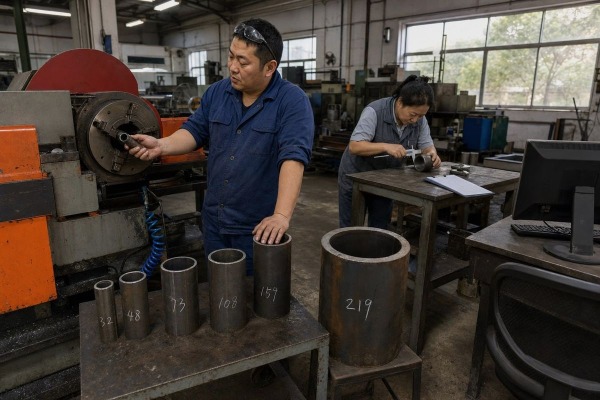
Buyers ask me about pipe cutting machine range almost weekly. On our Wenzhou production line, I have seen wrong-sized machines stall entire projects, so the question matters deeply.
A pipe cutting machine’s range meets customer needs when its diameter capacity, wall thickness capacity, material compatibility, cut-angle envelope, and minimum pipe length all cover the buyer’s full pipe portfolio—verified by sample cuts at the smallest, largest, and thickest workpieces, not just the spec sheet.
Range is not one number. It is a set of limits that must all fit your job. Below, I break the fit test into four practical checks you can run before ordering.
A German distributor once sent our engineers a list of only his largest pipes. We asked for his smallest too—and that saved his order from a costly mismatch.
Match diameter range by listing your smallest and largest pipe outer diameters, then confirming both fall inside the machine's chuck clamping range with margin at each end. A machine rated φ15 mm–φ240 mm fits only jobs fully inside that band, including future sizes.

Most buyers check the maximum diameter and stop there. In my experience, the minimum diameter causes just as many failures. A chuck built for large pipe often cannot grip small tube securely. The pipe slips, the cut wanders, and cutting precision collapses.
Before you compare any machines, write down every pipe size you cut today. Then add the sizes you expect within two or three years. This list becomes your primary fit filter. Manufacturers define capacity in narrow bands, not universal coverage. One model may list φ15 mm–φ240 mm. An industrial catalog system may span from 12 mm internal diameter up to very large pipe. Some tools even quote both inside and outside dimensions, such as a 6 5/8 in. I.D. to 24 in. O.D. range, because the clamping design rides the bore rather than the outer wall.
Also note whether your pipes are round only. Some shops need geometric versatility 1 for square, rectangular, or open-section channels. A machine that clamps round stock perfectly may not hold a C-channel at all.
| Check Item | What to Record | Why It Matters |
|---|---|---|
| Minimum OD | Smallest pipe you cut | Small tube may slip in a large chuck |
| Maximum OD | Largest pipe you cut | Hard capacity ceiling of the machine |
| I.D. vs O.D. spec | How the supplier defines range | Bore-riding tools measure differently |
| Non-round profiles | Square, rectangular, channels | Requires different clamping fixtures |
| Future sizes | Planned product additions | Avoids buying twice |
When we quote a machine, we ask for this inventory upfront. It removes guesswork on both sides.
Material and wall thickness matching is the check I weigh most heavily. In my own experience, this pairing—not diameter—decides whether a machine truly fits the processing need.
Check the machine's wall thickness capacity against your heaviest schedule, confirm the material list covers your hardest alloy, and verify the minimum pipe length the clamps require. Professional systems span roughly 1 mm to 100 mm wall thickness depending on design, so class matters.

Wall thickness changes everything about the cut. Thicker walls demand more cutting power, slower feeds, and tighter feed control. A machine that glides through 3 mm carbon steel may stall or overheat on 12 mm stainless. That is why I always put material compatibility and wall thickness on the same line of the technical specifications checklist. They interact.
Carbon steel, stainless steel, duplex, super duplex 2, and nonmetallic pipes each respond differently to cutting force. Stainless work-hardens. Duplex resists tool penetration. Plastic pipe needs correct tooling, guarding, and pipe support to cut safely. A cold cutting method may suit thin stainless where heat distortion is a risk, while heavy carbon steel walls 3 may favor a robust mechanical blade. When our team specs a machine for export, we ask three questions together: what alloy, what schedule, what surface finish after the cut.
Length limits are quieter but real. Some machines require a minimum pipe length 4 to clamp safely, and centerline height can constrain installation. Short offcuts below that minimum become scrap unless the machine uses a zero-tailing chuck system that grips close to the cut line and maximizes material yield.
| Parameter | Question to Ask the Supplier | Risk If Ignored |
|---|---|---|
| Wall thickness capacity | Max schedule at rated speed? | Stalling, overheating, blade wear |
| Material compatibility | Tested on my exact alloy? | Poor edge quality, tool damage |
| Minimum pipe length | Shortest clampable piece? | High-value scrap tails |
| Cutting method | Cold cutting or thermal? | Heat distortion on thin walls |
| Coolant system | Flow adequate for thick cuts? | Premature tooling failure |
Get these numbers in writing before you pay a deposit.
Trust but verify—that is the lesson a procurement manager from the US taught me early on. He never accepted our spec sheet alone; he demanded video proof on his own pipe.
Verify claims by requesting recorded sample cuts on your representative pipe: the smallest size, the largest size, the thickest wall, the hardest material, and the steepest bevel angle. Measure cut squareness, burr level, and cycle time, then compare results against your production throughput target.

Spec sheets describe the best case. Your production floor 5 lives in the real case. Bridging that gap requires a structured verification process, and I recommend buyers follow these steps in order.
Some buyers push back and say precision matters more than raw capacity. For fabrication and weld-prep work, they are right—a smaller, more accurate machine can outperform a larger general-purpose model. The sample cut resolves this debate with evidence, not opinion. If the machine passes at your extremes with the tolerances your welders need, the claimed range is real for you.
The trade-off I weigh most often with clients is upfront cost versus future flexibility. Our OEM/ODM work exists precisely because standard ranges rarely fit growing product lines perfectly.
Choose a fixed-range machine if your pipe portfolio is stable and fully covered with margin. Choose a customizable machine if you expect new diameters, materials, or cut types within three years, or need non-standard clamping, automation level upgrades, or integration into an existing line.

This decision is really a forecast about your business. A fixed-range machine costs less, ships faster, and carries proven reliability. A customized machine costs more upfront but bends to your roadmap instead of forcing your roadmap to bend to it.
Some buyers try to solve the future by buying the largest-capacity machine available. I push back on this. Oversizing increases cost, footprint, and operating complexity 6 without improving current job fit. A huge machine cutting small tube all day wastes floor space and often delivers worse cutting precision on light workpieces. Right-sizing with a defined upgrade path beats brute-force capacity.
Customization earns its price in specific situations. If you need multi-tasking functions such as tapping or part marking to consolidate steps, a non-standard build makes sense. If you need orbital cutting technology for in-line spool work, or a higher automation level with automatic feeding for continuous shifts, a smart PLC control platform 7 lets us extend the machine later. Our team in Wenzhou has built such non-standard solutions for buyers in the US, Germany, and Japan, and the common thread is always a clear three-year pipe forecast.
| Factor | Fixed-Range Machine | Customizable Machine |
|---|---|---|
| Upfront cost | Lower | Higher |
| Delivery time | Shorter | Longer, design phase needed |
| Future pipe sizes | Locked to current band | Expandable envelope |
| Automation level | As-built | Upgradeable via CNC control system |
| Best fit | Stable, known portfolio | Growing or shifting product mix |
| Spare parts | Standard, widely stocked | May need supplier support |
Whichever path you take, confirm spare parts availability, maintenance access, and operator training. Lifecycle cost, not purchase price, determines the true value of the range you buy.
Range is a fit test, not a spec number. Match diameter, wall thickness, material, and cut type to your real portfolio, verify with sample cuts, then buy with confidence.
1. Authoritative Wikipedia entry explaining the geometric versatility and capabilities of laser cutting. ↩︎
2. Detailed explanation of high-performance duplex and super duplex alloys in piping. ↩︎
3. Authoritative definition of carbon steel properties and its industrial applications. ↩︎
4. Authoritative Wikipedia entry covering pipe manufacturing, sizing, and engineering specifications. ↩︎
5. Authoritative Wikipedia entry defining the shop floor and production environment in manufacturing. ↩︎
6. Academic overview of how machine oversizing impacts operational complexity and efficiency. ↩︎
7. Authoritative Wikipedia entry explaining PLC technology and industrial control platforms. ↩︎
