

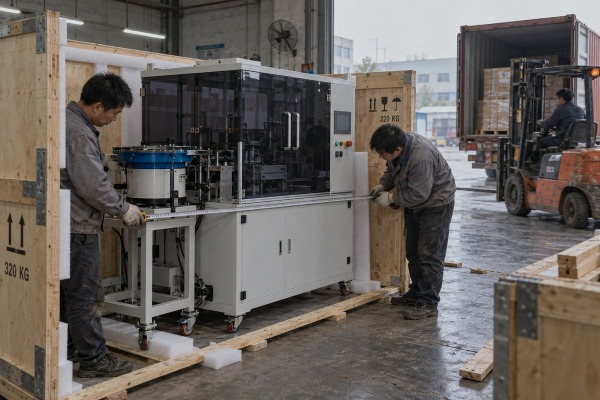
Last quarter we crated a bowl-feeder line for Germany. The quote looked cheap. Port fees followed. A cost-effective [shipping method](https://yqunique.com/how-choose-international-logistics-sourcing-automatic-pipe-cutting-machine-europe/) for large equipment from China needs more than one number.
Ocean FCL is usually the most cost-effective shipping method for large equipment from China when the machine fits a standard container and delivery is not urgent. Flat rack, RoRo, or breakbulk suit oversized units, rail fits China–Europe deadlines, and air only pays off for urgent compact parts.
That short answer hides a lot of detail. Below, I walk through how we compare sea and air, which fees catch buyers off guard, how deadlines change the math, and when consolidation actually saves money.
Our packing bay in Wenzhou has a rule: measure the crate, not the machine. A bowl feeder on its stand grows a lot once skids and frames go on.
Compare sea and air freight by total landed cost, not base rate. Sea FCL charges per container with low trunk cost but 25–60 days transit. Air charges per kilogram or volumetric weight, delivers in days, and only wins when downtime costs exceed the freight difference.

The mistake I see most often is comparing a per-container ocean freight rate with a per-kilogram air rate as if they were the same unit. They are not. A fair comparison needs the same cargo, the same scope, and the same delivery point.
Speed is the first filter. If your line can wait, ocean is the baseline. If it cannot, the choice narrows fast.
| Method | Typical cost level | Indicative transit | Best for | Main limits |
|---|---|---|---|---|
| Ocean FCL | Lowest | Roughly 25–60 days by route | Standard machinery, non-urgent orders | Container dimensions, port delays |
| Flat rack / open-top ocean | Moderate to high | Several weeks | Oversized or tall equipment | Out-of-gauge surcharges, special handling |
| RoRo / breakbulk shipping | Project pricing | Several weeks | Self-propelled or very large machines | Fewer sailings, specialized ports |
| Rail (China–Europe) | Intermediate | Roughly 15–25 days door to door | Time-sensitive heavy cargo to Europe | Corridor availability, border transfers |
| Air | Highest | Days | Urgent, compact, high-value parts | Weight and size limits |
Rates shift with season, fuel, and route disruption, so treat these as illustrations and request current quotations.
Air is priced on actual or volumetric weight, whichever is greater. Machinery-related air freight can reach several dollars per kilogram, and oversized pieces cost more. For a complete automation cabinet with a steel frame, that number climbs quickly. For a replacement PLC, a touchscreen, or a set of pneumatic actuators, it stays manageable.
When we quote an automation cell, we ask the buyer three things. How heavy is the packed unit? How soon does the line need it? What does one idle day cost? If the answer to the last question is high and the part is compact, air can be the cheapest total option. If the shipment is a full production cell, ocean nearly always wins on freight, and we focus instead on protecting precision components from handling damage. A low rate is worthless if the control panel arrives cracked.
A US procurement manager once sent me two forwarder quotes and asked why they differed by thousands. One was FOB port-to-port. The other included drayage and customs.
Watch for out-of-gauge surcharges, crane and lashing fees, terminal handling, customs brokerage, import duties such as Section 301 tariffs, demurrage and detention, storage, inland drayage, heavy-haul permits, and insurance exclusions. Together these hidden fees can double a cheap port-to-port quote.

Heavy machinery logistics has more line items than most buyers expect. The main carriage is often the single largest number, but it is rarely the majority of the total. Here is how I group the fees when I review a quotation with a client.
| Stage | Typical charges | Why buyers miss them |
|---|---|---|
| Origin | Export crating, disassembly, factory pickup, trucking to port, documentation | Often bundled into "EXW" or assumed free |
| Main carriage | Base freight, fuel and security surcharges, OOG surcharge, flat rack premium | Surcharges quoted separately from the headline rate |
| Destination port | Terminal handling, crane and lifting, lashing, storage, demurrage and detention | Billed after arrival by parties the buyer never spoke to |
| Customs | Brokerage, import duties and taxes, inspection fees | Varies by HS code and trade agreement |
| Final mile | Inland drayage, heavy-haul permits, escorts, unloading, positioning | Not included in port-to-port scope |
| After delivery | Insurance deductibles, reassembly, commissioning, delay costs | Treated as operations, not logistics |
FOB means the price covers delivery to the ship in China. Everything after loading is yours. CIF adds main freight and basic insurance to the destination port, but destination handling 1, customs clearance costs, and inland delivery still land on you. Neither term is a door-to-door price. Quotes under different Incoterms are not comparable until you add back the missing scope.
Our standard cabinets fit a 40HQ container. Add an external hopper or a tall signal tower that cannot be removed, and the unit becomes out-of-gauge (OOG) cargo. Flat rack container rates run roughly 50% to 100% above standard container rates, and some regional examples reach 1.5 to 2.5 times before crane, lashing, and engineering approval fees are added.
I recommend pricing every shipment three ways. Best case: normal transit, no storage, clean customs. Expected case: standard delays and handling. Worst case: congestion, inspection, demurrage, or damage. The gap between best and worst is your real risk budget.
Every quote we prepare forces the same trade-off. A faster mode costs more up front. A slower mode costs more if the client's line sits idle waiting on our cabinet.
Choose the shipping method by matching deadline, budget, and cargo size. Pick ocean FCL for flexible timing and container-sized machines, rail for China–Europe deliveries needed in 15–25 days, specialized ocean for oversized cargo, and air only when a compact part prevents expensive downtime.

A cost-effective shipping method for large equipment is the one with the lowest delivered cost after you price delay. That sounds obvious. In practice, most buyers still pick the lowest freight number. Here is the sequence I use.
| Factor | Ocean FCL | Rail |
|---|---|---|
| Indicative 40-foot rate, China to Germany | Roughly USD 2,800–4,500 | Roughly USD 6,800–7,500 |
| Door-to-door transit | Roughly 35–60 days | Roughly 15–25 days |
| Cost relative to air | Far lower | Roughly 40–50% of air |
| Reliability risk | Port congestion, rerouting | Border transfers, corridor limits |
Ocean keeps a 20%–40% trunk-freight advantage over rail on these lanes, and rail runs roughly two to three times standard ocean container freight. Rail still wins when inventory financing, lost sales, or a stalled commissioning schedule outweigh that gap. For our German and French clients, this is a real conversation, not a theoretical one.
Buyers tell me ocean is always cheapest. It usually has the lowest main-carriage rate, yes. It does not have the lowest total cost when a late machine stalls a product launch. Other buyers tell me rail is the perfect compromise. It is a strong option on established corridors, but it is not available everywhere, it struggles with extreme OOG cargo, and final trucking from the rail terminal can eat into the time saved.
Import duties and taxes are part of the budget too. Buyers in Asia-Pacific markets can check RCEP preferential rates 3 for industrial machinery sourced from China. US buyers should model Section 301 tariffs before comparing modes, because duty does not change with speed.
One lesson cost us a second container. We loaded three terminal crimping machines without a layout plan, and the last bowl feeder stand would not fit.
Yes. Consolidating multiple equipment orders into one FCL container cuts per-unit freight, destination handling, and customs clearance costs. Once combined volume passes roughly 15 CBM, FCL beats LCL, and modular disassembly plus 3D load planning can avoid flat racks and overflow containers.

Consolidation is the most reliable lever we have to lower a client's landed cost. It works because many fees are fixed per shipment, not per machine. One customs entry, one set of destination charges, and one delivery replace three.
LCL charges by cubic meter and looks cheap on paper. It also carries consolidation fees, warehouse charges, destination deconsolidation, and repeated handling at every transfer point. For precision equipment with touchscreens, pneumatics, and sensitive feeders, that extra handling is a damage risk I take seriously. The industry break-even sits around 15 CBM. Above that, a full container is usually cheaper and safer.
| Factor | LCL | FCL |
|---|---|---|
| Pricing basis | Per cubic meter plus fixed fees | Per container |
| Handling points | Multiple | Loaded once, sealed once |
| Damage exposure | Higher | Lower |
| Break-even | Below roughly 15 CBM | Above roughly 15 CBM |
| Best use | Single small machine or spare batch | Two or more machines, full cells |
Designing equipment so it splits into modules changes the shipping class. A cabinet that ships in a standard 40HQ instead of a flat rack container can cut freight expenses by 40% to 60%. When we build custom automation lines, we plan detachable feeder stands, removable signal towers, and caster-mounted bases for exactly this reason. Reassembly time at the client site is almost always cheaper than OOG surcharges.
A 3D load simulation shows where each irregular module sits before anyone lifts a crate. It maximizes container density 4 and prevents the overflow container I learned about the hard way. It also documents weight distribution, which carriers ask for on heavy cargo.
Some ports now favor green shipping corridors with priority berthing and carbon-related incentives. For buyers placing repeat orders, choosing those routes can add a modest long-term edge on top of consolidation savings.
Cheap freight quotes hide expensive surprises. Measure the crate, price the whole journey, and weigh downtime. Then request three itemized, like-for-like quotations before you book.
Interested in sourcing the products mentioned in this article? See details and request a quote here:
1. Official ICC guide to Incoterms, defining responsibilities for destination handling and terminal costs. ↩︎
2. Wikipedia overview of the Trans-Eurasia Logistics network connecting China and Europe by rail. ↩︎
3. Official portal for the RCEP trade agreement, detailing preferential tariff rates for member countries. ↩︎
4. Homepage of the ISO, the body responsible for international shipping container standardization. ↩︎
