

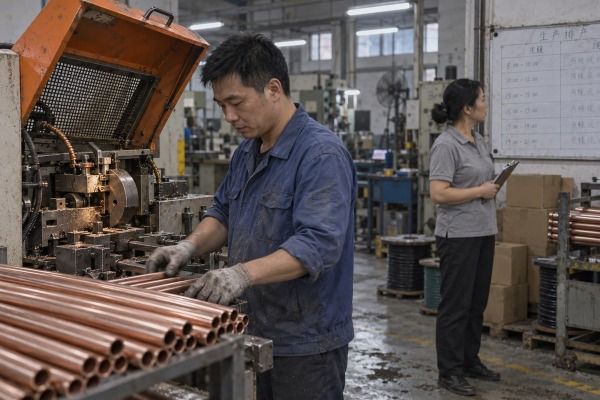
Last quarter a buyer asked me whether a five-machine order would stretch our production cycle for automatic pipe cutting machines. Delays cost him weekly. Here is my honest answer.
Yes. Order volume affects the production cycle for automatic pipe cutting machines mainly through setup, scheduling, and factory capacity, not through the machine’s cutting speed per piece. Larger orders spread fixed setup time across more units but can create queueing, tool wear, and assembly bottlenecks that extend lead time.
That answer has two sides. One side is what happens on your shop floor when you feed more tubes into the machine. The other side is what happens in our workshop when you order more machines. I will cover both, because procurement managers ask me about both in the same call.
One lesson from building cable lug cutting lines in Wenzhou: order quantity changes how we schedule, not how fast one machine cuts.
Order quantity influences lead time in two ways. On the buyer's floor, more pieces dilute fixed setup time per part. On the builder's side, more machines mean more design, assembly, and debugging hours, so lead time rises once the factory's parallel build capacity is reached.

Most confusion here comes from one word. "Production cycle" means three different things, and people mix them up. I separate them before quoting any number.
| Term | What it measures | Does order volume change it? |
|---|---|---|
| Machine cycle time 1 | Load, position, clamp, cut, unload, reset for the next piece | Almost never. It is set by the machine, the material, and the cut type. |
| Batch production time | Total time to finish one order, including machine setup time and material changes | Yes. Setup is roughly fixed, so bigger batches add cutting time but not much setup. |
| Order lead time | Time from order confirmation to shipment, including queueing, inspection, packing | Yes. Volume drives scheduling, capacity, and queue position. |
A university prototype I read about measured cycle time from tube loading to unloading. It targeted about 30 seconds per cut, while a different configuration reached four seconds per cycle and up to 120 pieces per hour. Those numbers are equipment-specific. They are not benchmarks for your line. I mention them only to show how wide the range gets when the definition of "cut" changes.
The useful formula is simple. Total order time equals setup time, plus pieces multiplied by effective cycle time, plus handling, inspection, maintenance, and downstream work. Divide setup by piece count and you get the setup burden per part.
| Scenario | Setup time | Effective cycle | Setup burden per piece | Cutting time only |
|---|---|---|---|---|
| 100-piece order | 30 minutes | 10 seconds | 18 seconds | 1,000 seconds |
| 10,000-piece order | 30 minutes | 10 seconds | 0.18 seconds | 100,000 seconds |
The machine did not get faster. The batch simply absorbed the fixed setup across more units. This is the whole case for batch size optimization and economies of scale 2 in CNC tube cutting. It is also why a 100-piece custom order can carry a high per-piece cost even when the cutting itself takes under 20 minutes.
Now flip to our side. When you order one machine, our engineers draft one design, source one bill of materials, and debug one unit. When you order five, the design and sourcing effort barely grows. The assembly and debugging hours grow almost in proportion. So your lead time depends on how many frames our team can build and test at the same time. I will show how to check that in the next section.
Every bulk request forces a trade-off on our side: run several frames in parallel and risk thin debugging time, or build in sequence and ship later.
Bulk orders do not automatically ship faster. They lower per-machine engineering and sourcing time because one design, one BOM, and one test plan cover all units. But total delivery depends on how many machines our workshop can assemble and debug at once, so we quote staged deliveries honestly.

The most useful thing I can tell a buyer is also the least flattering to any supplier. Before you trust a bulk delivery promise, examine the supplier's factory scale. Then combine that with the factory's production technology and efficiency to estimate how many machines it can genuinely build at the same time. Count the whole flow, from design through assembly to debugging. A workshop that can weld ten frames in a week may only be able to debug two of them in that same week.
| Build stage | Behaviour on a bulk order | Why |
|---|---|---|
| Mechanical and electrical design | Nearly fixed | One drawing set serves every identical unit |
| Parts sourcing 3 | Fixed effort, longer wait for quantity | Suppliers of servo drives, blades, and guards batch their own deliveries |
| Frame fabrication and assembly | Scales with quantity | Each unit needs bench hours and floor space |
| Debugging and sample testing | Scales with quantity, often the bottleneck | Each unit must run your tube sizes and pass dimensional checks |
| Packing and export documentation | Scales slightly | Crating is per unit, paperwork is per shipment |
Our team in Wenzhou is ten people across R&D, engineering, manufacturing, sales, and after-sales. That is a strength for customization and a limit for parallel builds. I say that plainly because it shapes how we schedule. When a distributor in India or Vietnam asks for several identical cutters, we propose staged shipments. The first unit ships after full debugging and sample testing on the customer's actual tube. The remaining units follow in production scheduling slots we have already committed.
Buyers often push back with a fair point. They say volume should always speed things up because fixed engineering is diluted and the line runs continuously. That is true until the workshop nears its practical limit. Machines and people operating near 90 percent capacity experience non-linear wait times for new work. Extra volume then adds queue time rather than output. A small urgent order can also get stuck behind a large batch. I would rather tell you that upfront than promise a lead time reduction I cannot deliver.
So what does bulk buy you? It buys consistent specification across units, one commissioning plan, one spare parts list, and one tooling set. It buys lower per-machine cost. It does not buy a shortcut past assembly and debugging hours.
During a final test run on a copper tube cutter, our technician found cut quality dropped on thick-walled stock long before the order size mattered.
Beyond order volume, the production cycle timeline depends on material wall thickness and composition, cut-length mix, tooling changeover speed, material handling automation, inspection requirements, preventive maintenance windows, and downstream capacity such as deburring or welding. Any one of these can become the real bottleneck.

Order volume is the variable buyers can control. These are the ones they tend to ignore until a deadline slips.
Wall thickness and composition set the feed rate. Dense or reflective materials like copper and thick-walled steel need slower feeds to hold cut quality, so a high-volume copper order runs longer per piece than the same count in thin aluminum. Diameter, steel grade, and heat management also decide blade wear, laser parameters, and whether a secondary finishing step is needed. Our pipe cutting machines run copper tube for cable lug and terminal work, so we tune parameters per alloy and per wall thickness during sample testing rather than trusting one nominal speed.
One repeated length batches cleanly. Ten different lengths in one order mean more stops. Machines that store several programmed cutting lengths reduce those interruptions, and one industrial automatic saw 4 on the market manages up to 10 cutting lengths with an automated scrap system. Changeover efficiency is the primary bottleneck for high-mix work. Software-driven, tool-less adjustment removes manual mechanical resets, which is where machine setup time hides.
Loading is often the real limiter, not the blade. Automatic bundle loaders and servo-driven feeders keep flow continuous between cuts. One supplier reports that automatic loading and centering can raise effective cutting time by 30 to 40 percent. Treat that as a vendor figure. The real gain depends on how manual your previous process was. Still, decoupling the cycle from manual labour is what allows lights-out operation during peak demand.
| Source type | Reported figure | Caution |
|---|---|---|
| Automatic tube separator | Up to 1,700 or 1,900 parts per hour by model | Depends on material and dimensions |
| High-speed circular saw | About 6.6 seconds per cut | Cut only, not door-to-door |
| Small-batch production | 5 to 15 seconds per cut | Includes more handling |
| Pneumatic systems | 4 to 6 seconds per cut | Simple straight cuts |
Those figures only compare if the definition of "cut", the pipe size, the material, and the loading assumptions match. They rarely do.
Preventive maintenance clashes with big runs. Skipping calibration to hit a deadline causes cumulative accuracy drift and rework, which costs more time than the skipped check. Newer systems use edge computing for real-time kerf compensation, adjusting blade or laser parameters for heat-induced expansion without stopping the cycle. Inspection plans matter too: prototypes get checked piece by piece, while volume runs use sampling. Finally, cutting may not be the bottleneck at all. Deburring, threading, bending, welding, or coating can cap manufacturing throughput and turn a fast cutter into a pile of work-in-process.
A procurement manager in Mexico once sent us drawings and a deadline in the same email. We mapped backward from his line start date, and that worked.
Plan custom orders backward from your line start date. Confirm drawings and process specs first, then ask the supplier for a staged timeline covering design, parts sourcing, assembly, debugging, sample testing, and shipping. Lock the sample approval date early and keep a buffer for freight and commissioning.

Custom equipment fails on schedule for boring reasons. Drawings arrive late. Tube samples arrive after the machine is built. Nobody agreed on what "approved" means. Here is the sequence I use with buyers in the United States, Canada, and South Korea, and it applies to any supplier.
The personal rule I follow when evaluating any workshop, including our own, is to assess factory scale together with production technology and efficiency, and then estimate how many machines can be in build at once across the full design-to-debugging flow. Ask these directly:
Your side can also deliver lead time reduction. Sending final product drawings and the process flow with the first inquiry lets our engineers start tooling design immediately instead of after three rounds of clarification. On the shop floor, direct CAD integration automates nesting and G-code generation 5 at order entry, which trims pre-production hours on every batch. Larger plants now use AI-driven predictive scheduling that re-routes orders across machines based on live tool wear and thermal data instead of static first-in, first-out queues. Some run digital twin simulations to stress-test a high-volume sequence and find forklift congestion or bin capacity limits before the first tube is loaded. Modular machine architectures let you add auxiliary discharge units or sorting bins for a volume surge without redesigning the floor. None of that replaces the basic discipline: confirm specs early, approve samples on time, and treat cycle time optimization as a system task rather than a machine spec.
Order volume shapes lead time through setup, scheduling, and factory capacity, not cutting speed. Check the supplier's parallel build capability, plan backward, and request complete production-time estimates.
Interested in sourcing the products mentioned in this article? See details and request a quote here:
1. NIST provides authoritative standards and research on industrial measurement and manufacturing cycle time optimization. ↩︎
2. Wikipedia entry defining how increasing production volume leads to cost advantages and operational efficiencies. ↩︎
3. The International Trade Administration provides resources for managing international parts sourcing and industrial supply chains. ↩︎
4. ISO develops international safety and performance standards for industrial machinery and automated sawing equipment. ↩︎
5. Wikipedia overview of the numerical control programming language used to direct automated machine tools. ↩︎
