

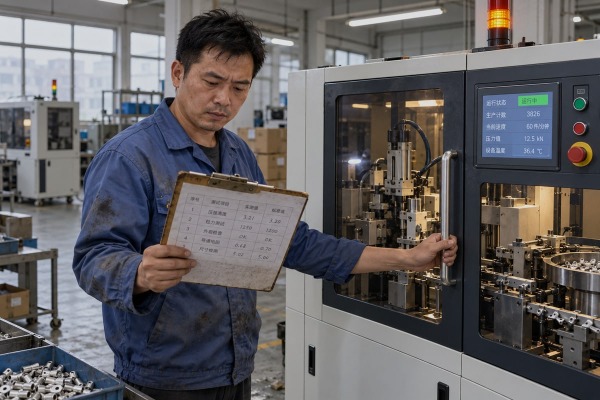
Our cable lug machines leave Wenzhou with every performance figure written down, because vague performance specs and capacity guarantees in an equipment contract have burned both sides before.
Write performance specs and capacity guarantees as measurable, testable obligations: name each parameter, its value, units, test location, operating conditions, method, tolerance, and duration. Then attach a test procedure, a cure and retest process, and liquidated damages for shortfalls.
A machine can be well built and still cause a dispute. The reason is almost always the paper, not the steel. So let me walk through how I draft these clauses today, and what I learned the hard way.
A procurement manager in the US once sent me a spec sheet that read "high precision, stable, efficient." I asked him what number would make him reject the machine.
Define each measurable performance spec with five elements: the parameter, the guaranteed value with units and tolerance, the measurement point, the operating conditions, and the test method or standard edition. Replace words like "high precision" with numbers, and put them in a performance schedule that controls over proposals.

He could not answer at first. That is the problem. "High precision" means one thing to his quality team and another to my engineers. So we rewrote every line together. That exercise is now the first thing I do on any custom automation project.
My rule is simple. Every adjective must become a number, a unit, a place of measurement, and a method. If I cannot re-test it, it does not belong in the contract. Here is how I convert the usual phrases on a terminal crimping or chamfering machine.
| Vague phrase | Measurable spec | Measurement point | Method |
|---|---|---|---|
| High efficiency | Throughput rate of X pieces per minute, sustained for 4 hours | Output counter at the exit chute | Witnessed run, agreed sample part |
| Runs stable | Uptime requirement of X% over a 72-hour reliability run, excluding scheduled stops | PLC alarm and stop log | Log export after the run |
| High precision | Chamfer length X mm ± 0.05 mm, Cpk at an agreed value | Caliper or CMM check on sampled parts | Sampling plan attached to the contract |
| Low energy use | Energy per unit of saleable output, kWh per 1,000 pieces | Dedicated power meter on the main feed | Metered during the capacity test |
| Fast changeover | Changeover from part A to part B in X minutes | Stopwatch from last good A to first good B | Two witnessed changeovers |
I keep these apart in every contract, because buyers often blend them. The technical specifications describe what the machine must be. The performance guarantee promises a result, such as a throughput rate under test conditions. Performance warranties cover defects, materials, and workmanship, and they run after acceptance. A warranty does not promise output. A guarantee does. Mixing them is how a buyer ends up with a defect-free machine that still cannot hit the plan.
My quotations are marketing documents. My drawings are design documents. The guaranteed values must sit in a single performance schedule 1 that wins over both. I write that order of precedence into the main agreement, and I require written approval for any later change to a guaranteed value. For semiconductor-style equipment, buyers may reference reliability metrics such as those in SEMI E10 2, but I still cite the exact edition and the exact metric, not just the standard name.
Modern lines add two more items. If the machine must talk to a plant network, I define operational parameters for data throughput and response latency. And many of my German and US customers now ask for an Overall Equipment Effectiveness 3 baseline. That is fine, but OEE needs its own definition of availability, performance, and quality in the schedule, or it becomes another vague word.
Last year we ran a terminal crimping line at full speed for a customer's video witness. The counter showed a great number. Then he asked which wire gauge we used.
Include a capacity guarantee clause that states the guaranteed output, its unit and measurement point, whether it is net or gross and sustained or instantaneous, the exact test conditions and inputs, the test duration, the acceptance threshold, and a degradation or availability guarantee for long-term production.

His question was the right one. A capacity number without its test conditions is just a number. Our machine ran faster on a clean, uniform wire. His plant used mixed suppliers. So we rewrote the clause around his material, not ours.
This is the point I push hardest. Capacity must state the conditions under which it was measured. Otherwise the supplier and buyer are each quoting a different machine. For our equipment, that means the part drawing, the material grade, the feed stock, the air pressure, the ambient temperature range, and the operator count. Here are the elements I now include in every clause.
| Clause element | What I write | Why it matters |
|---|---|---|
| Guaranteed value | Minimum net good parts per hour, not a nominal rating | Nominal ratings describe the design; the buyer needs output |
| Measurement point | Exit of the final station, after inspection reject | Gross output at the feeder is not saleable output |
| Sustained vs instantaneous | Sustained over a defined run, not a 60-second burst | Short bursts hide jams, heat, and feeder settling |
| Test inputs | Named material grade, size range, and sample lot | Input variability is the top cause of shortfalls |
| Boundary conditions | Ambient range, utility stability, air pressure, voltage | Conditions outside the range excuse or correct the test |
| Acceptance threshold | A percentage of the promised figure, agreed up front | One World Bank EPC template uses not less than 97% of promised capacity |
| Correction method | Correction curves for agreed deviations such as seasonal temperature | Avoids a failed test caused by weather, not design |
| Long-term term | Annual degradation limit or availability guarantee | Protects output over the useful life, not only on day one |
Suppliers like me will push back on one thing. We should not be liable for owner-supplied materials, utilities, or upstream equipment. That objection is fair. But I do not resolve it by weakening the guarantee. I resolve it by writing two lists: conditions I must design for, and conditions the buyer must provide. If the buyer runs recycled or variable-grade material, the clause states which grades the guarantee covers, and which trigger a corrected test instead of a failure.
Our bowl feeder may meet its feed rate. The crimping station may meet its cycle time. The line can still miss the target because of the interface between them. When we deliver a full custom automation line, I accept a system-level capacity guarantee. When we supply only one machine into an integrator's line, I guarantee that machine at its own boundary. The contract must say which case applies. Otherwise the gap belongs to nobody, and the buyer pays for it in lost output.
Every time a distributor asks me for uncapped penalties, I weigh it against the price. Higher risk means a higher quote. So we negotiate a structure instead.
Set penalty terms as a tiered remedy: first a cure period with repair and retest at the supplier's cost, then liquidated damages calculated per unit of shortfall below a threshold, then a buy-down or price reduction, and finally rejection or refund for chronic failure, all coordinated with liability caps.

A penalty clause that is too harsh gets priced in or ignored. A clause that is too soft protects nobody. The structure that has worked across our exports to the US, Germany, and Japan is a ladder. Each step is predictable, and each step gives me a chance to fix the problem before money changes hands.
| Tier | Trigger | Remedy | Who pays |
|---|---|---|---|
| 1. Cure | First failed performance test | Investigate, modify or replace, retest within a fixed cure period | Supplier bears all corrective and retest cost |
| 2. Liquidated damages | Shortfall remains after the cure period | Damages per unit of shortfall below the threshold | Supplier, up to the performance damages 4 cap |
| 3. Buy-down | Shortfall is small and replacement would cause long delay | Price reduction that settles the guarantee for that parameter | Supplier, by credit or refund |
| 4. Rejection or refund | Shortfall below a material floor, or a maximum number of retests exceeded | Buyer may reject, terminate, and recover payments | Supplier |
I prefer the term liquidated damages for a reason. In many jurisdictions a pure penalty is not enforceable, while a reasonable pre-estimate of loss is. So the clause should explain its own logic. The simplest formula is: guaranteed capacity minus tested capacity, multiplied by an agreed price per unit of shortfall. The contract should then answer the detail questions. Is there a minimum threshold before damages start, such as the 97% band? Are damages progressive, so a bigger miss costs more per unit? Do they apply per test or cumulatively? Are delay damages and performance damages added together, or capped as one pool? I always tell buyers to confirm enforceability with counsel in their governing law 5, not mine.
Buyers sometimes read a buy-down as a loophole. I see it differently. If a chamfering line delivers 95% of target and the alternative is three months without production, a credit is often the better business outcome. The clause just needs limits. State whether the buyer may still reject, whether the buy-down permanently satisfies the guarantee, and whether warranty rights survive. On my side, I ask for two protections: liability caps on total performance damages, and an exclusion of double recovery through both damages and consequential-loss claims. In return, I accept that fraud, willful misconduct, and fundamental nonperformance sit outside the cap.
The hardest lesson from our early exports was simple. A machine that passed Factory Acceptance Testing 6 in Wenzhou still failed on a customer's floor because the air supply was different.
Specify a staged acceptance regime: Factory Acceptance Testing, Site Acceptance Testing, commissioning, then a performance test with a named standard edition, calibrated instruments, stabilization period, minimum duration, multiple load points, measurement tolerance, raw data access, written test report, objection deadline, and a defined retest and expert dispute process.

That air supply case taught me that acceptance criteria are a sequence, not a single pass-or-fail event. Each stage proves something different, and the contract should say what each stage unlocks.
| Stage | What it proves | Typical gate it unlocks |
|---|---|---|
| Factory Acceptance Testing | The machine runs the buyer's sample parts at our plant before shipment | Shipment release and a payment milestone |
| Site Acceptance Testing / Installation Qualification | Installed correctly, utilities connected, safety circuits verified | Start of commissioning |
| Operational Qualification | Each function works across the operating range, including part load and changeover | Provisional acceptance |
| Performance Qualification / capacity test | Guaranteed throughput, precision, and energy figures met under load | Final acceptance, warranty start, release of retention |
| Reliability run | Uptime requirements met over an extended run, such as 72 hours | Release of performance security |
The final result is only as good as the process behind it. So I write the process as numbered steps.
A result of 99.8 against a guarantee of 100 will start an argument unless the contract has already answered it. I separate four things: the guaranteed minimum, the instrument uncertainty, any correction factor, and the acceptance band. If a tolerance exists, it sits in the performance schedule in plain sight. I never add a hidden tolerance to a minimum.
Our smart PLC control makes continuous verification easy. Many customers now ask for a clause that lets live sensor data confirm performance after acceptance, and that triggers a maintenance alert or warranty discussion when a trend drifts. I support this, with two conditions: the data-retention period is defined, and the buyer has audit rights to the raw logs. When a test result is disputed, I prefer a named independent testing engineer or expert determination over litigation, because the machine must keep running while the question gets answered. Good performance specs and capacity guarantees in an equipment contract are a measurement-and-remedy system, and this testing clause is the measurement half.
Vague words invite disputes. Numbers, test conditions, cure rights, and fair liquidated damages prevent them. Write it down before the machine ships, and both sides sleep better.
Interested in sourcing the products mentioned in this article? See details and request a quote here:
1. Authoritative source for international procurement standards and performance requirements in equipment contracts. ↩︎
2. Official standards body for semiconductor and electronics manufacturing equipment reliability metrics. ↩︎
3. Industry standard metric for measuring manufacturing productivity and equipment effectiveness. ↩︎
4. Legal definition and application of liquidated damages in commercial and performance-based contracts. ↩︎
5. Legal concept determining the jurisdiction and legal framework applicable to contract enforcement. ↩︎
6. Technical overview of the acceptance testing process, including factory and site-level verification. ↩︎
