

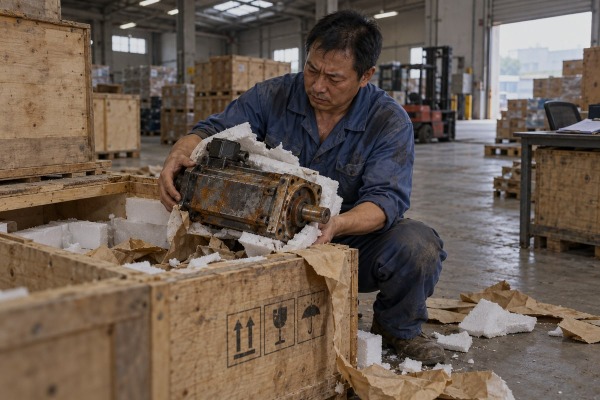
Export packaging and moisture/shock-proof treatment from assembly machine suppliers decide whether a tested machine arrives working. We have seen crates look perfect while the servo inside rusted. That hurts.
Require export packaging and moisture/shock-proof treatment from assembly machine suppliers by writing a packaging specification into the purchase contract as a technical annex. Define the route, barrier bags, calculated desiccant, VCI, bracing, ISPM 15 wood, indicators, photo evidence, pre-shipment approval, and remedies before ordering.
This guide walks through each part of that annex. I will show what to write, what to check, and what to refuse.
A procurement manager from Ohio once sent me a one-line request: "Please export pack." Our team asked him twelve questions back. His silence taught us both something.
Specify export packaging as a contract annex, not a sentence. State the destination, transport mode, transit and storage time, machine weight and center of gravity, permitted materials, ISPM 15 wood, moisture and shock protection methods, required photos and records, buyer approval before dispatch, and who pays when packaging fails.

My own rule is simple. I never let a contract say "the supplier shall pack the machine properly." That sentence protects nobody. It cannot be measured, so it cannot be enforced. Instead, I attach a packaging specification as a Technical Annex to the purchase order. The annex is signed with the order. It binds the supplier before any steel is cut.
The annex describes the real journey. A cable lug terminal machine shipped from Wenzhou to Monterrey rides a truck, a container ship 1, a customs yard, and another truck. Each step has its own risk. So I list them all.
| Annex item | Why it matters | Example wording |
|---|---|---|
| Destination and final address | Sets humidity, customs, and handling rules | "Final delivery: Guadalajara plant, unheated warehouse" |
| Transport mode and route | Decides vibration and salt exposure | "40ft container, Ningbo to Manzanillo, then truck" |
| Transit and storage duration | Sizes desiccant and preservation | "Design for 90 days from sealing to unpacking" |
| Weight, center of gravity, lifting points | Drives crate and skid engineering | "Supplier to mark CoG and forklift pockets" |
| Protected components | Targets fragile items | "PLC, HMI, bowl feeders, linear guides, cameras" |
| Permitted materials | Blocks bark wood, loose foam, untreated steel | "Solid wood must carry ISPM 15 mark" |
| Evidence package | Makes compliance visible | "Photos before and after sealing, desiccant calculation" |
| Approval gate | Stops premature shipment | "No dispatch without written packaging approval" |
| Remedies | Allocates cost of failure | "Supplier bears repair, repacking, and expedited freight" |
Standards help only when I tie them to a risk and an edition. A bare list of acronyms is decoration. Below are the references I actually use in procurement quality requirements.
| Standard | Covers | How I cite it |
|---|---|---|
| ISPM 15 | Solid-wood pest treatment and marking | "All solid wood per ISPM 15, current edition, with IPPC mark" |
| ASTM D6251 | Wood-cleated panel boxes for overseas shipping | "Crate construction per ASTM D6251, Style and Type to be stated in packaging plan" |
| CTU Code | Packing and securing cargo in containers | "Container blocking and lashing per CTU Code guidance" |
| MIL-PRF-3420 | VCI barrier materials | "VCI film per MIL-PRF-3420H or supplier-documented equivalent" |
| MIL-D-3464 | Desiccant units | "Desiccant per MIL-D-3464 Type II, quantity per calculation" |
| ISTA procedures | Lab transit testing | "Only where buyer requests a qualification test" |
| ISO 9001 | Controlled quality process | "Packaging inspection recorded under supplier QMS" |
I also state the Incoterms 2020 rule 2 and the named port in the same contract. Incoterms decide who pays freight and who carries risk at each point. They do not decide whether the crate is strong. That is why the annex still exists. Some suppliers push back on cost here. I answer with one comparison: a barrier bag and a few desiccant units cost a tiny fraction of one week of stopped production in Indiana.
Years ago our team opened a returned control cabinet from a customer in India. The desiccant bags were soaked. The barrier film had a pinhole. Lesson learned.
Verify moisture-proof treatment by demanding evidence: photos of the sealed aluminum moisture barrier bag, a desiccant calculation tied to volume and transit days, VCI product data with compatibility confirmation, humidity indicator cards visible inside, rust preventive on bare metal, and sealed cable and pneumatic entries.

Moisture does the slowest and most expensive damage. A sea voyage commonly runs 30 to 60 days. Humidity on the ocean can pass 90 percent RH. Container temperatures can swing 15 to 30 degrees between day and night. That cycle produces "container rain," where water condenses on the ceiling and drips onto cargo. These are illustrative route conditions, not guarantees, but I design for them every time.
I separate protection into layers. Each one has its own job. A supplier who skips one layer may still show a nice crate.
| Evidence | What it proves | When I want it |
|---|---|---|
| Desiccant calculation sheet | Quantity matches volume and duration | Before packing |
| VCI datasheet and compatibility note | No damage to screens, seals, lubricants | Before packing |
| Photo of humidity indicator card inside bag | Starting RH is low | At sealing |
| Photo of sealed seams | Vacuum heat sealing was done | At sealing |
| Photo of cabinet with desiccant and VCI emitter | Electronics protected separately | Before cabinet doors close |
| Written opening instructions | Protection can be renewed if unpacking is delayed | With packing list |
Some buyers ask whether desiccant alone is enough. My answer is no. Desiccant without a tight barrier saturates in transit. A barrier without enough desiccant traps the moisture that was already inside. Both must exist. For very long storage or repeated opening, humidity-controlled storage or renewable preservation beats passive desiccant.
Every quotation forces a trade-off for us: a bolted steel cradle costs more than foam blocks. For a top-heavy machine with two bowl feeders, I choose the cradle.
Request documented load immobilization, not "shock-proof" wording. Require locked axes and slides, bracing under heavy modules, cushioned mounts to the skid, a crate base engineered for weight and center of gravity, separate packing of fragile bowl feeders and screens, forklift-proof walls, clear handling marks, and shock and tilt indicators.

"Shock-proof" means nothing in a contract. A crate can arrive without a scratch while the machine inside shifted two centimeters and bent a feeder track. So I split the problem into three parts: what moves inside the machine, what moves inside the crate, and what moves inside the container.
Our assembly and terminal crimping machines carry slides, pneumatic cylinders, cameras, and vibratory bowl feeders. In transit, each of these can travel. I require the supplier to lock every axis at a defined position. Doors and panels get strapped. Removable assemblies get removed. Bowl feeders, which are heavy and spring-mounted, ship on their own stands or in their own crates. Touchscreens get rigid covers. Sensors and cameras get boxed separately when possible.
The machine must sit on a cushioned mount, not directly on plywood. Rubber anti-vibration pads 4 between the frame and skid cut continuous road and ship vibration. Blocking must stop vertical, lateral, and longitudinal movement. Heavy modules need support underneath so the frame does not distort. The supplier must show where the center of gravity is and how the blocking relates to it. I forbid lifting hardware on guards, panels, or cable trays.
Industrial machinery crating is not box making. The skid must carry the actual mass. Forklift pockets must sit under the load center. The walls need protection against fork penetration. Container door and aisle clearances at the destination plant go into the design. Where solid wood is used, ISPM 15 wooden crates 5 are mandatory. Heat treatment is commonly described as 56 degrees Celsius at the wood core for 30 minutes, with the IPPC mark, country code, and producer number. Readers should still verify current destination rules. ISPM 15 only addresses pests. It says nothing about strength or seaworthiness.
| Required mark | Purpose |
|---|---|
| Gross and net weight | Correct equipment selection |
| Center of gravity symbol | Safe lifting |
| Forklift entry and sling points | Prevents lifting from wrong side |
| This side up and tilt limit | Protects top-heavy machines |
| Moisture-sensitive contents | Stops outdoor storage |
| Opening instructions and serial number | Links crate to machine and records |
Shock and tilt indicators are cheap and stick to the crate. They show whether a limit was exceeded. Digital loggers record shock, tilt, temperature, and humidity over time. They give stronger claim evidence but cost more. If I specify a logger, the annex states sensor location, who owns the data, and which reading triggers a claim. Without that, the data starts arguments rather than ending them.
Last winter our packing team photographed every bracing block on a chamfering machine for a German buyer. He approved the pack remotely in two hours. That workflow became our standard.
Inspect export packaging through a pre-shipment gate: approve the packaging drawing first, then check photos of bracing, desiccant, VCI, humidity cards, sealed barrier bags, and indicators before the crate closes. Confirm ISPM 15 marks, weights, and packing list match, then issue written release.

The best time to find a packaging problem is while the crate lid is still off. The worst time is in a customs yard in Veracruz. So I make the inspection a gate in the contract. No release, no shipment.
The arrival side matters just as much. Sea freight packaging standards are only proven when the crate opens. The receiving team photographs the container before unloading, records seal numbers, checks indicators before moving anything, reads humidity cards, inspects the barrier film, and checks desiccant condition. Damaged packaging is kept. The supplier and carrier are notified within the contract period. Nobody powers the machine until responsibility is clear.
The annex states what counts as a packaging nonconformance. Remedies include supplier-funded repair, replacement, repacking, expedited freight, and documented downtime. One approach I accept from buyers is linking part of the final milestone payment to a latent damage window of about 30 days after arrival, covering electronic or calibration faults caused by transit vibration. It costs a careful supplier nothing. It costs a careless one a great deal.
Do not ask suppliers to "export pack." Require them to design, document, demonstrate, and warrant packaging for a defined route, written as a contract annex.
Interested in sourcing the products mentioned in this article? See details and request a quote here:
1. The IMO establishes global standards for the safety, security, and environmental performance of international shipping. ↩︎
2. The ICC maintains the Incoterms rules, which are the world’s essential terms of trade for goods. ↩︎
3. Explains the chemical properties and applications of different desiccant types. ↩︎
4. ASTM provides international standards for testing materials and products, including vibration and shock resistance. ↩︎
5. Official source for ISPM 15, the international standard for regulating wood packaging material in trade. ↩︎
