

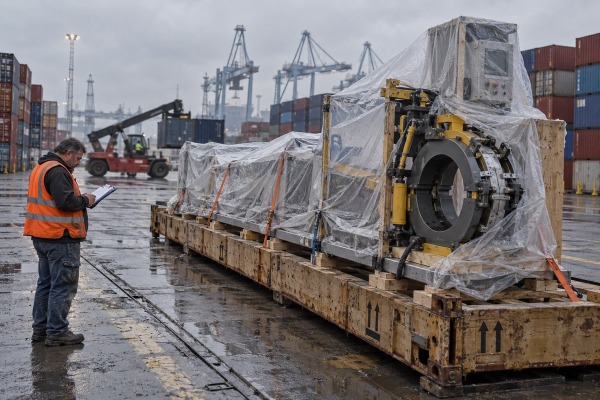
Port congestion delays when importing pipe cutting machines from Europe can stall a whole production line. We have watched our crated machines sit at Hamburg terminals 1 while schedules slipped. Planning fixes most of it.
To avoid port congestion delays when importing pipe cutting machines from Europe, verify packed dimensions early, pick the port of discharge by total route risk, submit customs documents before the vessel sails, book inland transport in advance, assign clear responsibilities, and keep an alternative routing ready.
Congestion itself is only part of the story. Most of the delays I see are preventable. Below, I break down the real causes, the shipping choices, the paperwork, and the supplier agreements that protect your delivery date.
Last winter one of our pipe cutting machines reached Hamburg on schedule. Then it sat for days. The vessel was not the problem. The inland rail slot was.
Most port congestion delays when importing pipe cutting machines from Europe come from vessel bunching, saturated terminal yards, inland rail and trucking shortages, low Rhine water levels, labor action, and incomplete customs files. Oversized cargo adds risk, because terminals handling out-of-gauge machines often reach capacity first.

When I talk to buyers about industrial machinery logistics, I ask them to stop using the word “congestion” as one single problem. It is really four separate clocks. Each clock runs on its own. Each one needs a different fix.
| Delay type | What it means | Typical cause | Who can fix it |
|---|---|---|---|
| Vessel waiting time | Ship anchored, waiting for a berth | Vessel bunching, labor action, blank sailings | Carrier, forwarder (rerouting) |
| Terminal dwell time | Cargo discharged but stuck in the yard | Yard saturation, special-equipment shortage | Terminal, forwarder, importer (early pickup) |
| Customs-release time | Declaration pending or held | Wrong HS code, mismatched documents, missing permits | Customs broker, importer, supplier |
| Inland-delivery time | Released cargo with no truck, rail, or barge | Driver shortage, rail limits, low river water | Forwarder, haulier, receiving site |
A machine can clear three clocks and still be late on the fourth. That is exactly what happened to our shipment in Hamburg.
The pressure moves around. In early 2026, Rotterdam and Hamburg saw vessel waiting times 2 of roughly three to seven days during peak congestion. Bremerhaven reported yard utilization approaching 90%, with the tightest capacity for out-of-gauge and regulated cargo. Genoa faced trucking shortages, rail limitations, and berth pressure after import volumes rose. Low water on the Rhine slowed barge movements out of Rotterdam even when ships berthed on time. Strikes, industrial incidents, and terminal closures can shut an otherwise good route for a week.
So no single European gateway is permanently safe. The delay often happens after the ship is already tied up at the quay.
Our own pipe cutting machines are long rectangular units with a raised control tower and a hydraulic cutting head. Some fit a 40-foot high-cube container. Others need a flat-rack or open-top. Flat-rack cargo competes for a small pool of heavy-lift slots and specialist trucks. When a yard hits 90% utilization, those slots disappear first. A “containerized” machine is not automatically a “simple” machine. I always tell buyers to measure the packed configuration, not the operating footprint, before they even ask for container shipping rates.
Cheapest sailing or most reliable terminal? We weigh that question every time we quote freight for a machine going to Italy or Germany, and the answer changes monthly.
Choose the shipping method by total route risk, not container shipping rates alone. Match equipment to the packed machine, prefer direct sailings when transshipment risk is high, compare major hubs with secondary ports, and consider air freight for critical components so sea delays never block installation.

The formula I use with our export team is simple: total delivery risk equals ocean delay plus terminal delay plus customs delay plus inland delay plus equipment-availability risk. The lowest freight quote rarely wins on that formula.
| Shipping mode | Best for | Watch out for |
|---|---|---|
| Standard 40′ HC container | Machines under about 2.3 m wide and 2.6 m high when crated | Internal bracing, forklift access, moisture protection |
| Open-top container | Over-height machines that still fit the width | Tarpaulin sealing, limited availability |
| Flat-rack | Over-width or over-weight machines | Terminal acceptance must be confirmed in writing |
| Breakbulk / project cargo | Very large or multi-module lines | Fewer sailings, crane plan, longer port stays |
Get the packed length, width, height, gross weight, center of gravity, and lifting points from the supplier before booking. Ask for photos of the sealed crate. Our engineers in Wenzhou prepare these for every export; your European supplier should do the same.
Buyers often ask me to route everything through a smaller port to dodge congestion. I understand the logic, but I push back. Smaller gateways do have shorter truck queues and lower yard pressure. They also have fewer sailings, more feeder dependence, weaker heavy-lift resources 3, and fewer backup options when something goes wrong. Major hubs like Rotterdam and Hamburg bring frequent services, deep freight forwarder services, and broad customs expertise, but they also bring vessel bunching and inland bottlenecks. The right answer is to compare the named terminal, not the city, and to check current waiting times before each booking. Inland “dry ports” with rail links can be a smart middle path for multimodal transportation into central Europe or onward to a US gateway.
A fast schedule with one transshipment looks attractive. But every connection is a chance to miss a feeder or get hit by blank sailings. A direct service sails less often, yet it removes one handling step and one terminal from the risk formula. For a single high-value machine, I usually favor direct.
Nobody flies a two-ton cutting machine. But the control unit, saw blades, or a hydraulic valve can fly in days. We keep critical spares separate from the main crate so a sea delay never blocks commissioning. That is lead time optimization at a cost most buyers accept.
A procurement manager in Texas once asked us why his broker rejected an invoice reading only “industrial equipment.” That vague wording cost him days of back-and-forth.
Prepare a commercial invoice with model and serial numbers, a package-linked packing list, bill of lading, HS code classification under Chapter 84, origin proof, Incoterms rule, insurance certificate, CE declaration of conformity, broker power of attorney, and any ISF filing, all matching each other before dispatch.

Documentation errors are the most preventable delay in the whole customs clearance process. They are also the cheapest to fix, as long as you fix them before the ship leaves.
| Document | What it must show | Most common error |
|---|---|---|
| Commercial invoice | Manufacturer, model, serial number, function, condition, value per major component | Vague description, totals not matching packing list |
| Packing list | Package numbers, dimensions, gross and net weight per package | Weights differ from the Verified Gross Mass |
| Bill of lading / sea waybill | Consignee, notify party, cargo description, container and seal numbers | Description does not match invoice |
| HS code classification | Correct heading in Chapter 84 for the cutting technology and material | Supplier code unsuitable for the importing country |
| Declaration of conformity | CE marking, applicable directive or regulation, model and serial | Treating the CE mark alone as proof |
| Power of attorney | Authority for the customs broker to act | Signed late, after arrival notice |
Consistency is the rule. Invoice, packing list, transport document, declaration, and the physical crate must carry identical descriptions, quantities, weights, package numbers, and serial numbers.
Pipe cutting machines can be classified by principal function, cutting technology, material worked, or degree of automation. A machine that also chamfers, drills, or auto-loads may fall under a different heading than a plain saw. Request a Binding Tariff Information 4 decision in the EU, or the equivalent ruling in your country, months before shipment. Keep the classification rationale in the import file. Separate blades, tooling, and software where the rules require it.
Some buyers tell me compliance papers are irrelevant to congestion because customs rarely checks them at the quay. That is half true. A missing declaration of conformity or technical file under EU Machinery Regulation 2023/1230 5 may not stop the crane, but it can stop customs release, trigger inspection, or block the consignee from accepting the machine. Confirm which legal framework applies based on the manufacture date and transition rules.
Our hardest logistics lesson came from a DDP order where nobody owned the demurrage clock. Since then, every machine quotation we issue carries a written responsibility matrix.
Work with your supplier by agreeing an Incoterms 2020 rule, signing a responsibility matrix, planning the route early, building a delivery buffer into the contract, sharing milestone tracking, setting escalation triggers, negotiating free time, and holding a pre-approved alternative transport plan.

The four habits that save us most often are these: plan the transport route in advance, reserve a delivery-date buffer, define who does what between supplier and forwarder, and prepare an alternative transport plan. Here is how I turn those habits into a working process with a buyer.
| Task | EXW | FCA | CIF | DAP | DDP |
|---|---|---|---|---|---|
| Export clearance | Buyer | Seller | Seller | Seller | Seller |
| Ocean booking | Buyer | Buyer | Seller | Seller | Seller |
| Import customs and duties | Buyer | Buyer | Buyer | Buyer | Seller |
| Inland delivery at destination | Buyer | Buyer | Buyer | Seller | Seller |
| Demurrage and detention fees | Usually unclear | Usually unclear | Usually unclear | Negotiate | Negotiate |
Notice the last row. Demurrage and detention fees are the gap in almost every standard term. Put them in writing. Also confirm the seller can legally act as importer of record before accepting DDP.
Demurrage is charged for containers left in the terminal past free time. Detention is charged for carrier equipment kept outside the terminal. Storage is the terminal’s own fee for space. Negotiate free time based on machine complexity, not standard box terms. Then add buffer at each stage: factory readiness, truck arrival, export clearance, terminal receiving, vessel departure, transshipment, import customs, and final delivery. I ask buyers to accept a contractual delivery date with buffer rather than a hopeful one without it.
Supply chain visibility only matters if someone acts on it. Agree escalation triggers with your forwarder: vessel rolled, port omitted, connection missed, cargo held, truck appointment unavailable, free time near expiry. For each trigger, name the alternative. That might be a second gateway, a different terminal, a rail leg instead of truck, or air freight for the control unit. When Bremerhaven filled up, that pre-agreed backup was the difference between a late week and a late month for one of our German customers.
Port congestion will not wait for you. Plan the route, buffer the schedule, fix responsibilities in writing, and keep a backup route. Then congestion becomes an inconvenience, not a crisis.
Interested in sourcing the products mentioned in this article? See details and request a quote here:
