

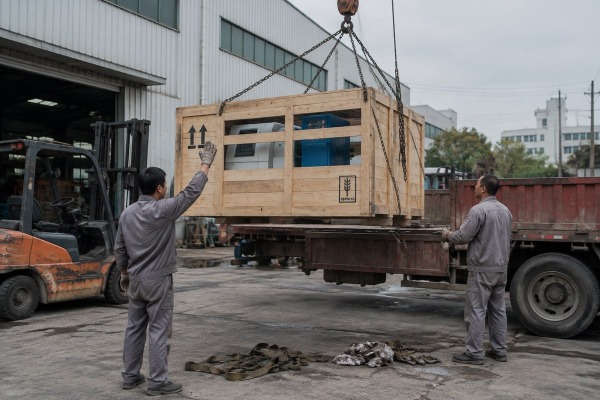
Our Wenzhou workshop builds pipe cutting machines. Yet one bad forwarder can leave them stuck at port. A reliable freight forwarder for shipping pipe cutting machines prevents that.
A reliable freight forwarder for shipping pipe cutting machines has proven machine-tool transport experience, offers door-to-door service, and keeps a dependable customs agent in the destination country. Weight these factors above the lowest ocean rate, demand itemized quotes, and confirm all-risk cargo insurance before booking.
That answer sounds simple. In practice, most buyers still pick the cheapest line on a spreadsheet. I want to show you why that habit hurts, and how we score forwarders instead. Let me walk through the four questions I get asked most.
A procurement manager in the United States once sent me three freight rate quotes. I asked him one question: which forwarder had actually moved a CNC machine before?
Check for recent machine-tool or automation equipment shipments, a dependable customs agent in the destination country, legal registration and customs brokerage authority, FIATA or national association membership, verifiable cargo insurance, and references from industrial clients. Also confirm whether the forwarder acts as principal, agent, or subcontractor on each leg.

None of those three forwarders had moved a machine tool. Two of them quoted without asking for dimensions or weight. That is the first red flag on my list. A pipe cutting machine with a raised control tower, a hydraulic cylinder, and a coolant system is not a pallet of consumer goods. It needs heavy machinery transport knowledge, not parcel knowledge.
Over years of exporting to the US, Germany, Japan, and Mexico, our small team settled on a scoring model. It differs from the generic industry checklist I often see online. Here is the comparison.
| Criterion | Our weighting | Typical industry checklist |
|---|---|---|
| Industrial equipment experience | 25% | Part of “capabilities” (30%) |
| Destination-country customs capability | 20% | Part of “compliance” (5%) |
| Quote transparency | 20% | “Pricing” (25%) |
| Insurance and risk control | 15% | Spread across service quality (25%) |
| Transit time and routing | 10% | Part of “capabilities” |
| Service responsiveness | 10% | “Technology” (15%) |
Notice the gap on customs. Generic checklists give compliance only 5%. We give destination clearance 20%. Why? Because a port hold costs more than a slow sailing. The forwarder must name its import customs brokerage partner before we book.
I use a few screening questions. First: “What would you inspect before accepting this machine from our factory?” A good answer covers crate strength, moisture protection, center of gravity, lifting points, and container floor loading. A weak answer is “we just need the packing list.”
Second: “Have you handled out-of-gauge cargo?” Larger pipe cutting lines with long infeed tables may not fit a standard container. The forwarder should talk about flat racks, open tops, or RoRo without prompting.
Third: “Do you understand dual-use export controls?” Most of our machines are standard. But CNC controllers and proprietary software can trigger extra documentation in some markets. A forwarder that has never heard the term is not ready for international shipping regulations on industrial goods.
Ask for business registration, ocean intermediary authority 1 where required, air-cargo credentials if you fly parts, and proof of insurance. Membership in FIATA 2 or a national forwarding body helps. So do ISO or AEO certifications. One checklist I reference suggests screening benchmarks of on-time performance 3 above 95 percent, response times under four hours, and claims resolution within roughly 30 to 90 days. These are screening targets, not guarantees. But a forwarder that refuses to share such numbers is telling you something.
Before our first pipe cutting machine left for Germany, we photographed every lifting point and bolted the control tower to the crate floor. One bent HMI bracket taught us that.
Use export-grade wooden crates that meet ISPM 15 treatment and marking rules, add vapor-barrier wrapping and desiccants, drain coolant and lubricants, immobilize the cutting head and hydraulic cylinder, bolt the base to the crate floor, fit shock and tilt indicators, and photograph everything before sealing.

Packaging is where forwarders separate fast. A weak forwarder places the machine in a container, throws plastic over it, and calls it done. A strong one asks about the drag chain, the touchscreen, the exposed linear rail, and the coolant nozzle arm. All of those parts on our machines can bend or corrode if they are not protected.
The right mode depends on size, value, and urgency. The forwarder should explain the choice, not default to the cheapest. Here is how I frame it for buyers.
| Mode | Best for | Main risk | Our usual advice |
|---|---|---|---|
| FCL (20′ or 40′) | One or more full-size machines | Container floor loading | Preferred for valuable units |
| LCL | Small chamfering units, spare tooling | Extra handling, deconsolidation delay | Only for accessories |
| Flat rack / open top | Long infeed lines, oversized cargo handling | Weather exposure, lashing | Needs rigging plan |
| RoRo | Wheeled or skid-mounted lines | Limited routes | Case by case |
| Air freight | Urgent control cabinets, parts | Battery and size limits, cost | Replacement parts only |
FCL gives fewer touch points. Each touch point is a damage chance. That is why I push buyers toward a full container even when the machine does not fill it.
Here is the sequence we follow with a forwarder that offers machinery crating services.
Precision matters more than it looks. A cutting line that lost its rail alignment in transit will not cut square. The buyer then blames the factory, not the ship. Good packaging protects our reputation as much as the machine.
Every quarter we weigh the same trade-off: a cheaper sea freight line with weak destination handling, or a pricier door-to-door package with no surprises. We usually pick the second.
Request itemized freight rate quotes covering pickup, export clearance, origin handling, crating, main freight, surcharges, terminal handling, customs brokerage, duties, delivery fees, crane or forklift service, and insurance. Watch especially for demurrage, detention, port storage, examination fees, and destination charges excluded by the quoted Incoterm.

The cheapest quote can become the most expensive shipment. I have watched a low ocean rate turn into a bigger bill once port storage, delivery appointment fees, and a forklift at the buyer’s site were added. None of those were in the headline figure.
Before comparing costs, pin down the term. Incoterms 2020 define who books transport, who clears customs, and where risk transfers. Buyers often accept a familiar term without checking the named place. That is where surprises hide.
| Term | Seller handles | Buyer handles | Common surprise |
|---|---|---|---|
| FCA (named place) | Export clearance, handover to carrier | Main freight, import, delivery | Buyer must have a forwarder ready |
| FOB | Export clearance, loading on vessel | Freight, insurance, import | Origin terminal fees vary |
| CIF | Freight and minimum insurance to port | Import clearance, duties, inland | Minimum cover is not all-risk |
| DAP (named site) | Transport to site, not unloaded | Import duties, unloading | Crane at site not included |
| DDP | Everything including duties | Unloading only | Loss of control over classification |
Some buyers ask us for DDP because it feels simple. I understand that. But DDP can hide how duties are calculated and whether the forwarder is even legally set up to import in that country. For repeat industrial shipments, I usually recommend FCA or DAP with a forwarder the buyer controls. You keep visibility over tariff classification 4 and import compliance. That is worth more than convenience.
Ask each forwarder for separate lines on these items:
Then send the same brief to three forwarders. Compare scope, not just totals. A difference in price should trace back to routing, equipment type, or risk allocation.
I once saw a machine-shipping listing advertising a 17 to 24 day transit and a starting rate of US$0.84 per kilogram. The fine print said final pricing depends on delivery details. That is honest, but buyers read only the big number. Freight costs move with weight, dimensions, route, mode, urgency, and season. Treat any online rate as an illustration, never as a booking price.
The lesson that cost us most was simple: carrier liability is not cargo insurance. A damaged control cabinet on a shipment to Mexico made that clear before any claim settled.
Buy all-risk cargo insurance for the full replacement value plus freight and duties, with warehouse-to-warehouse coverage, and confirm packaging exclusions in writing. For tracking, require milestone updates, container visibility, exception alerts, a named account manager, and an after-hours escalation contact, ideally backed by IoT shock sensors.

Carrier liability is usually calculated by weight. For a crated pipe cutting machine, that figure can be a small fraction of the purchase price. Cargo insurance is a separate policy. The forwarder should explain the difference clearly. If it avoids the topic, move on.
| Item | Carrier liability | All-risk cargo insurance |
|---|---|---|
| Basis of payout | Weight-based limit | Agreed insured value |
| Coverage trigger | Carrier fault must be shown | Most external causes covered |
| Loading and inland legs | Often excluded | Warehouse-to-warehouse |
| Poor packaging | Excluded | Usually excluded too |
| Who files the claim | Shipper | Shipper, with forwarder support |
The insured value should include the machine, freight, duties, and other recoverable costs. Ask about deductibles, mechanical failure exclusions, and claims notification deadlines. Many policies require damage to be noted on the bill of lading 5 or delivery receipt at the moment of unloading. If your site team signs clean, the claim gets harder. We brief every buyer’s receiving team on this before arrival.
Also confirm in writing whether damage from inadequate packaging is excluded. If it is, make sure the forwarder, not just the factory, owns the packaging decision. Otherwise the responsibility gets disputed later.
Email updates are not enough for a six-figure machine. I ask forwarders to report these milestones:
Forwarders that offer real-time container visibility and IoT shock monitoring give you more than comfort. The sensor log becomes claim evidence. It also shows whether the carrier or the inland trucker caused an impact.
Delivery date matters because installation teams are expensive. When we send engineers to commission a line, we want the crate at the site before they land. A forwarder should coordinate delivery appointments, crane booking, and site access so the machine, the rigging, and the technical team arrive in the same window. Some of our European buyers now also ask for carbon footprint reports on the chosen route. A modern forwarder should be able to supply that too.
The cheapest quote often becomes the costliest shipment. Choose the forwarder with real machine-tool experience, door-to-door service, and a trusted destination customs agent. Your machine then arrives ready to run.
Interested in sourcing the products mentioned in this article? See details and request a quote here:
