

Comparing [sea vs air freight costs for a pipe cutting machine](https://yqunique.com/?p=6547) gets messy fast. Pick wrong and your line idles for weeks. Our Wenzhou export team uses one clear method.
To compare sea vs air freight costs for a pipe cutting machine, get the crated dimensions and gross weight, request door-to-door quotes for both modes on the same Incoterm, then add duties, insurance, and the cost of delay to find the true total landed cost.
That sounds simple. In practice, most buyers compare a port-to-port sea rate with an airport-to-airport air rate and get the wrong answer. Below, I walk through each cost layer the way we do it for our own customers.
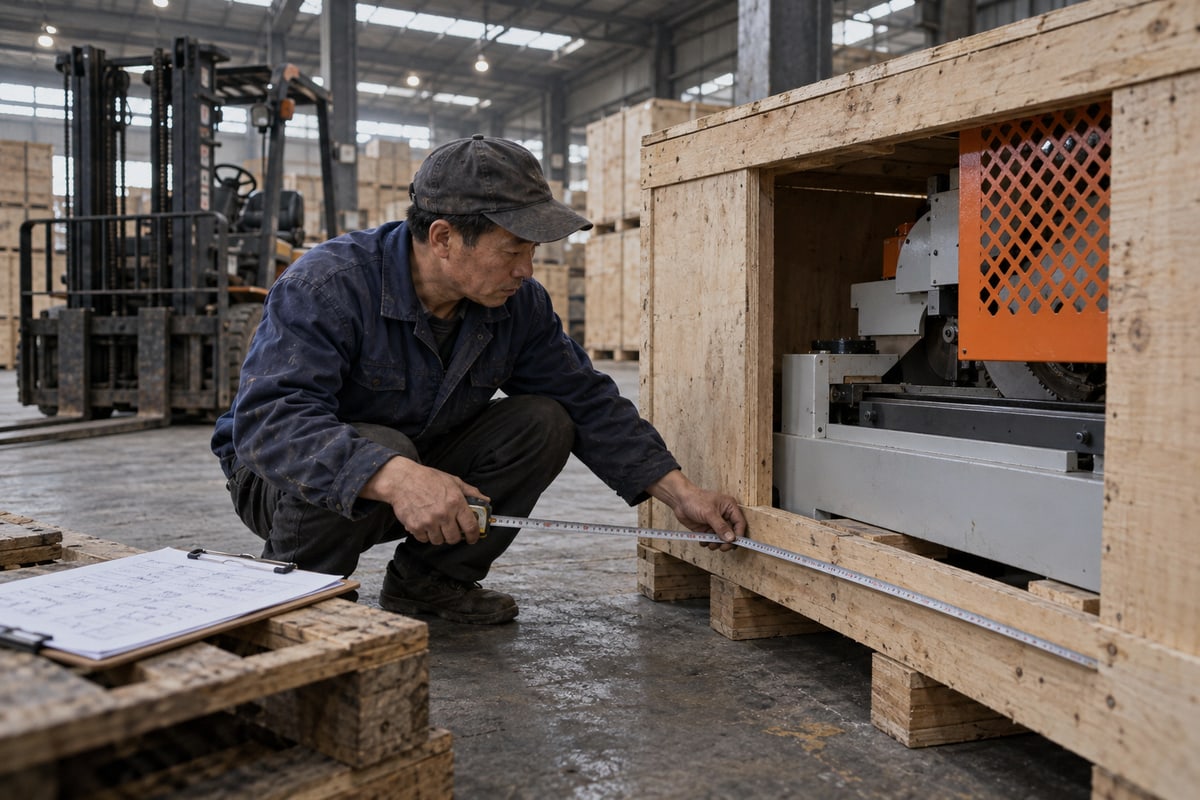
Last month our packing team crated a hydraulic pipe cutter for Germany. The crate added length, height, and weight, and the sea quote changed before the machine left our floor.
Sea freight costs for a pipe cutting machine depend on crated volume and weight, LCL or FCL choice, port pair, ocean freight surcharges, terminal handling at both ends, drayage, demurrage risk, VCI packaging, and the Incoterm that decides which charges you pay.

The single most useful thing I tell buyers is this: ask your supplier, whether that is our factory or a European builder, for the final crated length, width, height, and gross weight. Not the machine’s catalogue size. The crated size. Our pipe cutting machine has a long base cabinet, a raised control tower, and a hydraulic cylinder that sits proud of the frame. Once we add blocking, bracing, and a plywood crate, the volume grows. Sea freight prices that crated volume, so the quote is only as good as the packing data behind it.
Sea freight comes in two forms. LCL means your crate shares a container with other cargo. FCL means you book the whole container. LCL is priced by the “weight or measure” rule. Carriers usually treat 1,000 kg as equal to 1 cubic meter and charge whichever is higher. A dense pipe cutting machine often wins here, because its weight per cubic meter is high and the volume-based charge stays reasonable.
| Item | LCL (shared container) | FCL (dedicated 20ft / 40ft / 40HC) |
|---|---|---|
| Pricing basis | Per cubic meter, W/M rule, with minimum charges | Flat rate per container |
| Handling events | More: consolidation, deconsolidation, cross-docking | Fewer: loaded once at origin, unloaded once at destination |
| Best for | One well-crated machine, flexible schedule | Machine fills most of the box, or ships with tooling and spares |
| Damage exposure | Higher, cargo moves around other freight | Lower, we control the lashing ourselves |
| Typical door-to-door time | Often longer due to consolidation waits | More predictable |
The headline ocean rate is only part of the bill. We routinely see these line items on a sea quote: origin terminal handling, export documentation, Bill of Lading fee, bunker and peak-season surcharges, destination terminal handling, customs brokerage, port storage or demurrage if the container sits too long, drayage from the port, and last-mile delivery costs to the buyer’s plant, including a crane or forklift at unloading.
Salt air and condensation are real. For a machine with a polished linear rail and a touchscreen HMI, we vacuum-seal the unit in VCI film 1, add desiccants, and use heat-treated, marked wood that meets the importing country’s rules. This anti-corrosion packaging costs money and is largely unnecessary for a 5-day air trip. It belongs in your sea column.
Finally, add time. Port-to-port sea transit commonly runs 20–45 days or more. Add a buffer for blank sailings, port congestion, and customs exams. Transit time is not a cost on the invoice, but it becomes one later.
Every time a buyer in Mexico asks us to fly a machine, we weigh one trade-off: the extra per-kilo cost against the days saved on their installation calendar.
Air freight rates for a pipe cutting machine are billed on chargeable weight, the higher of gross or volumetric weight, often at $4–$12 per kilogram or more. Air cuts transit to roughly 3–7 days but usually costs several times the sea rate.

Air freight uses a different language than sea. Nobody quotes you per container. The airline quotes per kilogram of chargeable weight. If you do not understand dimensional weight calculation, you cannot compare sea vs air freight costs for a pipe cutting machine with any confidence.
The common formula is: volumetric weight in kg = length × width × height in centimeters ÷ 6,000. Some carriers use 5,000 or another divisor, so confirm the exact number with your forwarder. Then compare volumetric weight with actual gross weight 2. The higher figure is what you pay for.
| Illustrative crate | Value |
|---|---|
| Crated dimensions | 300 × 160 × 180 cm |
| Volume | 8.64 cubic meters |
| Volumetric weight (÷ 6,000) | 1,440 kg |
| Actual gross weight | 2,200 kg |
| Air chargeable weight | 2,200 kg |
For our pipe cutting machines, the steel frame, hydraulic cylinder, and motor make the crate heavy. So the actual weight usually wins. That is actually good news for air pricing, because you are not paying for empty space. If the same crate weighed only 1,000 kg, you would still be billed for 1,440 kg.
Industry guides place air door-to-door delivery at roughly 3–7 days. Some lanes run 1–7 days. But a crate 300 cm long does not fit in the belly of every passenger aircraft. This is why I tell buyers to ask the forwarder for a quote on a freighter flight, not a generic “air” rate. Freighters have main-deck capacity and nose or side doors for long crates. The rate differs, and the schedule differs.
Air is fast but not delay-proof. Capacity shortages, security screening, missed connections, and customs holds still happen.
Ask for every line, not just the per-kilo rate:
A common objection is that air is never suitable for machinery. I disagree. A compact chamfering machine, a control cabinet, or a replacement servo drive flies well. The main frame rarely does. The $4–$12 per kilogram figure is a broad market illustration, not a quote. Lane, season, and freighter space move it a lot.
A procurement manager in the United States once told me on WhatsApp that sea freight saved him a few thousand dollars. Then his technicians stood idle for two weeks.
Sea freight usually saves more on total landed cost for a pipe cutting machine when your installation date has a 30–40 day buffer. Air saves more when the cost of delay, downtime, standby technicians, and penalties exceeds the air premium.

| Factor | Sea freight | Air freight |
|---|---|---|
| Pricing basis | Per container (FCL) or per cubic meter (LCL) | Per kg of chargeable weight |
| Door-to-door time | Roughly 30–45 days with buffer | Roughly 3–7 days |
| Transport rate | Lowest | Several times higher |
| Packaging | VCI film, desiccants, heavy crate | Lighter crate, less anti-corrosion work |
| Handling events | More | Fewer |
| CO₂ per tonne-km (indicative) | About 10 g | About 500 g |
| Best when | Schedule is flexible | Downtime or penalties are expensive |
The formula we use on every export file is plain:
Total landed cost = transport + origin charges + destination charges + customs costs + inland delivery + insurance + packaging + storage + inventory carrying cost 4 + cost of delay
Most buyers stop after “inland delivery.” The last three terms decide the answer.
Here is the test I ask buyers to run. Net air advantage = cost of delay avoided − additional air cost. If sea saves $8,000 but pushes a line start back by 15 days, sea loses whenever those 15 days cost more than $8,000. Delay costs include lost contribution margin, idle operators, liquidated damages, rental equipment, and rebooking our commissioning engineer.
Three quieter costs also sit in the sea column. First, inventory carrying cost: your capital is tied up for a 30–45 day voyage instead of 5–7 days. Second, warranty erosion: a 30–45 day transit can consume over 10% of a standard one-year warranty before the machine ever runs. Third, rigging labor: specialized technicians charge daily standby fees, and sea arrival dates slip more often than air dates.
The numbers below are made up to show the method. Real prices depend on your lane and crate.
| Scenario | Freight + charges (door-to-door) | Days to site | Delay cost at $800/day beyond deadline | Total landed cost |
|---|---|---|---|---|
| Sea FCL, 40-day buffer available | $6,500 | 38 | $0 | $6,500 |
| Sea LCL, 40-day buffer available | $5,200 | 44 | $3,200 | $8,400 |
| Sea FCL, deadline in 20 days | $6,500 | 38 | $14,400 | $20,900 |
| Air freighter, deadline in 20 days | $19,800 | 6 | $0 | $19,800 |
| Split: frame by sea, control tower and tooling by air | $9,900 | Frame 38, controls 6 | $0 if staged commissioning works | $9,900 |
Three outcomes appear. Sea wins with a buffer. Air wins when the deadline is tight. The split shipment wins when only critical parts are urgent. Our machines are built so the blue control tower, HMI, and cutting tooling can ship separately, which makes the hybrid option realistic. Confirm staged commissioning with your supplier before you choose it.
Two objections deserve a direct answer. “Sea is always cheaper” is false once delay and standby costs are counted. “Free shipping means no logistics cost” is also false, because destination fees, duties, and unloading often remain yours.
One lesson from shipping to India taught us that duties can move more than freight. A higher air invoice inflated the taxable value, and the buyer felt it twice.
Customs duties and taxes are driven by HS Code classification and customs value, not by the transport mode itself. But where duty is assessed on a CIF basis, a higher air freight bill raises the taxable value. Insurance should be quoted identically for both modes.

Customs duties and taxes start with the HS Code classification of the machine. A pipe cutting machine, a chamfering machine, and a cable lug press can fall under different headings with different rates. We put the code on our commercial invoice and packing list, but the importer is responsible for the final declaration. Check it with your broker before quoting.
The second driver is customs value 5. Many countries, including several we export to, assess duty on a CIF basis: cost, insurance, and freight. If your machine costs $50,000 and air freight adds $19,800 instead of $6,500, the taxable base rises by over $13,000. Duty and VAT are then calculated on that larger number. This is the compounding effect most buyers miss. Ask your forwarder to show duties and taxes as a separate line on both quotes, computed on the correct valuation basis for your country.
Incoterms 2020 6 allocate cost and risk. They do not make quotes comparable by themselves. Never compare a supplier’s CIF sea quote with a door-to-door air quote you arranged yourself. Put both on the same term.
| Incoterm | Export clearance | Main freight | Insurance | Import clearance and duties | Last-mile delivery |
|---|---|---|---|---|---|
| EXW | Buyer | Buyer | Buyer | Buyer | Buyer |
| FCA / FOB | Seller | Buyer | Buyer | Buyer | Buyer |
| CIF / CIP | Seller | Seller | Seller (minimum cover) | Buyer | Buyer |
| DAP | Seller | Seller | Seller | Buyer | Seller to named place |
| DDP | Seller | Seller | Seller | Seller | Seller |
We quote most of our machines FOB Ningbo or CIF, and we are happy to run DAP when a buyer wants one number. Whatever term you pick, request the full breakdown. “Free shipping” advertised on a listing rarely covers destination terminal handling, brokerage, or unloading.
Insurance premiums differ by mode. Air often carries lower rates because the cargo has fewer touchpoints and less time exposed to theft or damage. Sea has more transfers, port handling, and condensation risk. So the premium gap partly offsets the freight gap, but only a little.
Quote marine cargo insurance for both options at the same insured value, usually invoice value plus freight plus a margin. Then check the deductible, exclusions, packaging conditions, and whether delay losses are covered. They usually are not. Also remember that a carrier’s standard liability under the Bill of Lading or air waybill is a small per-kilo amount. It is not full replacement value. Keep the Bill of Lading, packing list, and photos of the crate at loading. They are your claims documents.
Start with sea for a bulky pipe cutting machine. Switch to air only when the value of arriving 30–40 days earlier beats the price gap. Compare door-to-door, always.
Interested in sourcing the products mentioned in this article? See details and request a quote here:
