

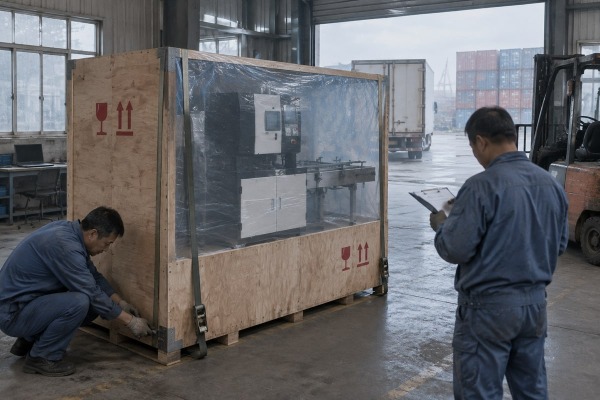
Every quarter, buyers ask our Wenzhou team about sea and air freight for a cable lug making machine. Pick wrong, and the press idles while costs pile up.
Choose sea freight for a cable lug making machine when the crated line is heavy, the start date is flexible, and landed cost matters most. Choose air freight when commissioning is urgent, the unit is compact, or downtime costs exceed the freight premium. Compare door-to-door quotes, not rates.
That short answer hides a lot of detail. In this article I will walk through the four questions we go over with every buyer before a machine leaves our factory. We look at cost, time, size and weight, and then customs and risk. The goal is simple. You should finish this article able to judge sea and air freight for a cable lug making machine by three things: total cost, your real delivery deadline, and whether each mode is even practical for your country.
A procurement manager in the United States once sent me two quotes side by side: an FOB ocean rate and a DAP air rate. They were not comparable, and he knew it.
Sea freight usually costs far less per kilogram for a crated cable lug making machine, while air freight can cost roughly 8 to 16 times more per kilogram. However, total landed cost, including duties, storage, demurrage, and lost production, decides which mode is truly cheaper.

That buyer was right to be suspicious. The two quotes covered different scopes, different risk points, and different hidden lines. Below is how we help buyers line them up.
Shipping cost per kilogram is where most buyers start. On a pure rate card, air freight can run 8 to 16 times the ocean rate. For a crated terminal line that weighs a tonne or more, that gap is real money. But the freight line is only one row in the final invoice. Our team has watched a cheap ocean shipment turn expensive once the container sat at a destination port because the installation crew was not yet booked.
| Cost line | Sea freight | Air freight |
|---|---|---|
| Main freight charge | Low per kilogram | Roughly 8–16 times higher per kilogram |
| Export packing | Heavy crate, VCI film, moisture barrier | Lighter crate possible, still needs shock protection |
| Insurance premium | Generally higher, weeks of exposure | Generally lower, days of exposure |
| Destination storage | Demurrage and detention risk on containers | Short airport storage, but daily fees apply |
| Inventory and financing | Capital tied up for weeks | Capital released sooner |
| Cost of production delay | Higher, because waiting is longer | Lower, because production starts earlier |
| Unloading and rigging | Container devanning, forklift, sometimes crane | Forklift at airport warehouse, then trucking |
We ask buyers to work through three short lines. First, total logistics cost equals freight and handling charges, plus customs and inland costs, plus insurance, plus storage and delay costs. Second, the economic cost of waiting equals your daily downtime cost multiplied by the extra waiting days. Third, the break-even air premium equals the avoided delay and inventory costs minus any extra air-related charges.
Here is an illustrative example, not a quotation. Suppose a lug machine contributes $1,500 per day once it runs. Suppose air brings it into production 30 days sooner. That is $45,000 of earlier output. If the air premium over sea is $12,000, air wins on paper. If the premium is $60,000 because the crate is huge, sea wins. The numbers change with route, season, and crate size, so run your own.
An FOB ocean quote 1 stops at the Chinese port. A DAP air quote stops at your door. Before comparing, add the missing lines to the FOB quote: ocean freight, destination terminal charges, import clearance 2, duty, VAT, and trucking. Good freight forwarder services will give you two door-to-door quotes with identical scope. Some buyers tell us the supplier's shipping quote is enough. It is not. Supplier quotes often leave out destination charges, unloading, and storage. Ask for the full list every time.
One lesson from shipping to Serbia and Slovakia taught us this: the sailing time on a schedule is not the delivery date. Inland legs add days nobody quoted.
Air freight moves a cable lug making machine in roughly 1 to 7 days of main transport, while sea freight typically needs 20 to 45 days. Door-to-door time adds supplier preparation, export packing, customs clearance, and inland delivery, so real arrival dates run longer in both modes.

The published number is only the middle leg. A proper transit time comparison has to cover every stage from our workshop floor to your factory floor. Here is the sequence we map out for each order.
| Stage | Sea freight | Air freight |
|---|---|---|
| Supplier preparation and packing | Same for both modes | Same for both modes |
| Origin trucking and export customs | Varies by port and documents | Varies by airport and documents |
| Main transport | Roughly 20–45 days | Roughly 1–7 days |
| Transshipment or connection | Common, adds waiting time | Less common, more frequent departures |
| Import clearance | Can extend if a container is held for inspection | Can extend if documents are missing |
| Inland delivery | Port to factory, often long for landlocked buyers | Airport to factory, usually shorter |
| Schedule disruption | Port congestion, weather, strikes, geopolitics | Capacity and rate swings, fewer long holds |
Not every order fits one box. A sea-air hybrid routes the crate by vessel to a hub such as Dubai or Singapore, then flies it onward. This can cut transit time by about half compared with pure sea while saving around 40 percent against pure air. We suggest it when a buyer in a distant market has a firm start date but cannot justify full air cost.
Our engineers travel for installation and commissioning on many projects. If the crate lands two weeks before the installation team can arrive, you pay daily port or airport storage for nothing. If the team lands before the crate, you pay for idle technicians. We plan door-to-door logistics backward from the installation date, then pick the mode that lands the machine a few days ahead of it.
Some buyers wait to fill a container so nothing ships half empty. That logic works for a distributor stocking several lines. For a single factory that needs one press, a smaller, earlier shipment is usually the better call.
Our engineers once crated a compact semi-automatic lug press and a full automated line in the same week. The crate dimensions, not the machine names, decided which one could fly.
Yes. Size and weight decide the freight mode. Air carriers bill chargeable weight, the higher of actual or volumetric weight, often at a 1:6000 divisor, so bulky crates get expensive fast. Heavy frames, long conveyors, and multi-crate lines usually belong in a sea container.

Freight is priced on the packed shipment, not the bare machine. That sounds obvious, but many first-time importers send us a net weight and expect an accurate quote. Here is what actually drives the number.
Airlines compare two figures and bill the larger one. The first is the actual gross weight on the scale. The second is volumetric weight 3, found by multiplying length, width, and height in centimeters and dividing by a divisor, commonly 6000. Take a crate of 220 × 140 × 180 cm. That is 5,544,000 cubic centimeters. Divided by 6000, it gives 924 kg of volumetric weight. If the crate weighs 700 kg on the scale, the airline bills 924 kg. The divisor can change by carrier and route, so confirm it before you compare.
Our terminal and lug machines typically ship as a main cabinet plus a stainless steel feeding or conveyor module on leveling feet, with the control panel mounted on an articulated arm. For air shipments we detach the conveyor module, fold or remove the arm, and crate them separately. That lowers the crate height and cuts volumetric weight. For sea shipments we often leave the machine more assembled, because cubic meters in a container cost less than kilograms in a hold.
| Specification to request | Why it matters |
|---|---|
| Net machine weight | Baseline only, never enough on its own |
| Gross packed weight | Actual weight billed by sea and air |
| External crate dimensions | Drives volumetric weight and container fit |
| Number of crates or pallets | Affects handling, consolidation, and packing list |
| Total cubic volume | Basis for LCL sea pricing |
| Center of gravity and lifting points | Safe forklift and crane handling |
| Accessories shipped together | Dies, feeders, hydraulic unit, spares add volume |
| Restricted items included | Hydraulic oil, lubricants, batteries need declarations |
| Commissioning equipment | Tooling and test fixtures may need a separate crate |
Good packaging for international shipping protects the machine in either mode. We bolt the frame to a reinforced base, use ISPM 15 heat-treated wood 4 where the destination requires it, and secure every moving guard and tooling head. For sea, we wrap high-carbon steel dies and blades in VCI film inside a vacuum-sealed barrier with desiccant, because salt air and condensation attack machined surfaces over weeks. We label center of gravity, gross weight, and lifting points on the crate. We photograph the interior before closing. On request we attach data loggers that record shock, tilt, and humidity, which gives a clear record if a claim is ever needed.
Every export file we prepare in Wenzhou weighs the same trade-off: clear the paperwork early and lose a few days, or rush and risk a hold at the destination port.
Verify the HS code for industrial machinery with a local customs broker, confirm Incoterms 2020 terms and risk transfer, insure the machine for replacement value, and check wood packaging, electrical conformity, and import permits before paying the balance. Sea adds moisture and congestion risk; air adds restricted-item rules.

Paperwork and physical risk are linked. A missing certificate can hold a crate at a humid port for days, which is exactly where corrosion starts. We treat the two together.
Start with classification. Do not copy the HS code for industrial machinery 5 from a supplier invoice. Duty treatment differs by country, so have a broker in your country confirm it. Then assemble the file: commercial invoice, packing list with crate numbers and contents, certificate of origin, serial numbers, and a clear technical description. Check electrical conformity documents and voltage and frequency compatibility, which we configure to the destination grid before testing. Confirm language rules for manuals and labels, country-of-origin marking, wood packaging rules, and permits for any regulated parts. Ask your broker whether the machine qualifies for industrial equipment exemptions. Do all of this before you release the balance payment, not after the crate is already sitting at a terminal.
| Risk factor | Sea freight | Air freight |
|---|---|---|
| Moisture and salt exposure | High over several weeks | Low over a few days |
| Handling and vibration | More lifts, transshipment, port handling | Fewer handling stages |
| Schedule disruption | Congestion, weather, strikes, geopolitical rerouting | Capacity swings, but frequent departures |
| Restricted items | Oils and batteries declared, usually accepted | Stricter rules, some items need removal |
| Dimensional limits | Rarely a problem in a container | Aircraft door and hold limits apply |
| Insurance premium | Generally higher | Generally lower |
Some buyers conclude that air is always safer. Shorter transit does reduce exposure, and fewer lifts protect the alignment of punching dies and feeding mechanisms. But a poorly blocked crate dropped at an airport warehouse damages a PLC cabinet just as badly as a rough port. Packing, lifting plans, and cargo insurance coverage matter in both modes.
For multimodal comparisons we often suggest FCA. It makes our export obligations clear and leaves the freight choice in your hands. It is not the right term for every deal, so take advice from your forwarder. Whatever term you use, confirm who handles export clearance, the exact named delivery point, who pays duty and VAT, who unloads, and when risk transfers. Do not assume CIF includes delivery to your factory. Insure the machine for replacement value, not just limited carrier liability, and agree in writing who acts if damage is found at delivery.
This is where my own rule applies: judge by cost, by time need, and by whether each mode is practical for your country. Serbia and Slovakia are landlocked, so sea means a European gateway port plus rail or truck haulage, while air can land closer to the plant. New Zealand sits at the end of long sea routes with limited air capacity, so planning ahead pays. India, Vietnam, and Malaysia enjoy frequent direct sailings 6 from Chinese ports, which makes sea very competitive. The United States, Canada, and Mexico are well served both ways, so the decision comes down to cost of delay. A practical approach is this: ship the main press by sea, and fly dies, sensors, and critical spares. For a phased expansion, air a small starter module and let the full automation line follow by container.
An idle press costs more than any freight line. Weigh cost, timing, and route feasibility, then request two door-to-door quotes. Email [email protected] and we will help you compare.
Interested in sourcing the products mentioned in this article? See details and request a quote here:
1. Official ICC resource defining global trade terms for risk and cost responsibility. ↩︎
2. Official European Commission guidance on customs procedures and import requirements for international goods. ↩︎
3. IATA guidelines on air cargo standards, including weight and volume billing principles. ↩︎
4. International standards for phytosanitary measures regarding wood packaging in global trade. ↩︎
5. WCO overview of the Harmonized System used for global product classification and duties. ↩︎
6. Industry insights from the World Shipping Council regarding global ocean transport and infrastructure. ↩︎
