

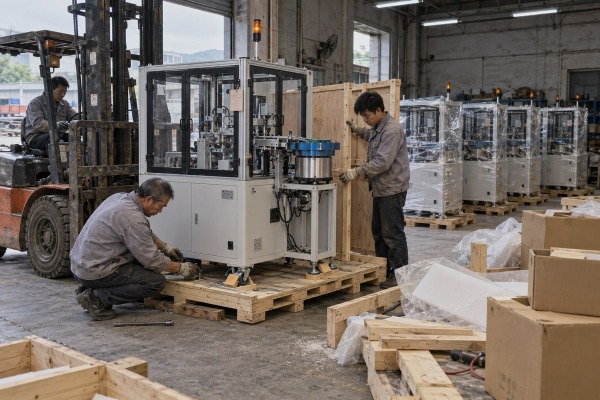
Last year a US distributor asked us to quote twelve assembly machines in one order. A phased delivery schedule for bulk automatic assembly machine orders sounded simple. It was not.
Arrange a phased delivery schedule for bulk automatic assembly machine orders by grouping machines into waves that match your production line needs, fixing the quantity and date of each batch, shipping one unit first for verification, confirming the supplier’s real capacity, and writing every batch into the contract.
The worst outcome is not a late machine. It is an early machine that sits in a crate because tooling, utilities, software, or trained people are missing. I have seen that happen. The sections below explain how we plan waves at our Wenzhou workshop so each shipment is useful on its own, and how you can hold your supplier to the same standard.
Every bulk quote we prepare in Wenzhou forces one trade-off: ship fast and risk idle machines, or ship in waves and accept more coordination. Waves usually win.
Plan phased delivery milestones around your production ramp date, line layout, site readiness, supplier capacity, and long-lead components. Define the quantity and date of each batch, make the first batch a single verification unit, and tie every milestone to acceptance tests rather than calendar promises.

Phased delivery is a production ramp strategy, not a shipping tactic. That is the first thing I tell a procurement manager who asks for "four equal batches." Equal batches are easy to write on a purchase order. They rarely match what a production line actually needs.
My own rule is to arrange delivery batches by production line requirements. Before we talk dates, I ask the buyer to document the required production start date, the target output and ramp curve, the number of cells, product variants and changeover needs, floor space, utility connections, and staffing. Then we work backward. Wave one might support pilot production. Wave two adds capacity. Wave three completes redundancy or the full rate.
I also insist on one point from experience: deliver one machine first for verification. A single cable lug assembly unit 1, with its bowl feeder, feed track, and PLC program, exposes design and integration issues before the rest of the order is built. It costs a little time up front. It saves weeks later.
Disputes often come from one word. "Delivery" can mean shipment from our factory, arrival at your plant, mechanical installation, Factory Acceptance Testing, Site Acceptance Testing, or production release. Your milestones must name which one applies to each batch.
Lead time management starts with honest numbers. Industry estimates give these ranges, and I treat them as planning bands, not promises:
| Machine type | Typical lead time | What adds variability |
|---|---|---|
| Standard machine | 6–16 weeks to site | Freight, customs, site prep |
| Configured machine | 13–27 weeks | Drawing approval adds 2–5 weeks |
| Custom-engineered machine | 21–39 weeks | Robots, vision, servo, custom fixtures |
| Simple custom system | roughly 16–20 weeks | Debugging and FAT corrections |
| Multi-station machine | about 6–9 months | Controls and integration |
| Complex validated line | around 10–14 months | Validation and documentation |
Our team is ten people. I say that openly, because production capacity planning depends on it. A buyer should ask any supplier how many units it can build and test per month, which components are in stock, and which depend on outside vendors. I provide a long-lead-item register 2 showing servo systems, PLCs, vision sensors, custom grippers, and imported pneumatic parts. If a supplier cannot show you that register, the delivery milestones are guesses.
During one Factory Acceptance Testing session, our bowl feeder jammed on a customer's terminal sample. We fixed it before the first unit shipped, not after ten arrived.
Maintain quality across delivery phases by treating Factory Acceptance Testing as a gate before every shipment, using the first verified machine as the reference standard for later units, freezing hardware and software baselines, limiting open punch-list items, and confirming each batch with Site Acceptance Testing.

Quality in a phased order is a consistency problem, not just a testing problem. Ten machines that each pass FAT but differ in alarm names, HMI layouts, or spare parts are still a maintenance headache for the buyer. This is why I push the first-unit verification so hard.
Once the pilot unit's hardware, PLC program, alarm list, naming conventions, and documentation are approved, every later unit follows that baseline. Any change must be a documented improvement that the buyer accepts in writing. This answers a common objection I hear: "If you deliver over nine months, later units will have different firmware or outdated parts." The fix is simple. We freeze the baseline after the pilot and run an inter-phase feedback loop. Real-world performance of the pilot can trigger minor hardware or software tweaks in later batches, but only through formal change control, never by quiet substitution.
A wave should not ship because the sheet metal is painted and the doors close. Our FAT plan for each batch covers:
| FAT item | What we verify | Shipment rule |
|---|---|---|
| Cycle time | Measured against contract target with customer parts | Must pass |
| Yield and reject limits | Continuous run with production materials | Must pass |
| Changeover | Variant swap time and tooling fit | Must pass |
| Safety | Guarding, interlocks, emergency stop, beacon | Must pass |
| Error recovery | Jam clearing on feeder and track | Must pass |
| Data and traceability | PLC logging, HMI records | Minor items allowed |
| Documentation | Drawings, manuals, calibration certificates | Minor items allowed |
The contract should state which punch-list items may remain open after shipment and which block release. It should also state whether one machine in a batch can ship while another is still debugging.
A machine without its product-specific tooling, control software, or safety documentation is not a usable delivery. Each wave from our side includes a minimum operating package: machine and controls hardware, tooling, guarding, electrical and pneumatic drawings, software and licenses, manuals, and training materials. We also front-load a start-up spare parts kit in the first wave. Without it, customers cannibalize un-installed machines for sensors and cylinders, and batch three arrives incomplete.
Site Acceptance Testing confirms performance under plant conditions: real air pressure, real voltage, local operators, and line integration. I ask buyers to run SAT on the pilot before we finish building the remaining units. That timing is the whole point of phasing.
A German engineering manager once asked me why our second batch shipped on a different vessel. The answer was port congestion, and our paperwork had to adapt.
For staggered shipments, prepare a batch shipping schedule with Incoterms, a commercial invoice and packing list per batch, bill of lading, certificate of origin, HS codes, insurance, rigging plans, and site-readiness confirmation, and assign one party to customs clearance for every wave.

Supply chain logistics for a phased order means repeating the full export cycle several times. That is the honest cost of phasing. A recent procurement analysis names inventory misalignment, customs delays 3, and fragmented last-mile coordination as the recurring causes of bulk-order disruption. Each of those risks multiplies with each wave, so the paperwork and planning must be standardized the first time and then reused.
I keep a document checklist per wave. The same template serves our shipments to the United States, Germany, Japan, India, Mexico, and the rest of our export markets, with local certification items added where needed.
| Document or item | Purpose | Prepared by |
|---|---|---|
| Commercial invoice per batch | Customs valuation, payment reference | Supplier |
| Packing list with crate dimensions and weights | Rigging, customs, insurance | Supplier |
| Bill of lading or air waybill | Title and carrier contract | Forwarder |
| Certificate of origin | Duty treatment | Supplier or chamber |
| HS codes agreed in advance | Prevents reclassification delays | Both parties |
| Insurance certificate | Damage claims in transit | Per Incoterms |
| Electrical and safety declarations | Local compliance, import inspection | Supplier |
| Calibration certificates and manuals | Part of minimum operating package | Supplier |
| Site-readiness confirmation | Floor, power, compressed air, network ready | Buyer |
Our machines ride on caster wheels with leveling feet, and the vibratory bowl feeders sit on separate stands. That helps on the factory floor but creates packing questions. We crate feeders separately, protect the stainless bowls from vibration, and lock the touchscreen HMI panel. Before FAT, I ask the buyer four questions: Can the crate pass your doors? Do you need a heavy-lift contractor? Is temporary storage available if a batch arrives early? Who is the importer of record?
Choose Incoterms once and apply them to every batch. Then write down who handles freight, insurance, export clearance 4, import clearance, unloading, storage, and damage claims. A batch shipping schedule should show each asset, destination, required arrival date, installation dependency, FAT status, shipping method, and responsible party.
I never place one large contingency at the end. Instead, I spread buffers across freight, customs, inland transport, and installation. Consolidating two waves can cut freight costs, but only if it does not delay the critical machine. If expediting is needed, expediting selected components is cheaper than rushing the whole machine, and expediting premiums of roughly 5–15% should be expected.
We learned the hard way that a verbal promise about batch two means nothing six months later. Now every batch date lives in the contract.
Communicate effectively by writing the phased delivery plan into the contract with batch quantities, dates, and milestone payment terms, holding short weekly schedule reviews, keeping a shared long-lead-item register, requiring written delay notices within a fixed period, and changing later batches only through formal change control.

Good communication in a phased order is mostly good documentation. Our customers like William, a procurement manager in the US, prefer concise messages and WhatsApp for quick decisions. I like that too. But a quick message is not a contract, and a phased plan lives or dies on the contract.
This is my strongest personal rule. The purchase agreement should state the quantity and date of each batch, the definition of delivery for each milestone, partial shipment rights 5, minimum shipment quantities, delay notification requirements, storage responsibility, change-order procedures, and the warranty start date. Warranty deserves special attention. If machine one ships nine months before machine ten, a warranty measured from shipment can expire before the full line runs. We agree to separate warranty starts at SAT or production acceptance per machine, within negotiated limits.
Payments should follow verifiable events, not just dates. A typical structure we use:
| Milestone | Evidence | Payment trigger |
|---|---|---|
| Order acceptance and design freeze | Signed drawings | Deposit |
| Long-lead component release | Register with PO status | Progress payment |
| FAT approval per wave | Signed FAT report | Pre-shipment payment |
| Arrival and installation | Delivery receipt, commissioning log | Progress payment |
| SAT approval per wave | Signed SAT report | Balance or retention release |
Weekly or biweekly schedule reviews work best for custom automation integration projects. Each review updates the long-lead-item register, open punch-list items, FAT readiness, and shipping dates. Equipment commissioning capacity on the buyer side is also reviewed, because installing several machines in rapid succession can overwhelm a site team. A smaller number of well-supported waves beats a fast schedule that creates an installation backlog.
Buyers sometimes argue that multiple freight events, duplicate commissioning, and more project management make phasing a bad deal. They are right that phasing is not automatically cheaper. It is justified when early learning, production continuity, site limitations, or supply risk outweigh the extra coordination cost. If all machines share one validated design and the site is fully ready, a consolidated shipment may be simpler. If the ramp is gradual or construction is staged, phasing is more resilient. The contract should let you decide this with data, not hope.
Idle machines and missed ramp dates cost more than extra freight. Plan waves around your line, verify one unit first, and lock every batch into the contract.
Interested in sourcing the products mentioned in this article? See details and request a quote here:
1. Wikipedia overview of electrical connectors and assembly units like cable lugs. ↩︎
2. UNCTAD resources on logistics management and tracking long-lead items in international trade. ↩︎
3. EU customs guidance on avoiding delays during international import and export procedures. ↩︎
4. Official ICC rules for allocating freight, insurance, and export clearance responsibilities. ↩︎
5. Authoritative legal resource defining rights and obligations in installment and phased delivery contracts. ↩︎
