

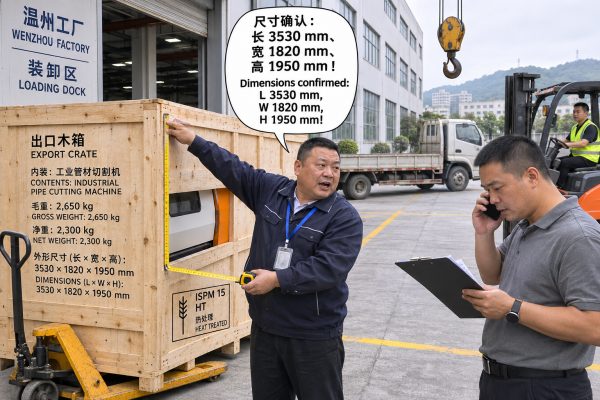
A pipe cutting machine can leave our production line tested and crated, yet still arrive late. I have seen it. The cause was never the machine, only poor freight coordination.
To coordinate with a freight forwarder for on-time pipe cutting machine delivery, engage the forwarder when the order is placed, share exact crate dimensions and weights, agree the Incoterm and HS code early, prepare customs documents before pickup, and follow up on every shipping date in writing.
Late delivery is a coordination problem. It is not just a transportation problem. Below, I walk through the four questions buyers ask us most often. Each one covers a stage of the shipment, from paperwork to installation day.
A buyer in Slovakia asked us why his customs broker 1 rejected a shipment file. The invoice said "industrial equipment." Nothing else. That one line cost him days of back-and-forth.
Before handoff, prepare a commercial invoice, detailed packing list, export declaration, certificate of origin, insurance certificate, customs broker power of attorney, and any import permits. Include machine model, serial number, HS code, Incoterms 2020 term, and matching dimensions and weights on every document.

Paperwork is the cheapest part of heavy equipment logistics. It is also the part that causes the most avoidable delays. The forwarder and the customs broker should review the full file before the crate leaves our factory, not after it reaches the port of discharge.
Here is the package we assemble for every export order of a tube cutting or metal processing machine.
| Document | Who prepares it | What the forwarder checks |
|---|---|---|
| Commercial invoice | Supplier | Model, serial number, origin, value, currency, Incoterm with named place |
| Packing list | Supplier | Every crate numbered, with length, width, height, gross and net weight |
| Bill of Lading 2 or air waybill | Forwarder or carrier | Shipper, consignee, notify party, description matching the invoice |
| Export declaration 3 | Supplier or forwarder | HS code and value consistent with invoice |
| Certificate of origin | Supplier via chamber | Required for preferential duty in some markets |
| Insurance certificate | Buyer or seller per Incoterm | Marine freight insurance covers loading, unloading, and inland legs |
| Power of attorney | Buyer | Allows the destination broker to file on the buyer's behalf |
| Import permits or conformity declarations | Buyer and broker | Electrical standards, machinery safety, local-language manuals |
| ISPM 15 treatment mark | Packing supplier | Heat-treated wood stamp visible on every crate |
Customs officers do not reward thick files. They look for mismatches. If the packing list says a crate weighs 1,850 kg and the Bill of Lading says 1,800 kg, someone will ask why. The same goes for serial numbers and descriptions. We write the description plainly: "numerically controlled pipe cutting machine for metal tube processing, with control cabinet, clamping tooling, and spare blades." That sentence tells the officer what the goods are and what they do.
Our machines ship in custom timber crates. Every crate carries the ISPM 15 packaging standards stamp. Without it, several of our markets, including the United States and South Korea, can refuse entry or order fumigation at the buyer's cost. We photograph the stamp, the lifting points, the center-of-gravity marks, and the shock indicators before pickup. Those photos go to the forwarder and the buyer on the same day. They also protect everyone if a damage claim appears later.
Booking freight before a machine is finished feels risky. Dimensions might shift. But waiting until final testing is done costs flexibility. On our line, we weigh that trade-off on every order.
Contact your freight forwarder when the purchase order is placed, not when the machine is ready. Confirm vessel space and lifting equipment at least two weeks before production completion. This early pre-alert lets the forwarder plan packaging checks, route options, permits, and cutoffs before any delay becomes expensive.

The strongest habit I can recommend is simple: follow up promptly on shipping time and shipment details. Do not wait for the next routine update. Ask for the date, confirm it in writing, and ask again when anything changes. That one habit has saved more installation dates for our customers than any clever routing.
We send the forwarder a preliminary profile as soon as engineering freezes the drawing. It lists the expected ready date, estimated crate dimensions, gross weight, package count, machine value, origin, destination, and whether the machine ships assembled or split. For a mid-size pipe cutting machine with a pedestal base and a separate control cabinet, that often means two or three crates. The numbers are marked "provisional." Final numbers follow after packing. This gives the forwarder weeks of planning time instead of days.
An estimated arrival date is not a plan. We ask forwarders for a milestone sheet with an owner for each step. A typical sequence looks like this:
Each milestone has a planned date, a latest acceptable date, and an escalation contact. If a date slips, the forwarder must tell the buyer immediately. A missed terminal cutoff reported three days late has no recovery option. Reported the same day, it often does.
Buyers sometimes focus on transit time 4 optimization and ignore the rest of the lead time. Total door-to-door time includes export packing, origin handling, port dwell, customs, and inland delivery. A direct sailing with one extra week of ocean time can still beat a cheaper routing with two transshipments and a congested hub. For oversized units, the forwarder should also compare a standard container against a flat rack. If the machine width forces a flat rack, the buyer should weigh that cost against partial disassembly and reassembly during commissioning. We can advise on which sub-assemblies separate cleanly, because we built the tooling.
The lesson that stuck with me came from a shipment to Mexico. The HS code on our invoice did not match the broker's. Customs held the crate while everyone argued.
Share the HS code validated by the destination broker, a precise machine description with function, declared value and currency, Incoterm with named place, consignee and notify party details, country of origin, port of discharge, package count with dimensions and weights, and any regulated materials such as hydraulic fluid or batteries.

Customs problems rarely come from a single missing form. They come from information that nobody confirmed. Three areas deserve attention before the machine is packed: the responsibility split, the classification, and the import compliance checklist.
Incoterms 2020 define where cost and risk pass between seller and buyer. They do not define unloading, installation, storage charges, or site access. Here is how the common terms split the work for a machine shipped from Wenzhou.
| Incoterm | Seller handles | Buyer handles | Watch out for |
|---|---|---|---|
| EXW factory | Makes goods available | Pickup, export clearance, all freight | Buyer needs a China-side agent for export filing |
| FOB named port | Export clearance, loading on vessel | Main carriage, insurance, import | Risk passes at ship's rail, so insurance must start there |
| CIF destination port | Freight and insurance to port | Import clearance, duties, inland delivery | Minimum insurance cover may undervalue the machine |
| DAP named address | Delivery to site | Import clearance, duties, unloading | Demurrage if import documents are late |
| DDP named address | Everything including import duties | Unloading only | Seller must be able to act as importer locally |
A buyer once asked us for DDP "to keep it simple." We declined. We are not registered as an importer in that country, and pretending otherwise would have created a hold at the port. DAP with a competent local broker was the practical answer. The cheapest-looking term is often the one that leaves a gap nobody owns.
The international HS structure stops at six digits. Countries add their own subdivisions. The code our export declaration uses may not be the code the destination applies. So we ask the buyer's broker to confirm the full national tariff line before packing. We also cross-reference it with the latest destination tariff schedule 5, because trade remedies and surcharges change. For high-value or unusual configurations, a formal customs advance ruling can lock the classification in before the vessel sails. That removes the risk of a multi-week dispute at the port of entry.
Depending on the market, the broker may need machinery safety or conformity declarations, electrical standards evidence, control-system approvals, local-language manuals, country-of-origin marking, and declarations for residual lubricant or hydraulic fluid. Used-equipment rules do not apply to our new machines, but some markets still ask for a cleanliness statement. We prepare these items while the machine is still on the assembly floor. A compliance question is cheap to answer in Wenzhou. It is expensive to answer while storage charges accumulate at the port.
During sample testing on a tube cutting line for a Vietnamese customer, our engineer asked one question first: which day does the crate land? Installation planning started with that date.
Track your pipe cutting machine shipment through the forwarder's milestone updates, container or Bill of Lading tracking, and a GPS data logger inside the crate. Work backward from customs release, not vessel arrival, to book riggers, the installation crew, and commissioning, and keep a buffer for port dwell.

Supply chain visibility used to mean an occasional email from the forwarder. Buyers now expect more, and so do we. A shared tracking sheet, updated at every milestone, keeps the supplier, forwarder, broker, and receiving team working from the same dates.
| Tracking layer | What it tells you | What to do with it |
|---|---|---|
| Carrier container tracking | Vessel position, port calls, transshipment status | Compare against the milestone sheet weekly |
| Forwarder milestone updates | Booking, pickup, departure, arrival, customs release | Trigger the next site action at each confirmed step |
| GPS data logger in the crate | Real-time location plus shock and tilt events | Flag any impact that could misalign guide rails or the cutting head before unpacking |
| Broker status portal | Document submission, queries, release | Resolve queries the same day to avoid storage charges |
The data logger matters for precision machines. Our tube cutting machines carry hardened guide rails, clamping tooling, and a control cabinet with a touchscreen. A recorded G-force spike tells the receiving team to inspect alignment before power-on, rather than discovering it during the first cut.
Vessel arrival is not the date to plan around. The machine is only usable after customs release and last-mile delivery. We advise buyers to build the schedule in reverse:
For the final leg, we ask the forwarder for a physical route survey when the crate is oversized. Logistics software can miss a low bridge or a weight-restricted road. The buyer should also confirm gate dimensions, floor loading, dock availability, and whether inside delivery is needed. If the setup crew arrives on a fixed date, a project-linked demurrage extension of around ten days at the destination port can hold the crate until the site is ready, instead of paying for an emergency warehouse move.
Before anyone signs the delivery receipt, the receiver should check crate condition, package count, serial number, ISPM 15 marks, shock indicators, and seal numbers. Photograph everything. Note any damage on the delivery document. Then reconcile against the packing list and tell the forwarder about concealed damage within the claim window. Because our tooling and spare parts ship with the machine, the packing list is the fastest way to confirm nothing is missing before commissioning starts.
A finished pipe cutting machine is not a delivered one. Treat your freight forwarder as a planning partner, share complete details early, and follow up on every date in writing.
Interested in sourcing the products mentioned in this article? See details and request a quote here:
1. Official U.S. Customs resource defining the role and responsibilities of licensed customs brokers. ↩︎
2. Comprehensive overview of the Bill of Lading’s role as a title document and carriage contract. ↩︎
3. Official trade.gov resource for export documentation, including the Electronic Export Information (EEI) declaration. ↩︎
4. Definition and significance of transit time in logistics and supply chain management. ↩︎
5. Official WCO overview of the Harmonized System used for global product classification and tariff schedules. ↩︎
