

A buyer in Mexico once asked our Wenzhou factory, his new pipe cutting machine supplier, to ship within two weeks. His line was down. Every other factory simply said yes.
Evaluate a pipe cutting machine supplier for urgent orders by verifying physical stock, checking current factory workload, demanding a dated lead time with a defined start point, requiring documented factory acceptance tests, and confirming shipping, commissioning, and spare-parts support in writing before payment.
That “yes” is the problem. Anyone can promise a date. Few can prove it. Below, I walk through the four checks we ask buyers to run on us, and on anyone else they are comparing us against.
Here is the lesson that changed how we quote rush jobs: a big factory is not a free factory. Workload today predicts delivery tomorrow.
Judge production capacity by the supplier's current workload, not factory size. Ask whether workers are already at full load every day, request a dated backlog and stock confirmation, then compare the size of your urgent order against the open capacity before the deadline.

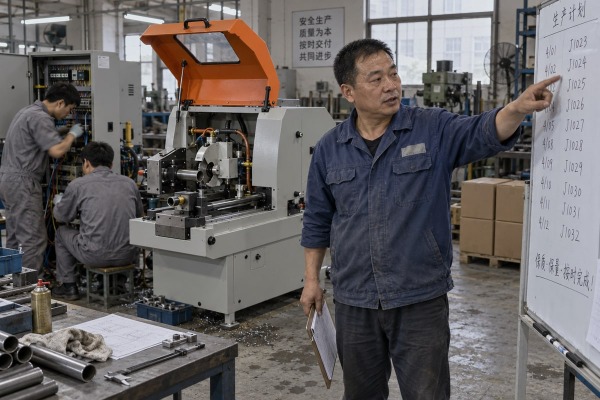
The first thing I tell buyers is to look at the actual production situation in the factory right now. Are the workers at full load? Is every assembly station busy every single day? If the answer is yes, that is not automatically bad news. But it changes the math. You then have to put the size of your urgent order next to that daily load and ask a plain question: can this team finish my machine, test it, and pack it by the agreed date without pushing someone else's job off the schedule?
Our own team is ten people covering R&D, engineering, assembly, sales, and after-sales. We cannot hide behind headcount. So when a rush request comes in, I open our job board, count what is already committed, and tell the buyer honestly whether we have room. A supplier who refuses to show you that board is asking you to trust a slogan.
| Level | What it really means | Realistic for a true rush order? |
|---|---|---|
| Ready to ship | Assembled, tested, documented, packed, not reserved for anyone else | Yes |
| Ready to configure | Core machine exists, but options, voltage, or fixtures still need installing | Only if parts are confirmed in stock with a fixed completion date |
| Production slot available | Machine will be built after order confirmation | Rarely, unless the deadline is weeks, not days |
Ask for a dated inventory confirmation, a serial number or production status, a video of the actual unit, and a written statement that the machine is not promised to another customer.
A short live-video factory audit answers most of this in twenty minutes. The question that reveals the most is still the simplest one: "What exact machine is physically available today?"
The trade-off we weigh on every rush quote is simple: promise a short date and risk missing it, or quote honestly and risk losing the order.
Expect roughly 3–7 days ex-works for a standard pipe cutting machine already in stock, 7–30 days for configured units, and 60–90 days for engineered-to-order systems. A reliable supplier states when the clock starts and separates factory shipment from door delivery.

| Machine category | Commonly published delivery window | Main risk driver |
|---|---|---|
| Standard machine in stock | About 3–7 days to ship | Whether the unit is truly packed and unreserved |
| Standard machine needing configuration | About 7–30 days | Component availability and a configuration freeze |
| Stock orbital cutting system | About 15–45 days | Testing and documentation time |
| Custom-configured or engineered system | About 60–90 days | Engineering, programming, procurement, and FAT |
These numbers come from supplier listings and sourcing guides. They are not promises. They show you how far apart "fast" can be depending on what you order. Our own manufacturing turnaround time sits in the middle rows most of the time, because most of our machines are built to a customer's drawing.
This is the question that separates lead time reliability from marketing. Ask the supplier to state, in writing, whether the quoted days begin after payment clears, after technical approval, after final specifications, or after factory acceptance testing. A "five-day" promise that only starts after a two-week drawing exchange is really a nineteen-day promise.
Then convert that promise into a full timeline:
"Ships in three days" only covers step five. Air freight shortens step six but may not suit a heavy machine. Sea freight costs less but adds port uncertainty. Ask about expedited shipping options, who books the carrier, whether the crate is rated for air handling, and whether the supplier works with freight forwarders who know your destination.
Some buyers say rush orders justify any premium. Others want the lowest price regardless. Both views miss the same point. Add up the real cost: machine price, expedited freight, installation, lost production per day, spare parts, customs risk, and the customs regulations 1 chance of needing a replacement. If downtime costs more than the premium, pay it. If a cheap machine arrives fast but cannot cut your diameter or material, it has increased your downtime, not reduced it. Never accept a substitute machine only because it can leave the factory sooner.
During a rush copper tube order, our QC lead refused to pack the machine until the cut-face check passed twice. That decision saved us a return shipment.
Verify quality assurance protocols by demanding a documented factory acceptance test on the exact unit, cutting samples in your material, dimensional inspection reports, and dated videos. Check ISO 9001 and CE certificates against official databases, and write failure remedies into the purchase order.

When time is short, the temptation is to skip testing. That is the moment quality usually breaks. The fix is not more trust. It is more paper. Ask for evidence tied to the specific serial number you are buying, not to a model in general.
| Evidence item | What it proves | Red flag if missing |
|---|---|---|
| Cutting samples in your material or equivalent | The configuration handles your job | Supplier offers only generic demo clips |
| Dimensional inspection report | Accuracy and repeatability are measured, not claimed | Report has no date or no serial number |
| Photos of cut faces and bevels | Surface finish and perpendicularity | Images belong to a different model |
| Factory acceptance test record | Machine ran through defined criteria before packing | Supplier calls FAT "optional" on rush jobs |
| Calibration and burn-in records | Controls and drives were exercised, not just powered | No run-time data available |
| References with comparable applications | Field performance | Supplier cannot name one similar project |
The purchase order should state what happens if the machine fails the test: rework, replacement, price adjustment, or cancellation. Define that before shipment, not after.
A factory certificate is not a machine certificate. ISO 9001 tells you a quality management system exists. CE marking, where it applies, tells you the specific model is declared conformant for a given market. Ask to validate both in official databases rather than accepting a logo on a quote sheet. For thermal cutting, ISO 9013 gives you measurable cut-quality criteria 2 such as roughness, perpendicularity, and slag adherence. ISO 3834 may matter for welding-related equipment. Standards like ASME B31.3 3 govern piping design and construction 4, not the cutting machine itself, so do not let a supplier wave that reference as proof of machine compliance. Also ask for the declaration of conformity, electrical schematics, parts list, user manual, and warranty exclusions in the same package.
Send a one-page urgent-order technical data sheet with your RFQ. Include diameter range, wall thickness, material, cutting method, bevel needs, tolerance, power supply, control language, and site conditions. This stops suppliers from quoting different configurations and lets you compare answers in minutes. If the supplier runs simulation or a digital-twin check of your cutting program before the build, that is a genuine time saver, because program validation moves off the physical machine. We do this for our customer-drawing jobs, and it cuts setup time more than any extra shift does. Whether the process is a saw, cold cutting, orbital, plasma, or CNC laser cutting technology, the principle is the same: define measurable acceptance criteria before the crate closes.
A procurement manager in Canada once told me he chose us because we answered his WhatsApp at 11 p.m. with a drawing, not a slogan.
Look for a named emergency-order coordinator, technically complete quotations within hours, availability across time zones, milestone updates with photos, a written commissioning plan before shipment, remote diagnostics, defined breakdown response times, and a critical spare parts package shipped with the machine.

Supplier directories list response times from one to six hours. Treat that as a hint, then test it yourself. Time how long the supplier takes to acknowledge your inquiry and how long it takes to send a quotation with a model number, full configuration list, and expiration date. Notice whether they ask the right clarification questions about diameter, wall thickness, material, bevel, voltage, and control language. A fast but incomplete quote can cost you more days than a slower, technically correct one. Ask who the named coordinator for your order is, and whether that person is reachable in your time zone. Then ask for a written recovery plan: "If you slip the date, what exactly happens?"
Buyers often tell me a local distributor is safer: faster delivery, local installation, simpler warranty claims. That can be true, and I will not pretend otherwise. But distributors usually carry fewer configurations and add margin, and the engineering answer still has to come from the factory. Buying direct gives you one accountable party and direct engineering support, which matters most when your machine is built to your drawing. The honest resolution is this: if a stock unit from a distributor fits your critical requirements, take it. If you need any configuration, go to whoever can confirm component stock and a fixed completion date in writing, and that is usually the factory.
Fast shipping is useless if operators cannot run the machine safely. Require a commissioning plan before shipment covering site preparation, power, compressed air, lifting equipment, network access, and operator availability. Confirm technical support availability for remote installation, video tutorials, operator and maintenance training 5, and remote diagnostics. On warranty, sourcing guides cite 12–24 months as common, but length matters less than the operational terms: when it starts (shipment, delivery, installation, or acceptance), breakdown response time, who pays travel and labor, and how fast parts ship. Buy a critical spares package with the machine, especially when importing. A supplier's spare parts inventory often matters more than its initial shipping speed. Milestone updates with photos, or a live production dashboard if the supplier offers one, let you see progress instead of asking for it.
| Criterion | Suggested weight | Rate 1–5 |
|---|---|---|
| Verified machine availability | 20% | |
| Technical fit | 20% | |
| Tested performance and documentation | 15% | |
| Confirmed logistics and delivery plan | 15% | |
| Service, installation, and spare parts | 15% | |
| Quality and regulatory compliance | 10% | |
| Commercial terms and financial risk | 5% |
Shift the weights for your project. Safety-critical work should push compliance and testing higher. A temporary production emergency should push availability and service response higher. One rule does not change: disqualify any supplier that fails a critical requirement, even with a high total score. Finally, run three checkpoints. In the first 24 hours, confirm stock, workload, and technical fit. By 72 hours, lock the configuration freeze, FAT criteria, Incoterms, and milestone payments. Before shipment, review the FAT record, packing photos, documents, and the commissioning plan.
Urgent orders punish guesswork. Pick the pipe cutting machine supplier who proves stock, workload, testing, logistics, and support in writing. Email [email protected] and we will show you ours.
Interested in sourcing the products mentioned in this article? See details and request a quote here:
1. Authoritative .gov source for Mexico’s customs regulations, directly relevant to the article’s case study. ↩︎
2. Official ISO standard for thermal cutting quality and dimensional tolerances. ↩︎
3. Official ASME page for the standard governing process piping design and construction. ↩︎
4. Overview of piping systems and the standards governing their design and construction. ↩︎
5. Information on technical maintenance and the training required for industrial equipment operation. ↩︎
