

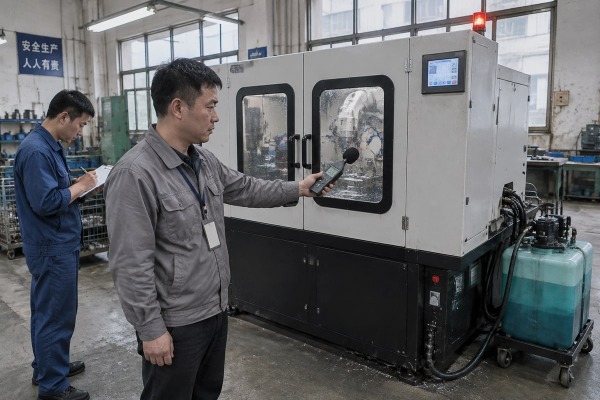
Buyers ask us whether a fully automatic chamfering machine will pass EU noise and vibration standards noise emission values 1. A wrong answer can stall an entire line. So our documentation now starts there.
A fully automatic chamfering machine can meet EU factory noise and vibration standards when the manufacturer reduces emissions at source, documents sound pressure and vibration values under the Machinery Regulation, and the employer verifies worker exposure on site against Directive 2003/10/EC and 2002/44/EC limits.
That answer has two halves. One half belongs to the machine builder. The other half belongs to the factory. I will walk through both, then show you how to check a supplier before you commit.
One lesson from our export work is simple. The limits buyers quote are usually worker-exposure limits, not machine emission limits EN ISO 20643 2. Mixing them up leads to wrong purchasing decisions.
Under EU rules, you must keep daily occupational noise exposure below the 87 dB(A) limit, act at 80 and 85 dB(A), keep hand-arm vibration under 5 m/s² and whole-body vibration under 1.15 m/s², while the machine itself must declare emissions above 70 dB(A).

The first layer is machine-product compliance. For years this sat under the Machinery Directive 2006/42/EC. It is now transitioning to Regulation (EU) 2023/1230. Both require the builder to design the machine so noise and vibration risks are reduced to the lowest level reasonably achievable. Neither sets a single universal decibel cap for every machine. Instead, they set reporting duties. If the emission sound pressure level at a workstation exceeds 70 dB(A), the builder must state it. If it exceeds 80 dB(A), the A-weighted sound power level must also be given. If the C-weighted peak passes 130 dB, that must be stated too. I always tell buyers to check which law applies on the date the machine is placed on the market and in which Member State. Transition arrangements differ.
The second layer is workplace exposure. This is where the real decibel limit requirements live.
| Directive 2003/10/EC value | Daily/weekly exposure (8-hour normalized) | Peak sound pressure | What it triggers |
|---|---|---|---|
| Lower exposure action value | 80 dB(A) | 135 dB(C) | Information, training, hearing protection available |
| Upper exposure action value | 85 dB(A) | 137 dB(C) | Mandatory protection, control program, signage |
| Exposure limit value | 87 dB(A) | 140 dB(C) | Must not be exceeded, after hearing-protection attenuation |
Vibration has its own directive, 2002/44/EC, with two separate paths.
| Vibration type | Daily action value | Daily limit value | Typical relevance for a fixed chamfering cell |
|---|---|---|---|
| Hand-arm | 2.5 m/s² A(8) | 5 m/s² A(8) | Low, because the operator does not hold the tool |
| Whole-body | 0.5 m/s² A(8) | 1.15 m/s² A(8) | Possible through floors, platforms, adjacent equipment |
Some Member States allow an alternative whole-body vibration dose value, with an action value of 9.1 m/s^1.75 and a limit of 21 m/s^1.75.
A buyer once told me, "My operator stands away from the spindle, so exposure is not my problem." I understand the logic, but it is incomplete. Loading, unloading, jam clearing, tool changes, and maintenance all bring people back to the machine. Workers at neighboring stations may spend the full shift in the same area. And an automatic machine can run unattended all day, so area noise never pauses. On vibration, a value measured on the frame is not the worker's A(8) exposure. Exposure depends on the contact path and the time spent in contact. That is why on-site assessment still matters even with a well-built machine.
A US procurement manager once sent me a competitor sheet showing a single noise figure and no test conditions. I asked where the microphone stood. He had no answer.
Verify compliance before ordering by requesting the CE Declaration of Conformity, certification certificates for EU standards, the declared sound pressure and sound power levels with ISO 3744 test conditions, vibration emission values, enclosure and mounting specifications, and the harmonized standards such as EN ISO 12100 and EN ISO 4871.

My own rule is to confirm compliance through certification certificates first. I ask every supplier, and I expect every buyer to ask us, for certificates that match the EU standards named in the Declaration of Conformity. A phrase like "tested according to CE" is not enough. CE marking certification is a conformity indicator. It is not a noise certificate. The certificate and the technical file behind it should name the actual standards used. For a chamfering cell, that usually means EN ISO 12100 for risk assessment 3, EN ISO 4871 for declaring noise emission values, ISO 3744 for sound power determination 4, and EN ISO 20643 for vibration emission values. If a supplier cannot name these, I treat the quoted numbers as marketing.
A catalogue figure only means something when you know how it was produced. Here is the evidence list I use when we prepare documentation for a customer, and the reason each item matters.
| Document or data point | Why you need it |
|---|---|
| Emission sound pressure level at each named workstation | Lets you model operator dose |
| A-weighted sound power level | Required above 80 dB(A); needed for room acoustics planning |
| C-weighted peak values | Checks against 135/137/140 dB(C) workplace peaks |
| Vibration emission values with measurement points | Shows whether structure-borne vibration is a concern |
| Test standard, instruments, calibration date | Confirms the number is repeatable |
| Tooling, material, spindle speed, feed, workpiece | A test on an empty machine is not production |
| Pneumatic accessories active during test | Blow-off nozzles often dominate the noise profile |
| Acoustic enclosure and isolation-mount specification | Tells you what the number depends on |
| Installation and maintenance instructions | Residual risks and foundation requirements |
One more point for the future. Digital product passports are moving toward real-time IoT vibration data to show continuous compliance across the machine's life, not just at delivery. I expect buyers in the EU to start asking for that data interface soon.
Every enclosure design on our chamfering cells involves a trade-off. Thicker acoustic panels cut noise but add weight, cost, and heat. We balance those factors part by part.
Noise and vibration drop when the machine combines acoustic enclosures around the cutting zone, dynamically balanced spindles and tooling, correctly specified anti-vibration mounts, low-noise motors and drives, reduced-pressure pneumatic blow-off, rattle-free panels, and a preventive maintenance schedule for bearings, belts, and inserts.

When we first enclosed the cutting zone on our industrial deburring equipment, I expected the biggest gain from the spindle. It was not. The blow-off nozzle and parts dropping into the chute mattered more. That experience shaped the source-by-source approach we use now.
| Source in an automatic chamfering cell | Control at source | Note |
|---|---|---|
| Spindle, motor, drive | Low-noise motors, balanced rotors, quality bearings | Imbalance also drives vibration |
| Tool engagement | Sharp inserts, stable parameters, runout control | Worn inserts raise both noise and vibration |
| Pneumatic blow-off and air leaks | Lower pressure, shaped nozzles, leak checks | Often the dominant source |
| Vibratory bowl feeder and transfer | Lined tracks, soft stops, decoupled stand | Repetitive impact noise |
| Workpiece impact at chute or bin | Damped chute lining, reduced drop height | Easy and cheap to fix |
| Panels, doors, covers | Gaskets, latches, stiffening ribs | Rattles grow with age |
| Frame and foundation resonance | Anti-vibration mounts matched to mass and speed | Wrong mounts can worsen it |
| Extraction and coolant pumps | Acoustic treatment, remote placement | Add to area noise all shift |
The hierarchy of controls applies here. Eliminate, substitute, engineer, then manage, and only then rely on hearing protection. Protection is part of the strategy once action values are exceeded, but it never removes the builder's duty to reduce emissions at source.
I see these three terms mixed up in buyer specifications. Stiffness resists deflection under cutting load. Damping converts vibration energy to heat inside the structure. Isolation stops vibration crossing from the frame to the floor. A soft mount isolates well in some frequency bands but can let the machine rock or hit resonance if poorly matched. We specify mounts using the machine's mass, spindle speed, excitation frequency, and the floor conditions the customer sends us. The softest pad is not the right pad.
A fair objection is that automation shifts risk rather than removing it. Faster cycles, more motors, more conveyors, and longer unattended running all add area noise. That is true, and it is why we treat the feeder stand, chute, and pneumatics as part of the acoustic design, not add-ons. Integrated acoustic enclosures 5 with heavy-duty mounts are commonly cited as bringing well-built automatic machines into the 70–75 dB(A) workstation range, though your own figure depends on parts, tooling, and layout. Looking ahead, acoustic-signature monitoring for bearing wear and active noise cancellation for high-frequency cutting tones are emerging options. They are promising, but they complement source control. They do not replace it.
During final assembly of a chamfering cell bound for Slovakia, our engineers swapped the standard leveling feet for isolation mounts matched to the floor spec the customer sent us.
Yes. YQUNIQUE customizes chamfering machines to your country's compliance standards, adapting enclosure design, anti-vibration mounts, pneumatic systems, electrical specifications, and documentation to EU, US, or other national requirements, and supplies certification certificates and test data on request so your technical team can verify compliance before shipment.

Our team is small, ten people covering R&D, engineering design, manufacturing, international sales, and after-sales. That size has a benefit for compliance work. The engineer who draws the enclosure also talks to the buyer about the floor and the layout. Here is the sequence we follow on an OEM or ODM chamfering project.
| Input from the buyer | Why it changes the build |
|---|---|
| Floor type, thickness, and nearby presses or conveyors | Determines mount selection and anchoring |
| Target country and installation date | Sets the applicable machinery law |
| Shift pattern and operator position | Shapes workstation measurement points |
| Existing area noise levels | Shows how much headroom the machine has |
| Compressed air pressure available | Allows lower-pressure blow-off design |
I will be honest about limits. We build to the standards named in the order and provide the certificates to match. We cannot certify your workplace exposure from China. That final measurement belongs to you, on your floor, with the machine running your parts. What we can do is make that measurement easy to pass and easy to document.
Automation alone will not satisfy an EU inspector. Verified emission data, proper installation, and on-site exposure checks will. Send us your drawings and floor conditions, and we'll document the rest.
Interested in sourcing the products mentioned in this article? See details and request a quote here:
1. Authoritative ISO standard for the declaration and verification of noise emission values for machinery and equipment. ↩︎
2. Official standard for the measurement and evaluation of vibration emission from hand-held and hand-guided machinery. ↩︎
3. Official ISO page for the EN ISO 12100 standard regarding risk assessment and reduction in machinery safety. ↩︎
4. International standard for determining sound power levels of noise sources using sound pressure measurements. ↩︎
5. Detailed explanation of the design and application of enclosures used to mitigate industrial noise emissions. ↩︎
