

A fully automatic chamfering machine stuck at EU customs can freeze an entire production schedule Machinery Directive 2006/42/EC 1. I have watched buyers lose weeks over missing paperwork, and the fix is simpler than most people think.
Yes. A fully automatic chamfering machine placed on the EU market must comply with the Machinery Directive 2006/42/EC, including CE marking, a Declaration of Conformity, and technical documentation. From 20 January 2027, the new Machinery Regulation (EU) 2023/1230 replaces it.
The rules sound complicated, but they break down into a few clear questions. Let me walk you through what the directive actually demands, how to check your supplier, which safety features matter, and what papers you need at customs.
A buyer from Slovakia once asked me why our quote listed a CE compliance line item. His previous supplier had skipped it, and his machine sat in Bratislava customs for a month.
The Machinery Directive 2006/42/EC requires a risk assessment, conformity with Essential Health and Safety Requirements, a technical file, an EC Declaration of Conformity, CE marking, and operating instructions in the user's language before any chamfering machine is placed on the EU market.

The directive is not a suggestion. It is EU law. It applies to complete machinery with moving parts and a defined function. A fully automatic chamfering machine fits that definition perfectly. It has a spindle, feed mechanisms, guards, and a control system. The word "automatic" changes nothing legally. In fact, automation raises the bar. More moving parts and less human control mean the risk assessment 2 must cover more scenarios.
Compliance depends on four things, not on the machine's brand or price:
| Variable | What It Means | Impact on Your Machine |
|---|---|---|
| Scope | Is it machinery, a safety component, or partly completed machinery 3? | A standalone chamfering machine is complete machinery |
| Placement date | Before or after 20 January 2027 | Before: Directive 2006/42/EC. After: Machinery Regulation (EU) 2023/1230 4 |
| Machine status | Complete machine vs. incomplete module | Complete machines need CE marking 5; partly completed machinery needs a declaration of incorporation instead |
| Risk profile | Hazards from rotating tools, chips, automation | Drives the depth of the risk assessment and guarding |
The Machinery Regulation (EU) 2023/1230 keeps the same core structure. However, it adds explicit rules for software that performs safety functions, tighter requirements for autonomous behavior, and mandatory cybersecurity measures for connected machines. It also clarifies what counts as a "substantial modification" after sale. If you upgrade a machine significantly, the compliance analysis may need to be redone. When we design equipment for European buyers today, we already plan around both frameworks, because a machine ordered now may still be in service for fifteen years.
One important caveat: if the machine never enters the EU market, the directive does not apply. But the moment it is imported into any EU member state, the obligation is triggered.
's Machine Meets CE Compliance Standards?Our engineers keep a checklist pinned to the wall of our Wenzhou workshop for exactly this reason. Buyers ask us for proof, and we would rather show documents than make promises.
Ask the supplier for the EC Declaration of Conformity, evidence of a documented risk assessment, the technical file summary, a list of applied harmonized standards, and sample operating instructions. Then verify the CE marking is physically affixed and matches the declaration details.

Verification is where many buyers get burned. A CE sticker on the enclosure costs a supplier almost nothing to print. Real compliance costs engineering time. So your job is to look past the sticker and check the paper trail behind it.
's legal name and address, the applicable directive, and the harmonized standards used. Check that the model number matches your quotation.Manufacturer responsibilities include the conformity assessment, the technical file, and affixing the CE marking. But importers and distributors carry duties too. If you import the machine into the EU under your own name, you inherit obligations to verify the documentation exists. That is why we send full document packages before the machine ever leaves our factory. In our experience exporting to markets like Slovakia and Serbia, buyers who review documents at the deposit stage never face customs surprises later.
During a factory acceptance test last year, a visiting production manager pressed our emergency stop mid-cycle just to see what would happen. The spindle halted instantly. That test told him more than any certificate.
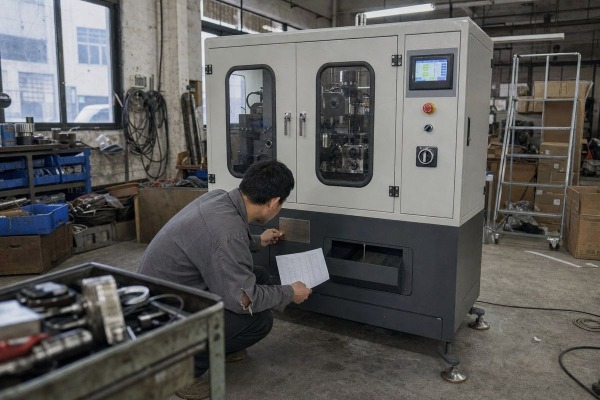
Look for interlocked guards on access doors, an emergency stop that halts all hazardous motion, protection against unexpected start-up, enclosed cutting zones with viewing windows, safe chip discharge, compliant electrical cabinets, and clear warning labels. These map directly to the Essential Health and Safety Requirements.

Machine safety under the directive is built on a hierarchy. First, design the hazard out. Second, guard against it. Third, warn the operator. A well-built fully automatic chamfering machine should show evidence of all three layers when you inspect it.
Our standard cabinet design uses dual hinged doors with reinforced viewing windows. Operators can watch the process without exposure to the rotating tool. The doors carry latch locks, and on EU-destined builds we fit safety interlocks so the machine cannot run with a door open. The lower chip-collection chute discharges material away from the operator's hands. These are not decorative choices. Each one traces back to a specific hazard in the risk assessment.
| Safety Feature | Hazard Addressed | Directive Relevance |
|---|---|---|
| Interlocked access doors | Contact with rotating spindle | Guarding requirements in the Essential Health and Safety Requirements 6 |
| Emergency stop button | Any hazardous motion during a fault | Mandatory stop function accessible to the operator |
| Reinforced viewing windows | Ejected chips or broken tooling | Protection against ejected parts |
| Rotary mode selector | Unexpected start-up during maintenance | Control system safety and mode separation |
| Chip discharge chute | Hand injury during waste removal | Safe material handling design |
| Enclosed electrical cabinet | Electric shock | Electrical safety of machinery |
Because the machine is fully automatic, the control system does real safety work. The touchscreen HMI should separate operator mode from maintenance mode. Parameters that affect safety should be password-protected. Under the incoming Machinery Regulation (EU) 2023/1230, safety-related software faces its own conformity assessment, and connected machines need cybersecurity measures. If your machine will run for a decade, ask your supplier now how they handle software updates and access control. We already restrict parameter access on our HMIs for this reason, and since our equipment can be customized to customer requirements, we can adapt interlock logic, guarding, and control modes to match your plant's specific safety rules.
The hardest lesson I learned in export came from a shipment where one document listed an old model number. Customs held everything until we couriered a corrected declaration.
For EU customs clearance you need the EC Declaration of Conformity, the commercial invoice and packing list matching the machine nameplate, operating instructions in the destination language, and visible CE marking. The technical file stays with the manufacturer but must be available to authorities on request.

Customs officers do not read your technical file. They check consistency. Every document must tell the same story: same manufacturer name, same model, same serial number, same year. A single mismatch invites inspection, and inspection means delay.
| Document | Who Prepares It | When You Need It |
|---|---|---|
| EC/EU Declaration of Conformity | Manufacturer | Must accompany the machine; customs and market surveillance can demand it |
| CE marking on nameplate | Manufacturer | Affixed before shipment; checked visually at inspection |
| Operating instructions | Manufacturer, translated for destination | Must be delivered with the machine in the local language |
| Technical file (drawings, risk assessment, test results) | Manufacturer, retained for 10 years | Not shipped, but must be produced if authorities ask |
| Commercial invoice and packing list | Exporter | Standard customs entry documents |
| Declaration of incorporation | Manufacturer, only for partly completed machinery | Replaces the Declaration of Conformity for incomplete modules |
This distinction changes your paperwork entirely. If you buy a standalone chamfering machine ready to plug in and run, it is complete machinery. It needs full CE marking and a Declaration of Conformity. But if you buy a chamfering module to build into a larger production line, it may qualify as partly completed machinery. It then ships with a declaration of incorporation and assembly instructions instead, and the CE obligation shifts to whoever completes the final line. When buyers send us their drawings for a custom unit, we clarify this status at the quotation stage, because it decides which documents we prepare. Getting it wrong in either direction creates customs problems that are painful to fix after the container is on the water.
A fully automatic chamfering machine bound for the EU needs Machinery Directive compliance today and Machinery Regulation compliance from 2027. Verify documents early, inspect safety features, and demand a complete paperwork package. Do that, and customs becomes a formality instead of a crisis.
1. Provides the official text and context of the EU Machinery Directive. ↩︎
2. Details the process and necessity of risk assessment under the Machinery Directive. ↩︎
3. Replaced with the official EUR-Lex document for the Machinery Directive 2006/42/EC, which defines ‘partly completed machinery’ in Article 2(g). ↩︎
4. Contains the official text of the new EU Machinery Regulation. ↩︎
5. Explains the meaning and requirements of CE marking in the EU. ↩︎
6. Replaced with the official EUR-Lex document for the Machinery Directive 2006/42/EC, which contains the Essential Health and Safety Requirements in Annex I. ↩︎
