

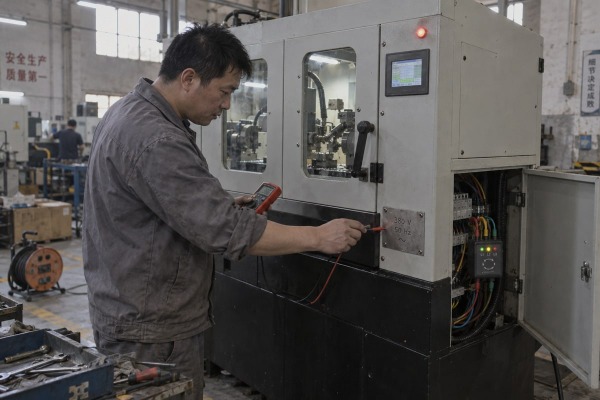
A chamfering machine electrical system that fails European voltage standards can stall a line. On our Wenzhou floor, we have watched buyers learn this too late. Prevention starts at purchase.
To confirm a chamfering machine’s electrical system meets European voltage standards, check the nameplate for 400V three-phase or 230V single-phase at 50Hz, request the EU Declaration of Conformity citing the Low Voltage Directive and EN 60204-1, then measure voltage, phase sequence, and earth continuity at the installation point.
That short answer hides four separate jobs. You need the right certifications, the right wiring, the right voltage and frequency, and the right paperwork. I will walk through each one below, in the order we handle them on a real European order.
A Slovak procurement manager once asked us for "the CE certificate" before ordering a chamfering machine. We explained that CE is a declaration, not a certificate, and listed what matters.
Request an EU Declaration of Conformity referencing the Low Voltage Directive 2014/35/EU, EMC Directive 2014/30/EU, and Machinery Directive 2006/42/EC, plus confirmation that the electrical equipment follows EN 60204-1. Ask for motor efficiency class documentation and component certificates, since CE marking is a manufacturer's declaration, not third-party certification.

The confusion in that Slovak buyer's email is very common. Many people treat CE marking certification 1 as a stamp from an independent lab. It is not. It is the manufacturer saying, under its own legal responsibility, that the machine conforms to the EU rules that apply to it. That is why the question is not "do you have CE?" but "which directives and standards does your declaration cover, and can you show the evidence behind it?"
A powered chamfering machine usually falls under three pieces of EU legislation at once. They do not compete. They apply side by side.
| Legislation | What it covers | Why it matters for voltage compliance |
|---|---|---|
| Low Voltage Directive (LVD) 2014/35/EU | Electrical equipment rated 50–1,000V AC or 75–1,500V DC | Your 400V three-phase or 230V single-phase supply sits squarely inside this range |
| EMC Directive 2014/30/EU | Electromagnetic Compatibility (EMC) of equipment | Variable-frequency drives and switching power supplies can disturb other equipment on the same grid |
| Machinery Directive 2006/42/EC | Overall machine safety, guarding, emergency stops, risk assessment 2 | The electrical system is part of the safety case, not a separate box to tick |
A note on timing: the Machinery Directive is being replaced by the Machinery Regulation (EU) 2023/1230 3, which becomes applicable in January 2027. If your delivery lands near that date, ask the supplier which text the declaration will cite.
Directives tell you what outcome is required. EN 60204-1 safety standards 4 tell you how to get there for the electrical equipment of machines. The standard covers machine electrical systems up to 1,000V AC and 1,500V DC at frequencies up to 200Hz. Its scope starts where the incoming supply meets the machine's terminals or main disconnecting device. When we build a control cabinet for a European order, this is the standard our wiring layout, colour coding, bonding, and protective devices are checked against.
Two more items belong on your request list. First, motor efficiency. The EU Ecodesign rules now require IE3 or, for certain power ranges, IE4 motors. Ask for the motor datasheet showing its efficiency class. Second, if any of your sites are in the United Kingdom, ask whether a UKCA marking is also provided, because CE alone no longer covers that market in the same way.
Here is the objection I hear most: "If the supplier gives me a proper declaration, that should be enough." For a new, unmodified machine installed exactly as instructed, that view is reasonable and efficient. But a declaration describes the machine as it left the factory. It cannot describe your site's actual supply, fault current, cable length, or earthing arrangement. Documentation is necessary. It is not sufficient. The next section covers what you still need to verify yourself.
During a final inspection, our electrician found a 24V DC sensor wired to a 24V AC tap. The main 400V motor circuit was perfect. The control circuit was not.
Verify wiring and components against CE voltage requirements by comparing every component rating to the EN 60204-1 design, confirming conductors are sized for current and a maximum 5% voltage drop, testing protective bonding continuity with a meter, checking control-circuit voltage separately, and ensuring breakers match the prospective short-circuit current.

That sensor incident taught our team something simple. A machine can pass on its main supply and still fail on a secondary circuit. So we now check every circuit, not just the motor feed. Below is the sequence we follow, and the one I suggest your installer follows too.
| Symptom after installation | Likely electrical cause | First check |
|---|---|---|
| Motor runs hot or trips on overload | Undersized cable, high voltage drop, wrong star/delta link | Measure voltage at motor terminals under load |
| Spindle or feeder rotates backwards | Incorrect phase sequence | Use a phase-sequence tester at the incoming terminals |
| Drive shows undervoltage or overvoltage faults | Supply outside the drive's rated band, or voltage sag on start | Log supply voltage during start-up |
| Nuisance tripping of site RCD | Drive leakage current, EMC filter type | Confirm RCD type is compatible with the drive |
| Relays chatter or PLC resets | Control transformer loaded beyond rating, loose terminals | Measure control voltage at the farthest device |
| Random stops with no fault code | Poor bonding, interference on signal cables | Re-test bonding continuity and cable separation |
One caution. Insulation-resistance and dielectric tests 5 can destroy drives, PLCs, filters, and surge devices if applied blindly. Our schematics mark which components must be disconnected first. Ask your supplier for the same marking before anyone connects a test set.
Here is a trade-off on every European order. Our Wenzhou supply is 380V 50Hz. We can step voltage down for testing, but cannot push it above our domestic standard.
Before shipping to the EU, confirm the chamfering machine is rated for three-phase 400V 50Hz or single-phase 230V 50Hz, with a tolerance band of roughly 380–415V, correct star or delta motor connection, 50Hz-rated drives and transformers, and an earthing arrangement matching the destination site's industrial power supply requirements.

That testing limit is why I push buyers to settle the voltage specification at the purchase stage, not at the packing stage. If a customer in Serbia or Slovakia tells us "400V three-phase, 50Hz" when the order is placed, we select motors, drives, and control transformers rated for that band from the start. We can then run the machine on our 380V supply, which sits inside the 380–415V tolerance of those components. What we cannot do is simulate a 415V site, or any supply above our domestic standard. So the final confirmation at full site voltage must happen at installation, with your electrician present.
| Parameter | Typical Chinese factory supply | Typical European industrial supply | What to confirm |
|---|---|---|---|
| Three-phase line-to-line | 380V | 400V (often marked 380–415V) | Nameplate shows a band that includes your measured site voltage |
| Single-phase line-to-neutral | 220V | 230V | Control circuits using neutral are rated for 230V |
| Frequency | 50Hz | 50Hz | Motors, drives, and transformers rated for 50Hz |
| Earthing system | Varies | TN-S, TN-C-S, TT, or IT depending on country | Protective conductor arrangement matches the site |
The good news is that both regions use 50Hz. The trap is the voltage band. A nameplate marked 220/380V on an older design does not automatically mean the machine is happy at 230/400V. Ask for current motor nameplate data, not a legacy label.
Star or delta connection. A 230/400V motor must be linked in star on a 400V three-phase supply. A delta link puts 400V across windings rated for 230V. This is the single most expensive mistake I have seen on relocated machines.
Phase sequence. Wrong sequence reverses the motor, the coolant pump, and the feeder vibrator. A brief bump test is not enough. A phase-sequence tester takes thirty seconds and prevents damaged tooling.
Frequency-dependent parts. Fans, pumps, and transformers behave differently at 60Hz. If a used machine came from a 60Hz market, do not assume a drive will rescue every component.
Measured site voltage, not nominal. Measure at the machine's incoming terminals with calibrated instruments. Nominal utility voltage and the voltage at the end of a long sub-main are not the same number.
A buyer once suggested avoiding all this with a plug adapter or an external step-up transformer. I understand the appeal. But an adapter fixes a connector, not a rating. And a transformer adds cost, losses, and one more failure point. Correcting the machine's electrical configuration at the design stage is cheaper and safer.
One lesson cost us a week: a buyer's installer rejected our panel because the schematics did not match a drive swapped during assembly. Now we update drawings first.
Ask your supplier for the EU Declaration of Conformity, electrical circuit diagrams, a parts list with component ratings, nameplate data, a risk assessment, EN 60204-1 test reports covering bonding continuity and insulation resistance, operating and installation instructions, and EMC information. Each document must match the machine model and configuration shipped.

That week of emails changed how we release documents. A drawing that does not match the cabinet is worse than no drawing, because the installer trusts it. So before any European shipment leaves our factory, the schematic revision, the parts list, and the physical panel are checked against each other by someone who did not wire the panel.
| Document | What it must contain | Red flag to watch for |
|---|---|---|
| EU Declaration of Conformity | Machine model, serial number, manufacturer, directives, harmonised standards, signatory | Generic model name, no serial, or no mention of EN 60204-1 |
| Electrical circuit diagrams | Every circuit, terminal numbers, wire colours, protective device ratings | Revision date earlier than the build date |
| Parts list | Make, model, and rating of each electrical component | Components that do not appear in the drawings |
| Nameplate data | Rated voltage, phases, frequency, full-load current, short-circuit data, earthing requirement | A photo of a different machine's plate |
| Risk assessment | Hazards, safety functions, emergency-stop category | A one-page template with no machine-specific content |
| Test reports | Protective bonding continuity, fault-loop impedance, insulation resistance, functional safety tests | Pass marks with no measured values recorded |
| Operating and installation instructions | Supply connection method, recommended upstream protection, cable sizing guidance, components to isolate during testing | No statement on whether the machine is hardwired or plug-connected |
| EMC information | Filter requirements, cable shielding, RCD compatibility | Missing entirely on a machine with a variable-frequency drive |
A CE mark with no matching declaration and no technical file behind it is a warning sign, not a comfort. Three quick tests help. Does the declaration name the exact model and serial number on the machine in front of you? Does the standards list include EN 60204-1 and not just a general safety standard? Do the test reports show numbers, such as a measured bonding resistance, rather than a bare "pass"?
Documentation deserves extra scrutiny when a chamfering machine is second-hand, rewired for a different voltage, fitted with a replacement drive, or relocated from outside Europe. In those cases the original declaration may no longer describe the machine. Ask who performed the modification and whether the schematics and risk assessment were updated. If nobody can answer, treat the machine as unverified.
Finally, close the loop with a documented acceptance. We prefer a simple sign-off sheet with three signatures: ours, the installer's, and the site's responsible electrical professional. It records the measured supply voltage, phase sequence, bonding results, and the drawing revision used. It is the fastest way to end future arguments before they begin.
A chamfering machine electrical system that fails European voltage standards stops production and strains trust. Confirm specs at purchase, verify at installation, and sign a documented acceptance together.
Interested in sourcing the products mentioned in this article? See details and request a quote here:
1. Official European Commission guide on CE marking requirements and manufacturer responsibilities in the EU. ↩︎
2. EU-OSHA guidance on the risk assessment process required for workplace and machinery safety compliance. ↩︎
3. Official EU page for the Machinery Regulation (EU) 2023/1230, replacing the Machinery Directive for machine safety. ↩︎
4. ISO standard page for 60204-1, the basis for European electrical safety standards for machinery. ↩︎
5. Wikipedia entry explaining dielectric withstand tests used to verify electrical insulation and safety. ↩︎
