

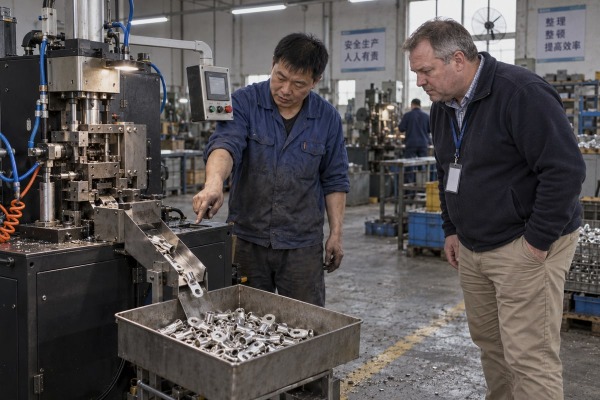
A trial unit or bulk order for a cable lug 1 making machine feels like a discount question. Our Wenzhou team has watched that mindset multiply mistakes; testing first prevents it.
For a cable lug making machine, buy a trial unit when drawings, demand, tooling, or the supplier are unproven. Visit the factory, run your own material, and verify stability first. A bulk order only makes sense after a documented test confirms repeatable quality, real output, and dependable after-sales support.
The rest of this article walks through that decision step by step dimensional repeatability 2. I will explain when a single machine is worth the delay, what a pilot run protects you from, how to structure the deal so you keep bulk pricing without taking bulk risk, and which technical factors to measure before you commit. Each section ends with practical checklists and tables you can take into your next supplier meeting.
A procurement manager from the United States once asked me to skip the factory visit and quote five machines immediately. I asked him to come test one first.
A trial unit is worth the extra time whenever you cannot yet answer five questions with evidence: the lug designs are final, your exact material is tested, demand is backed by orders, operators are ready, and the supplier has proven stability. Uncertainty on two or more means test first.

That buyer did come to our factory in Wenzhou. He spent two days watching a machine run his drawings. He went home with samples, a revised tooling list, and a clear view of what he actually needed. He ordered one machine, then more later. That sequence is the point of this section.
Suppliers use the phrase "cable lug making machine" loosely. It may describe a punching press, a barrel-forming unit, a terminal crimping machine for wire harness manufacturing 3, or a full integrated line with strip feeding, forming, deburring, and output chute. Two quotations with the same machine name can have very different automation levels and included equipment. So define the terms before you compare anything.
| Term | What it covers | When it fits |
|---|---|---|
| Trial unit | One machine bought for product validation, process testing, operator training, or pilot production | New product, new supplier, uncertain demand, imported equipment |
| Bulk order | Several machines, a complete line, or a large equipment package under one contract | Stable product range, confirmed demand, proven supplier |
| Phased order | One machine first, with a contractual option for more at an agreed price | Buyer wants scale economics but still needs proof |
In our experience exporting to markets such as India, Vietnam, Mexico, and the United States, these conditions almost always justify a single pilot machine:
If your situation matches two or more lines above, the extra weeks are cheap insurance.
For a first purchase, my strongest advice is simple. Come to the factory, run the machine, and walk the floor. Watch continuous production, not a thirty-second demo. Talk to the engineers who design the tooling, not only the sales staff. You are evaluating three things at once: the stability of the machine, the professionalism of the supplier, and the reliability of the technical R&D behind it. Only after that visit should you decide between one unit and a batch. We built our sample-testing process around this because a buyer who sees the machine run his own copper strip asks far better questions.
Rate each category from 1 to 5. A 1 means guesswork; a 5 means documented proof.
| Category | Score 1 looks like | Score 5 looks like |
|---|---|---|
| Product certainty | Drawings still in revision | Final drawings with tolerances |
| Demand certainty | Hopeful forecast | Purchase orders or contracts |
| Supplier certainty | First contact, no references | Visited factory, passed sample test |
| Technical complexity | Multiple materials and sizes | One stable product family |
| Financial capacity | Full project strains cash flow | Working capital and scalability modeled |
I treat a total under 13 as a clear trial case. A total above 19 opens the door to a phased or bulk order. Treat it as a decision aid, not a formula.
Years of commissioning lug-forming lines taught our engineers one hard lesson: a defect you accept in one machine becomes a defect you own in five.
Testing a cable lug making machine before a bulk order avoids multiplied design flaws, wrong tooling for your material, inflated output claims, high scrap during commissioning, unprepared power and floor space, and locked capital in idle machines. One pilot exposes these problems before they repeat.

Bulk pricing is attractive because it lowers the quoted figure per machine. It also lowers freight per unit and training cost per machine. None of that matters if the design has a flaw. When machines are built together, they share the same tooling philosophy, the same control logic, and the same weaknesses. A trial machine breaks that chain. Below is how I explain the exposure to buyers who are tempted to skip the pilot.
| Risk | How a trial run exposes it | Cost if multiplied across a fleet |
|---|---|---|
| Shared design flaw | Repeatability drifts across a long batch | Every machine needs the same rework or retrofit |
| Tooling mismatch | Burrs, cracks, or thinning on your copper or aluminum grade | New dies for all units, plus delayed production |
| Inflated output | Measured parts per hour fall short of the headline strokes-per-minute figure | Undercapacity despite the full capital spend |
| Commissioning scrap | Scrap rate during the first batches is tracked and costed | Scrap repeated at every installation |
| Utility gaps | Pilot reveals real 3-phase power, air, and cooling needs | Facility upgrades after machines already arrived |
| Tooling incompatibility | Trial dies tested for carry-over to faster machines | Full tooling redesign for the bulk fleet |
| Idle capital | Demand validated with real samples and customer feedback | Machines and warehouse space tied up with no return |
Testing also tests the supplier. During a sample run at our facility, buyers see how our engineers respond when something needs adjusting. That behavior is hard to fake. Watch for these warning signs with any supplier:
A trial unit keeps working after the bulk fleet arrives. It becomes a training platform. Your operators learn die alignment and maintenance before high-speed machines land on the floor. Later it can serve as a hot standby. Many factories keep the first unit as N+1 redundancy or for urgent low-volume custom orders, so the main line never stops for a small job. That is a return on the pilot that a unit cost analysis usually ignores.
Every quotation we prepare balances two pressures: the buyer wants bulk pricing on day one, and we want our first machine to earn the second order.
Negotiate a phased order: buy one trial unit now with a contractual option to purchase additional machines at a pre-agreed bulk price after acceptance. Tie payments to a factory acceptance test, request a documented lead time for each phase, and compare total delivered cost, not unit price.

Our pricing sits in the mid-to-high range because machines are built to the customer's drawings with tooling and sample testing included. So I rarely negotiate by cutting the base price. I negotiate scope, timing, and structure. That approach works for buyers too, because it keeps the economics of scale while protecting them from technical uncertainty.
| Pathway | Price position | Lead time profile | Risk exposure | Best for |
|---|---|---|---|---|
| Full trial purchase | Highest per unit; separate freight and installation | Shortest; sometimes ready-to-ship or certified used stock | Lowest | First-time producers, unfinished drawings |
| Phased order | Bulk price locked for later units | Pilot ships first; later units follow acceptance | Low to moderate | Buyers with likely but unproven demand |
| Controlled bulk order | Lowest per unit | Longest; multi-machine builds often run 90 days or more | Highest, but staged by milestones | Proven product, confirmed orders, trained staff |
The phased order resolves the central objection. Buyers tell me a single machine costs more and delays full production. Both points are true. But a framework agreement gives the right, not the obligation, to buy more at the agreed price. You capture most of the bulk benefit and release the second payment only after the first unit proves itself.
Unit price is the least useful number in the quotation. Build a simple comparison instead.
Trial-unit cost = machine price + logistics + setup + testing + training + operating cost + cost of delayed scale.
Bulk-order cost = total equipment cost + logistics + installation + working capital + risk of unused capacity + cost of correcting repeated defects.
Here is an illustrative example, not real data. Imagine a trial machine has a higher delivered cost because it ships alone. It then reveals that the planned dies cannot hold tolerance on your aluminum grade. That one finding prevents four more machines arriving with unusable tooling. The pilot was the cheaper decision. Replace this example with your own quotations and model return on investment under conservative, expected, and optimistic demand before you sign.
During one sample test on our shop floor, the lugs looked perfect until we measured hole position across the batch. That drift decided the whole project.
Evaluate dimensional repeatability, hole position, barrel geometry, burrs, cracks, plating coverage, pull-out strength, and electrical resistance across a full batch made from your own material. Also measure real cycle time, changeover time, scrap rate, utilization, tool wear, control-system brands, and power requirements before approving bulk.

A trial run should test the complete process, not whether the machine switches on. When we run samples for a customer, we ask for their strip or tube stock in advance. Samples made from our own material can mislead both sides. The checks below are the ones I would insist on before any bulk commitment.
Write the quality control standards into the factory acceptance test 6 before the machine is built. The document should state material grade and thickness, product drawings, permitted tolerances, sample quantity, target speed, maximum scrap rate, tooling configuration, inspection method, and what happens if the criteria are not met.
| Check | What to measure | Why it matters for bulk |
|---|---|---|
| Overall dimensions | Length, palm width, flatness | Confirms the dies match the drawing |
| Hole diameter and position | Variation across the full batch | Drift here fails assembly at the customer |
| Barrel diameter and wall | Geometry and thinning after forming | Affects crimp fit and conductivity |
| Edges and surface | Burrs, cracks, wrinkles, finish | Indicates tool wear and material stress |
| Plating or tinning | Coverage and adhesion | Corrosion and resistance over time |
| Mechanical performance | Pull-out or tensile result with intended cable | Safety-critical in the final installation |
| Electrical performance | Resistance across the joint | Often more important than appearance |
| Repeatability | First-to-last part comparison | Proves the result is not a lucky sample |
A machine advertised at maximum speed produces far less sellable output in a mixed-size environment. Use this estimate:
Effective monthly output = nominal cycle output × operating hours × utilization rate × yield.
The utilization rate must include changeovers, planned maintenance, operator breaks, material loading, and unplanned stops. Then run three demand scenarios. Compare the cost of undercapacity with the cost of idle machines. A factory targeting more than 30,000 units per day on a few standardized geometries can justify several high-speed units. A plant running many sizes in small lots usually cannot, no matter how good the per-unit price looks.
Buyers often ask us for one machine that handles every lug size. I understand the appeal. But I push back when volume on one or two sizes is high. A dedicated machine offers faster cycles, simpler setup, and tighter repeatability for those products. Versatility only pays when the changeover is quick and quality holds across the whole range. During the trial, time an actual die change, inspect the tools for wear, and confirm that the trial dies will carry over to the bulk machines without a redesign.
Record the electrical and control-system brands, the servo or pneumatic configuration, and whether remote diagnostics are available. Audit your site for 3-phase industrial power, compressed air, and cooling, because higher automation levels often need more than a standard footprint. Finally, confirm spare-parts lead time and technical response time in writing. Technical success in a trial means little if the fleet cannot be supported.
Guessing wrong on quantity multiplies cost. Test one machine with your material first, then scale through a phased order. Send us your drawings and samples to start.
Interested in sourcing the products mentioned in this article? See details and request a quote here:
1. Wikipedia entry providing a technical overview of electrical terminals and cable lugs. ↩︎
2. International organization for standardization of industrial and geometric product specifications. ↩︎
3. Official industry association for wire harness manufacturing and terminal assembly standards. ↩︎
4. National authority for electrical measurement standards and resistance testing guidelines. ↩︎
5. Official body for Incoterms governing international shipping and delivery responsibilities. ↩︎
6. Global authority defining standards for commissioning and factory acceptance test protocols. ↩︎
