

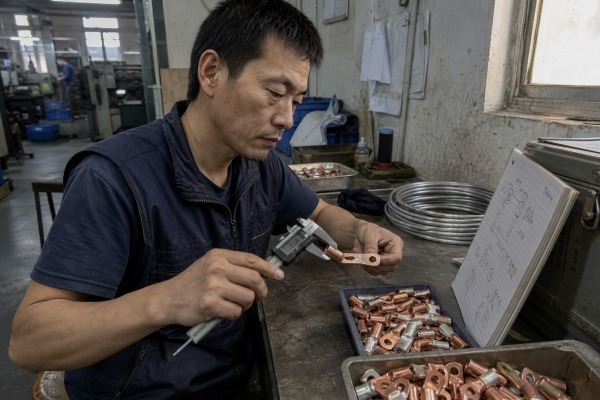
Every month, buyers ask our Wenzhou workshop for a cable lug making machine sample — then freeze when a fee appears. Pay blindly, and you risk overpaying; refuse, and negotiations stall.
To request samples for a cable lug making machine, send the supplier your lug drawings, material specs, and physical product samples, then negotiate the sample fee in writing. Buyers usually pay freight and trial material costs, but you can often get fees credited against the bulk order.
This guide walks through the whole process. I will show you what to send, how to negotiate, what refund terms look like, and how to test the sample before mass production.
A procurement manager once sent our team a single blurry photo of a copper lug. Two weeks of emails followed before we could even quote the tooling.
Provide detailed technical drawings, lug dimensions (barrel diameter, wall thickness, tongue width), material grade, physical product samples, expected output rate, and your automation requirements. Suppliers need your actual lug samples to calibrate tooling, set machine parameters, and confirm material compatibility before trial production.

For custom equipment, samples are not optional. In our own process, the customer must first ship us physical product samples. Only then can we adjust the machine settings and parameters based on the exact dimensions, specifications, model, and material of those lugs. A drawing alone tells us the target. The physical lug tells us the truth about wall thickness variation, copper hardness 1, and surface finish.
There is another point most buyers miss. A cable lug making machine is capital equipment, not a consumable. So a "sample" can mean three different things. Be clear about which one you want, because the fee depends on it.
| Sample Type | What You Get | Typical Cost Driver |
|---|---|---|
| Demo run | Video or live trial on the supplier's machine | Trial material and labor |
| Finished sample lugs | Physical lugs made by the machine, shipped to you | Material plus international freight |
| Trial machine unit | A test unit shipped for inspection | Full machine cost, often deposit-based |
Send precise technical drawings 2 with outer diameter and wall thickness marked. State your material grade — bare copper, tinned copper, or aluminum. If you can, ship your own raw copper or aluminum tubing for the trial run. This verifies the machine handles your specific material hardness, not just the supplier's stock. Also state your target production capacity per hour and whether the machine feeds into a wire harness processing line 3 or a terminal crimping machine downstream. These details drive the custom mold design and the final quotation.
There is a real trade-off in every sample quotation we issue: charge too much and serious buyers walk; charge nothing and we drown in casual inquiries.
Negotiate a fair sample fee by asking the supplier to break costs into machine time, materials, engineering, and shipping. Offer to pay real costs, request a refundable credit against your bulk order, and use video trials or live streams to cut international shipping costs.

Sample policies vary wildly in this market. One marketplace listing shows a sample price of US $1,550 per set. Another lists a sample at US $0. Marketplace summaries also note sample lead times of roughly 10 to 30 days depending on customization. So there is no fixed "market rate" — everything is negotiable if you negotiate on facts.
Start by understanding both sides. Suppliers charge fees because setup, calibration, trial materials, and labor consume real hours on a real production line. Buyers push back because they are evaluating machines priced around US $22,000–25,000 or even US $26,400–26,600 per set, and a serious buyer at that ticket size expects goodwill. Both views are fair. The balanced answer is a fee tied to documented costs, with credit or accountability attached.
In our experience exporting to the US, India, and Mexico, the biggest sample expenses are always freight and trial material fees. Confirm in writing who bears each one. In most deals, the customer covers both — but you can trade that concession for something better.
| Lever | How It Works | When to Use It |
|---|---|---|
| Cost breakdown request | Supplier itemizes machine time, material, engineering, shipping | Always — it exposes padding |
| Sample credit clause | Fee deducted from the final machine price | When you intend to order |
| Spare parts offset | Fee waived against pre-committed dies and cutting blades | High-wear tooling buyers |
| Live Stream Factory Acceptance Test | Remote real-time trial replaces shipped samples | When international shipping costs are high |
| Multi-size discount | Lower per-sample fee for testing several lug sizes | Multi-product factories |
One more tip: negotiate the sample fee alongside Minimum Order Quantity (MOQ), lead time, warranty, and spare parts — never in isolation. Sample terms are also part of your supplier verification process. A factory that documents its sample costs transparently usually documents its quality the same way.
Early in our export business, we lost a Canadian order because our refund terms lived only in a WhatsApp chat. That lesson changed how we write every sample agreement.
Sample fees are often refundable or deductible, but only if you negotiate it before paying. Most suppliers will credit the fee against your first machine purchase or tooling costs once you place a bulk order, so put the refund clause in the proforma invoice.

Refunds are common — but never automatic. The industry norm is a "paid sample with approval credit" structure: you pay now, and the amount is deducted later if the order goes ahead. In our own contracts, we treat the sample fee as a deposit on the buyer's seriousness, not as profit. Once a machine order lands, that fee flows back as a deduction.
However, not everything gets refunded. Freight almost never does. When we ship sample lugs to New Zealand or Slovakia, the courier bill is real money spent, and in standard practice the customer bears both the freight and the trial material cost. The refundable portion is usually the setup and labor component.
| Structure | Refundable Portion | Best For |
|---|---|---|
| Full sample credit | 100% of sample fee deducted from machine price | Buyers committed to ordering |
| Tooling credit | Fee applied to custom mold design costs | Custom lug profiles |
| Spare parts offset | Fee converted into dies and blades shipped with the machine | Long-term operators |
| Partial refund | Setup fee refunded; freight and material excluded | Standard-configuration machines |
| Non-refundable | Nothing returned | Avoid unless fee is trivial |
Put the agreed structure into a formal proforma invoice. Define the sample lead time, the shipping terms, the performance benchmarks the sample must meet, and the exact wording of the credit. Also link the clause to bulk order pricing: if you commit to a second machine or higher volumes, ask for the credit to scale. Verbal promises evaporate. Documented clauses get honored.
Our quality control inspection bench in Wenzhou holds calipers, a tensile tester 4, and a conductivity meter. Every sample lug crosses that bench before it ships to a customer.
Check the sample lugs against your drawings: dimensions, wall thickness, crimp barrel quality, and surface finish. Then verify tensile strength, electrical conductivity, scrap rate, cycle time, and die changeover speed. Request a factory test report documenting every measurement before you approve mass production.
The sample stage is your last cheap chance to catch problems. After the machine ships, every fix costs freight, downtime, and patience. So evaluate the sample like an auditor, not like a hopeful buyer. Whether the machine is a fully automatic line or a hydraulic lug press station, the same discipline applies.
Here is the evaluation sequence I recommend to every procurement manager:
Only after all seven checks pass should you release the balance payment and green-light mass production. Tie the acceptance criteria back to the proforma invoice you signed earlier, so "pass" and "fail" are defined on paper, not by opinion.
Sample requests decide whether your machine purchase succeeds or stalls. Send complete specs, negotiate itemized fees with refund clauses, and test every sample rigorously. Do that, and risk shrinks dramatically.
1. This reference explains the concept of material hardness, which is a critical factor in copper lug manufacturing. ↩︎
2. ISO develops international standards for technical drawings and documentation used in industrial manufacturing. ↩︎
3. Trade.gov provides resources for evaluating technical capabilities and production lines of international manufacturing partners. ↩︎
4. Wikipedia is an authoritative source and the page directly describes the ‘tensile tester’ (Universal Testing Machine). ↩︎
