

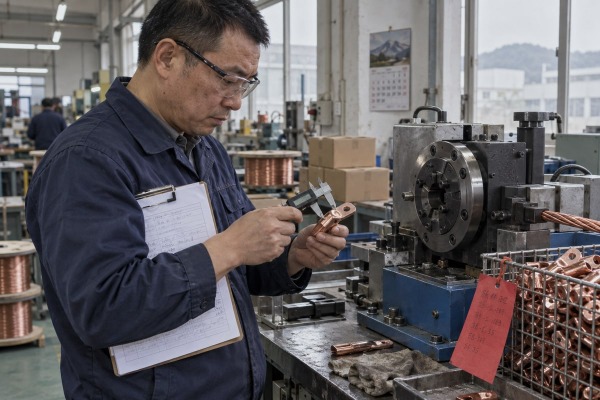
A failed cable lug machine sample can freeze your entire launch plan. On our Wenzhou production floor, we have sat on both sides of that tense conversation many times.
When cable lug machine samples fail tests, freeze acceptance, document every nonconformity against the agreed specification, then negotiate a written corrective plan with deadlines, retest criteria, and supplier-funded remedies. Confirm every commitment in writing before releasing payment or shipment.
That is the short answer. The rest of this article breaks it into four steps. I will show you what evidence to collect, how to ask for compensation, when to retest, and what to write into your next contract.
Last year, a buyer in Germany sent our team a rejection report that worried us — until we checked his drawing together and found one tolerance had been written wrong.
Before confronting your supplier, gather the signed drawings, the agreed pass/fail criteria, dated photos, pull-test and crimp height data, cross-section analysis results, a numbered non-conformance report, and proof of the test conditions used. Verify your own drawing parameters first to rule out specification errors.

In my experience, failed samples fall into two buckets, and you must know which one you are in before you send a single angry email. First, the customer’s drawing may contain an error, so the machine produced exactly what was asked — and what was asked was wrong. Second, the machine’s parameters were tuned poorly, or the machine itself lacks stability, so output drifts across a run. The negotiation path is completely different for each. If the drawing is wrong, you fix the drawing and re-confirm parameters. If the machine is unstable, you demand re-tuning, proof of stable output, and a fresh acceptance round.
Pull out the original technical drawings 1 and compare every parameter against what you actually needed. Check crimp height, die profile, terminal pitch, and material grade. Only after this check should you build your case against the supplier.
Speed matters. Send a numbered defect list within 24 hours of the failed inspection. Rank each defect by severity. Attach a photo and a measurement to every item.
| Evidence item | What it proves | Format |
|---|---|---|
| Signed drawings and spec sheet | The agreed standard | PDF with revision number |
| Pull-test / tensile strength test data | Pull-out force below requirement | Measured values vs. threshold |
| Crimp cross-section analysis | Voids, poor compaction, wrong compression | High-resolution photos |
| Crimp height validation records | Dimensional nonconformity | Micrometer readings |
| PLC Parameter Optimization Log | Actual test conditions at the factory | Exported machine log |
| Non-conformance report | Formal, numbered defect list | Dated document |
Ask for the machine’s PLC Parameter Optimization Log specifically. It tells you whether the sample was run at your required electrical load and cycle speed, or at gentler settings that flatter the result.
A procurement manager from the US once told me on WhatsApp: “I don’t want a refund. I want a machine that works.” That sentence reshaped how we handle rework talks.
Present the supplier with quantified defect costs and two or three remedy options — rework, replacement, or price adjustment — instead of ultimatums. Ask them to fund the second sampling round and air freight, then confirm the full corrective plan in writing before any payment moves.

The core rule is simple: negotiate from data, not opinions. When we handle a dispute on our own terminal crimping equipment, the conversation goes better every single time the buyer quantifies the impact. Say “this delay costs me three weeks of production and one missed customer deadline,” not “this is unacceptable.” Numbers keep the discussion professional. Emotion gives the supplier room to get defensive.
Start by requesting a formal Root Cause Analysis 2 or an 8D report. This forces the factory to identify whether the failure came from inferior components, poor assembly, or incorrect calibration. Then ask for a written Corrective Action Report with named actions and dates. A supplier who agrees on paper is far more likely to deliver.
Give the supplier a menu. This preserves face and keeps the relationship working.
| Remedy | Best when | What to demand in writing |
|---|---|---|
| Rework and re-tune | Parameter or setup fault | Retest criteria and deadline |
| Replacement parts or units | Component-level defect | Supplier pays materials and air freight |
| Price adjustment | Minor, tolerable deviations | Revised invoice before shipment |
| Wear-and-tear compensation package | Delay caused project losses | Free extra crimping dies and blades |
| Shipment hold | Severity still unclear | Written release conditions |
If the supplier resists giving money back, shift to non-price terms. Ask for a shorter lead time, extended quality guarantees, free spare dies, covered shipping, or better payment terms. In our own supplier disputes, non-price concessions often deliver more real value than a small discount. And remember: nothing is agreed until it is in writing. Verbal promises are weak leverage.
Every week we weigh the same trade-off in our own component sourcing: a retest costs about two weeks, but qualifying a brand-new machine builder costs two months or more.
Request a second sample round if the failure traces to machine parameters or setup, because tuning is fixable. Switch suppliers only when defects are structural, the Root Cause Analysis is evasive, or the factory refuses stability proof such as a continuous stress test.

Here is the quick decision comparison before we go deeper:
| Signal | Retest with same supplier | Move to a new supplier |
|---|---|---|
| Failure cause | Parameter tuning or setup | Frame, design, or component quality |
| Supplier response | Full RCA within days | Excuses or silence |
| Stability proof | Agrees to extended sample run | Refuses repeatability testing |
| Cost bearing | Funds second sampling round | Pushes all costs onto you |
| Transparency | Offers live-streamed retest | Blocks third-party inspection |
From my side of the workshop, most failed cable lug machine samples come from parameter adjustment, not fatal design flaws. When that is the diagnosis, the right move is not to walk away. It is to require the supplier to re-tune the machine, guarantee stable output across a real run, and then hold a fresh acceptance round. A competent factory will welcome this, because it proves capability.
Do not reopen the whole acceptance process. Define re-sampling protocols that focus on the failed points plus a small additional sample run for repeatability. A narrow scope keeps deadlines short and the discussion focused.
Ask for a live-streamed Factory Acceptance Test 3 using your specific regional cable brands and lug metallurgy. Material hardness varies by market, and a machine tuned on generic Chinese copper wire may behave differently on your local stock. For high-stakes orders, propose an independent third-party inspection agency to verify the second round before shipment. If the supplier resists both, that resistance is itself your answer. Use the value of your full production order and future business as leverage — a supplier who wants the relationship will prioritize your corrective actions over other clients.
One hard lesson from exporting terminal machines to buyers in Germany, Japan, and the US: vague acceptance criteria cost more than any single failed sample ever did.
Add a Quality Assurance Agreement covering technical specification compliance, pull-out force requirements, crimp height validation, defined re-sampling protocols, a conditional payment milestone tied to a 48-hour stress test, and a live-streamed Factory Acceptance Test using your regional cable brands and lug metallurgy.

Contracts do not prevent defects. They prevent arguments about defects. When our team drafts non-standard automation agreements with overseas buyers, we push to write pass/fail criteria into the purchase agreement 4 before production starts, because a dispute without a written standard is a dispute nobody wins. If your last negotiation was painful, the fix is better drafting, not just a better supplier.
| Contract clause | What it prevents |
|---|---|
| Technical specification compliance annex | Arguments over “what was agreed” |
| Pull-out force requirements with numeric thresholds | Subjective pass/fail debates |
| Crimp height validation method and tooling | Measurement-method disputes |
| Re-sampling protocols with fixed timelines | Endless, undefined retest loops |
| Conditional payment milestone (balance in escrow) | Paying before proof of stability |
| Live-streamed FAT with your materials | Flattering tests on soft generic wire |
| Corrective Action Report deadline (e.g., 5 working days) | Slow, evasive responses |
| Supplier performance evaluation reviews | Repeat failures going unrecorded |
The conditional payment milestone deserves special attention. Hold the final balance until the machine completes a 48-hour continuous stress test on your own facility floor. This single clause aligns the supplier’s incentive with your uptime, not just your signature at handover. Also tie every remediation deadline to your production lead time, with buffer days built in, and pre-agree consequences if the supplier misses the fix date — expedited air freight at their cost, or cost-sharing on the delay. Finally, run a formal supplier performance evaluation after every order. A documented track record turns your next negotiation from a fight into a review.
A failed sample is a negotiation moment, not a disaster. Verify the drawing, build evidence fast, trade remedies in writing, and contract for stability. That is how launches survive.
Interested in sourcing the products mentioned in this article? See details and request a quote here:
