

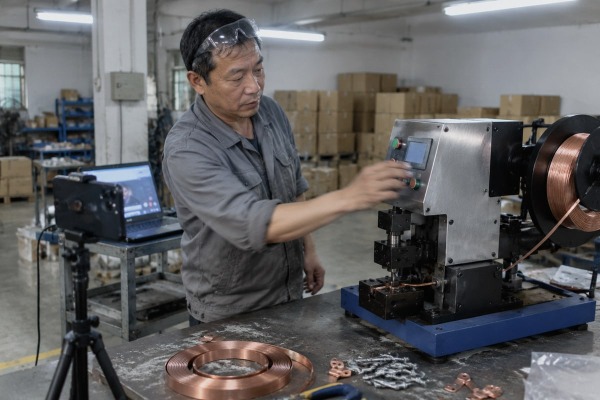
Flying to China to test one machine is expensive. Many buyers of our cable lug making machines ask for an online trial or remote inspection instead—and it works.
To arrange an online trial or remote inspection for a cable lug making machine, book a date with the supplier at least one week ahead, send your acceptance checklist and sample materials, join a live video session, witness the tests, and request recorded video and photo evidence.
That is the short version. Below, I walk through each step in detail. I cover scheduling, platforms, the exact tests to demand, and how to lock in verified proof afterward.
Last quarter, a procurement manager from the US messaged me on WhatsApp asking to verify his terminal machine before final payment. We scheduled his remote inspection in four days.
Schedule a remote inspection by booking a session at least one week in advance, sending your purchase order details, technical specification sheet, sample lug sizes, acceptance criteria, attendee list, and time zone, then confirming the inspection checklist with the supplier before the live meeting.

The scheduling stage decides whether your remote trial becomes a credible Factory Acceptance Test 1 or just a sales demo. In our export work with buyers in the US, Germany, Japan, and India, we always ask clients to book early and prepare documents first. Time zones alone can kill a session if nobody plans for them. So we treat scheduling as a formal process, not a casual calendar invite.
Here is the timeline we recommend to every buyer:
| Timing | Action | Who Is Responsible |
|---|---|---|
| 7–14 days before | Book the date and confirm time zones | Buyer and supplier |
| 7 days before | Send PO details, technical specification sheet, lug sizes | Buyer |
| 5–7 days before | Ship your actual cables and lugs to the factory | Buyer |
| 3–5 days before | Supplier sends the inspection checklist and test items | Supplier |
| 1–2 days before | Confirm attendees, platform, and backup connection | Both |
| Session day | Run the live trial against the agreed checklist | Both, on camera |
One point I insist on from my own experience: ask the supplier to provide the machine inspection checklist and detection items in advance. Then review it before the meeting. If any point is important or likely to cause a dispute—such as crimping tolerance, output speed, or die changeover time—raise it with the supplier ahead of time. Do not wait until the live call. We also recommend shipping your own raw materials to the factory in advance. Testing copper tube terminal production 2 on your actual components proves far more than a run on the supplier’s stock parts. Finally, agree in writing that the whole session will be recorded and archived.
There is a trade-off we weigh in every live video demonstration: WhatsApp is fast to set up, but Zoom gives sharper detail on crimping close-ups.
Use high-definition video platforms such as Zoom, Microsoft Teams, or WhatsApp for the live trial, combined with multi-angle cameras, PLC screen sharing, and optional tools like AR headsets, VPN remote access, or industrial cloud monitoring for real-time machine data.

The platform matters less than how you use it. In our Wenzhou workshop, we have run real-time video inspection sessions on all the major tools. Each has a place, and the right choice depends on how deep you want to go.
| Tool or Platform | Best For | Limitation |
|---|---|---|
| Zoom / Microsoft Teams | HD video, screen sharing, recording | Needs stable bandwidth on both sides |
| WhatsApp video | Quick checks, informal follow-ups | Lower resolution, no easy multi-camera |
| PLC screen share | Cycle times, pressure accuracy, error logs | Requires supplier cooperation and setup |
| AR headset (e.g., HoloLens) | First-person view of internal components | Not every factory owns one |
| VPN / industrial cloud access | Live machine data, remote commissioning | Needs IT setup and security agreement |
One camera hides problems. Ask for a multi-angle configuration: a wide shot of the whole machine, plus macro close-ups of the crimping, cutting, and feeding mechanisms. On our terminal machines, buyers often want a dedicated view of the vibratory bowl feeder sorting ring terminals single-file, because feeding jams are a common worry. Good lighting matters as much as the lens. We use an articulated LED work lamp aimed at the die area so every stroke is visible.
A live PLC data stream through screen sharing lets you watch cycle times and error logs directly, not just the machine’s exterior. Some suppliers now offer cloud-connected monitoring or a digital twin comparison, mapping live performance against the virtual design model. These options are still emerging, but they show where machine performance verification is heading. Always keep a backup channel—usually WhatsApp—in case the main connection drops mid-test.
During a recent Factory Acceptance Test at our Wenzhou workshop, one client asked us to run the machine at full speed for thirty minutes straight. Smart request.
Ask to see machine configuration checks, safety system tests, electrical cabinet inspection, HMI navigation, tooling alignment, a continuous sample run at rated speed, a sustained stress test, and dimensional measurements of finished lugs taken with calibrated tools on camera.

A remote trial only builds confidence if the tests are hard to fake. A common buyer objection is fair: the supplier controls the environment, so only favorable runs might be shown. The answer is to demand continuous, uncut testing on your own materials, with measurements taken live. Here is the test sequence we run for our own clients.
| Test | What to Watch For | Evidence to Capture |
|---|---|---|
| Machine ID and configuration | Serial number, model, options match the PO | Photos of nameplate and layout |
| Safety systems | E-stop response, guard sensors, protective housing | Video of each trigger test |
| Electrical cabinet | Wiring quality, component brands, labeling | Close-up photos, door open |
| HMI and software | Menu navigation, parameter setting, error handling | Screen recording |
| Tooling and die alignment | Correct dies for your lug sizes, changeover process | Video of setup and alignment |
| Continuous sample run | Uncut production at rated speed | Full recording, output count |
| Stress test | Maximum speed sustained; stability and heat | Timed video, temperature check |
| Sample measurement | Crimp height, forming dimensions, tolerances | Calibrated caliper readings on camera |
Test what your machine actually does. For a hydraulic terminal press, watch pressure accuracy and repeatability across strokes. For cold forging technology, inspect the formed barrel surface and wall thickness on camera. For copper tube terminal production lines, check the feed strip, cutting burrs, and hole punching alignment.
Be honest about limits. A live demo proves configuration and short-run quality; it does not prove five years of reliability. That is why the sustained stress test matters, and why a production capacity analysis over a timed run beats a claimed speed on a brochure. For long-run assurance, lean on warranty terms and quality control standards 3, not the demo alone.
A lesson we learned the hard way: an undocumented trial is worth nothing three months later. Now we record every detail and archive it for each client.
Request a signed inspection report that classifies issues as critical, major, or minor, plus a full high-resolution recording of the session, close-up photos, sample measurement data, and shipped test samples. Release final payment only after corrective actions are documented.

Evidence is what turns a live video demonstration into a decision tool. In my own practice, I ask our team to record every detail point by point during the session, then keep the full video and photo files for the client. You should demand the same from any supplier. Here is the evidence package to request.
| Evidence Item | Purpose |
|---|---|
| Full session recording in high resolution | Technical reference and FAT baseline for your engineers |
| Close-up photos of dies, cabinet, and samples | Proof of build quality and configuration |
| Measurement data with calibrated tools | Objective verification against your tolerances |
| Signed inspection report with issue classification | Formal record; critical, major, minor findings listed |
| Physical test samples shipped to you | Hands-on check of finish, crimp quality, and fit |
If you cannot attend live, or the order value is high, appoint a local third-party agency as your on-site eyes. The inspector joins the call, verifies tolerances with calibrated calipers and gauges, and issues an independent pre-shipment inspection report 4. Yes, it costs more and adds scheduling friction. But it reduces dispute risk and creates an objective record that both sides respect.
Tie the evidence to money. Require corrective action on any critical or major finding before payment release. Reference the inspection report in your shipment terms and warranty. When we handle remote commissioning after delivery, that archived FAT footage becomes the baseline we compare against. That is how documentation keeps protecting you long after the call ends.
A remote inspection done right removes travel costs without removing certainty. Book early, set the checklist, witness the tests live, and keep every piece of evidence. Then buy with confidence.
Interested in sourcing the products mentioned in this article? See details and request a quote here:
