

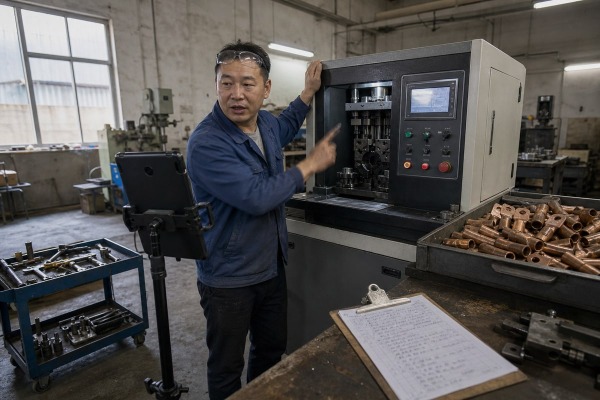
A buyer in Slovakia once told me he could not fly to our Wenzhou workshop. Skipping inspection risked a bad machine. A remote FAT for his [cable lug making machine](https://yqunique.com/?p=5855) solved everything.
To request a remote FAT for a cable lug making machine, book a date with your supplier in advance, ask for their acceptance checklist and Factory Acceptance Test protocol, join a live video meeting, witness each test personally, and require recorded video, photos, and signed documentation.
That is the short answer. Now let me walk you through each stage, step by step, based on how we actually run these sessions for our own customers.
A procurement manager in Mexico once asked me what he should send before his remote FAT. My answer surprised him: preparation decides the result more than the test itself.
Before requesting a remote FAT, prepare your purchase order details, technical specifications, sample cable and lug sizes, acceptance criteria, attendee list, and preferred time zone. Then ask the supplier for their machine validation checklist and full document package at least one week before the session.

The single most important habit I recommend is this: book the time slot early and ask the supplier for their inspection checklist and test items in advance. In our own practice, we send customers the acceptance checklist 1 about a week before the meeting. This gives both sides time to add items, remove items, and agree on acceptance criteria. It also removes surprises. Nobody wants to argue about crimp height tolerance while the camera is rolling.
Equally important: identify the points that are most likely to cause disputes, and settle them with the supplier before the session. Cycle time, dimensional tolerances 2, and scrap rate are the usual suspects on cable lug equipment. Write those numbers down. Get email confirmation. This one habit has prevented more conflict than any camera setup ever will.
Here is the structure I suggest for your request email or WhatsApp message:
| Item to Include | Why It Matters | Example |
|---|---|---|
| Machine name and order number | Links the test to your contract | PO-2024-118, copper lug press line |
| Requested FAT dates and time zone | Avoids scheduling friction | Week of May 12, US Central time |
| Buyer attendee list and roles | Supplier prepares the right experts | Production manager, QC lead, electrician |
| Acceptance criteria and standards | Defines pass and fail before the test | Crimp height ±0.05 mm, cycle time target |
| Materials and lug sizes for the run | Ensures the test reflects your production | 16 mm² copper spade lugs, your drawings |
| Recording requirement | Creates your evidence archive | Full video plus close-up photos |
| Platform preference | Confirms the tech setup works | Zoom, Teams, or a browser-based link |
Also ask about connectivity. A remote FAT lives or dies on bandwidth. We test our factory network before every session, because a pixelated stream during a high-speed cycle proves nothing. Many suppliers, including us, can host sessions that need no software download at all — just a browser link, a microphone, and a stable connection. Confirm technical specification compliance in writing before the meeting, so the session focuses on verification, not negotiation.
Last spring, our team ran a Pre-FAT on a terminal crimping machine two days before the live session. We caught a die alignment issue the buyer never had to see.
Ask the supplier to perform safety tests, electrical cabinet inspection, tooling verification, a live sample run with your specified lug sizes, dimensional checks, crimp quality inspection, cycle time measurement, repeatability tests, and alarm handling — all recorded on video with results logged in the FAT protocol.

A good remote FAT follows a written test plan, not an improvised demo. Insist that your supplier runs an internal Pre-FAT first. This internal run flushes out mechanical and software bugs, so the official session with you is about verification, not repair. We do this on every line that leaves our floor. When the customer joins the call, the machine should already be in a proven state.
Here is the equipment performance verification scope I recommend for a cable lug making machine. Adapt it to your specific line, whether it cuts, forms, presses, or crimps.
| Test Area | What to Watch on Camera | Acceptance Evidence |
|---|---|---|
| Machine ID and configuration | Nameplate, layout matches drawings | Photo of serial plate and stations |
| Safety systems | E-stop press, guard interlock trip | Video of machine halting instantly |
| Electrical cabinet | Wiring neatness, labeling, component brands | Close-up photos against schematics |
| HMI and software | Full menu navigation, parameter entry | Screen recording of key functions |
| Tooling and die setup | Die condition, alignment, changeover | Close-up video at each station |
| Live sample run | Continuous production with your lug sizes | Timed footage of stable output |
| Dimensional checks | Caliper and micrometer readings on camera | Measured values written in the report |
| Crimp and forming quality | Barrel condition, blade flatness, burrs | Macro photos of finished lugs |
| Cycle time and repeatability | Timed batches, consecutive samples | Data logged in the checklist |
| Alarm and fault handling | Simulated jam, recovery procedure | Video of alarm and reset |
Ask how defects will be handled during the stream. The standard flow works like this: you flag an issue, the supplier logs it on the punch list 3, corrects it, and you witness the re-test live. Each item gets marked open or closed. Final sign-off only happens after all critical items are closed. This process is essentially an operational qualification 4 of the machine, witnessed by you in real time. Plan for a long session — a thorough remote FAT on a multi-station line can run around five hours.
There is a real trade-off between camera footage and hard data. In our Wenzhou workshop, we learned early that video alone convinces nobody; video plus numbers convinces everyone.
Verify machine quality remotely through multi-camera live video inspection, real-time PLC data such as crimp pressure, measured sample dimensions shown on calibrated tools, sample shipments for physical checks, recorded test footage, and, if needed, an independent third-party inspection at the supplier’s factory.

Some buyers object that remote testing cannot replace hands-on feel. I understand that concern, and it is partly fair. You cannot touch a crimped copper lug through a screen. But every gap has a practical fix, and the fixes stack up into something very close to an on-site visit.
| Verification Method | What It Proves | How to Request It |
|---|---|---|
| Multi-camera live video inspection | Overall motion plus component detail | One fixed wide camera, one handheld HD camera for close-ups |
| Calibrated measurement on camera | Dimensional accuracy of output | Caliper readings filmed clearly, calibration certificates on file |
| Live PLC or telemetry data | Consistent crimp pressure, stable cycles | Screen share of the HMI or data dashboard during the run |
| Material traceability check | Correct copper grade and heat codes | Coil labels read on camera against material certificates |
| Pre-shipment sample delivery | Tactile and physical quality | Courier finished lug samples before or right after the FAT |
| Third-party inspection | Independent trust layer | Hire a local inspection agency to attend on-site while you watch remotely |
The multi-camera setup matters more than people expect. A fixed wide shot shows machine rhythm and safety behavior. A handheld close-up shows die wear, barrel roundness, and blade surface finish. Ask the supplier’s coordinator to wear a noise-canceling headset so you can give live instructions over the sound of the press.
For the tactile objection, the sample shipment is the honest answer. We often courier finished lugs to customers so they can measure barrel wall thickness and check the flat tongue with their own tools. Combined with recorded footage and live data, this layered approach gives you evidence a single factory visit rarely produces. And if trust is still thin, a third-party inspection bridges the final gap at modest cost.
One shipment dispute taught us a lasting lesson: if a test result is not written down, filmed, and signed, it effectively never happened.
Request the signed FAT report, completed test checklist with measured values, full session video recording, detailed photos, calibration certificates, punch list with closed items, quality assurance documentation, packing list, and a written statement confirming the machine met all acceptance criteria before shipment.

After every remote FAT we run, our team records the details item by item and hands the complete video and photo archive to the customer. I strongly advise you to demand the same. The archive is not a courtesy. It is your legal record of acceptance, your reference during installation, and later, a training resource for your operators.
Ask for these records in a single organized folder, not scattered across chat threads. The completed Factory Acceptance Test protocol should show every test item, the measured value, the acceptance limit, and a pass or fail mark. Vague checkmarks are a red flag. A serious supplier writes actual numbers: crimp height readings, cycle times per batch, sample dimensions from consecutive parts.
The video archive deserves special attention. Request the full unedited session recording, plus separate short clips of critical moments — the emergency stop test, the sample run, each dimensional measurement. Ask for macro photos of finished lugs from multiple angles: the barrel bore, the tongue surface, the transition zone. We photograph each detail one by one because customers thousands of kilometers away deserve the same visibility as someone standing at the machine.
Finally, connect the FAT records to what comes next. Your remote FAT confirms the machine works at the factory. The Site Acceptance Test 5 after installation confirms it works in your plant, with your operators and your material. The FAT documentation becomes your baseline for that comparison. If cycle times or dimensions drift between FAT and SAT, the signed records tell you exactly what changed, and who is responsible for fixing it.
Book early, agree on criteria, demand a written protocol, witness every test live, and keep the full video and document archive. Do that, and remote acceptance becomes genuinely reliable.
