

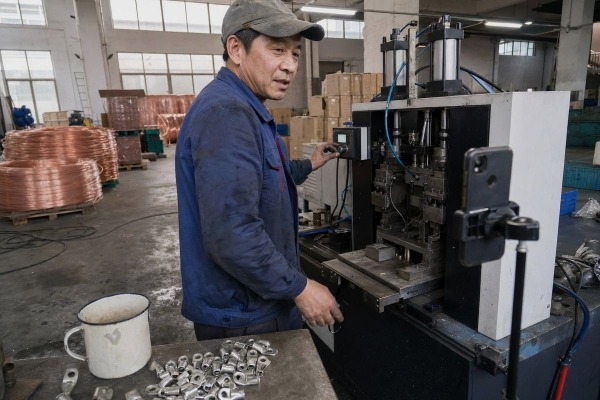
Choosing a [cable lug making machine supplier](https://yqunique.com/?p=5855) looks easy until the “factory” you paid turns out to be a middleman. Our workshop in Wenzhou has fixed machines those buyers received.
To tell if a cable lug making machine supplier in China is a factory or trader, verify the business license scope for manufacturing terms, request a live unannounced video tour of the workshop, test technical depth with engineering questions, and confirm bank details match the licensed entity.
These checks sound simple. But most buyers skip them. Below, I break down each verification step in the order I would use it myself, based on what actually works.
A buyer from Mexico once emailed me a competitor's quote and asked why our price was higher. I asked him one question: did they send you a business license? They had not.
Request the Chinese business license and check the business scope for 生产 (production), 制造 (manufacture), or 加工 (processing). Also ask for VAT invoice samples, ISO 9001 certification, customs export records, and any recent manufacturing facility audit report from SGS, TÜV, or QIMA.

Documents are your first layer of proof. They cost the supplier nothing to provide, so any hesitation here is already a warning sign. The single most reliable document is the business license, because you can verify it yourself on China's official registry.
Every legal Chinese company has a business license (营业执照). The business scope (经营范围) section tells you what the entity is legally registered to do. Sourcing guides consistently identify business license scope 1 as the single most reliable signal. Here is what the wording means:
| Chinese Term | English Meaning | What It Suggests |
|---|---|---|
| 生产 | Production | Factory |
| 制造 | Manufacture | Factory |
| 加工 | Processing | Factory |
| 销售 | Sales | Trader |
| 贸易 | Trade | Trader |
| 批发 | Wholesale | Trader |
| 进出口 | Import/Export | Trader or hybrid |
| 技术咨询 | Technical consulting | Trader or service firm |
Do not stop at the copy they send you. Verify it on the National Enterprise Credit Information Publicity System (GSXT). Match the Chinese legal name, unified credit code, registered address, and company status. Then compare all of that against the quotation, the proforma invoice, and the bank account name. A mismatch between the bank beneficiary and the licensed entity is one of the strongest trader signals there is.
Beyond the license, ask for these:
On GSXT you can also audit the social insurance headcount. A company building terminal production equipment 2 needs registered workers on payroll. A trader often shows fewer than ten.
Visiting the factory in person is the evaluation method I trust most, and I tell every serious buyer the same thing. Our own workshop floor reveals more in ten minutes than a hundred emails.
During a visit or live video call, verify the company name on the gate matches the license, walk from the entrance through active assembly areas, look for work-in-progress machines, raw materials, and testing stations, and ask staff to demonstrate a cable lug machine running on the spot.

Physical evidence is hard to fake in real time. That is why I recommend a confidence ladder: documents first, live video second, third-party manufacturing facility audit third, and an in-person visit at the top. Each rung costs more effort but gives stronger proof.
Insist the on-site inspection video happens live, over WeChat or WhatsApp, with little or no advance notice. A pre-recorded video can come from anywhere. Start the call at the front gate. The company name on the gate sign should match the business license exactly. Then move through the workshop in one continuous shot.
Look for these things:
Ask them to power on a cable lug making machine and crimp or form sample terminals while you watch. When we run these demos for buyers, we feed real copper strip and show the finished ring terminals on camera. A trader cannot improvise that.
Cross-reference the registered address on Baidu Maps or Google Earth. Real factories sit almost exclusively in industrial zones 3 on city outskirts, with workshops and loading areas visible in satellite imagery. Traders typically operate from high-rise commercial office towers in city centers. For higher-value orders, a third-party audit from SGS, TÜV, Bureau Veritas, or QIMA is worth the fee. The auditor physically confirms the equipment list, the production capacity assessment, the workforce, and the quality control standards on site.
| Verification Method | Cost | Reliability | Best For |
|---|---|---|---|
| Address check via satellite maps | Free | Moderate | First screening |
| Live unannounced video tour | Free | High | Every order |
| Third-party facility audit | Paid | Very high | Orders above your risk threshold |
| In-person factory visit | Travel cost | Highest | Long-term partnerships |
Price negotiation is where traders expose themselves fastest. I have watched buyers forward me questions their "factory" could not answer, and the pattern is always the same: sales fluency, technical silence.
Ask who owns the production line, request same-day answers on hydraulic tolerances and PLC logic, ask for monthly output and lead time figures, and confirm whose name appears on the VAT invoice, export documents, and certificates. Traders delay, deflect, or give inconsistent answers.

The negotiation table is a free diagnostic tool. Every question below costs you nothing to ask, but each one forces the other side to reveal whether they control production or merely resell it.
A factory's sales engineer sits meters from the assembly line. A trader's salesperson sits in an office tower. So ask specific engineering questions in real time:
A manufacturer answers instantly and consistently. A trader says they need to "consult the technical department" — which really means calling the actual factory. One delayed answer proves nothing. A pattern of delays proves a lot.
Then move to the commercial side:
| Question | Factory Answer | Trader Answer |
|---|---|---|
| Who owns this production line? | "We do — visit anytime" | Vague or "our partner facility" |
| What is your monthly output? | Specific figure with lead time | Rounded or shifting numbers |
| Whose name is on the VAT invoice? | Matches the license | A different or offshore entity |
| Can you show assembly today on video? | Yes, immediately | Needs scheduling |
| What is your wholesale factory price for 3 units? | Clear tiered pricing | Recalculated after "checking" |
Now, one fair objection: some traders genuinely offer good service, faster quotations, and broader sourcing flexibility than a single factory can. That is real commercial value. But it does not replace legal clarity. If you knowingly buy from a trader, you can price that service in. The danger is paying factory-direct expectations — on warranty, spare parts, and modifications — to a party who controls none of them. Also remember that many Chinese companies are legitimately both manufacturer and trader. The real question is not "pure factory or pure trader" but whether they actually build the specific cable lug making machine you are ordering. Trade assurance protection on platforms helps with payment risk, but it cannot substitute for knowing who really makes your equipment.
Last year a Slovakian client sent us terminal drawings with an unusual barrel geometry. Our engineers redesigned the forming dies, ran samples, and filmed the test — all in-house. That workflow is impossible to fake, and it is my favorite verification test.
Real manufacturers accept your product drawings, modify tooling and dies in-house, produce test samples on their own line, and provide direct engineer-level after-sales support. Traders can only relay requests to a third party, causing slow responses, limited customization, and vague technical answers.

Customization is where the factory-versus-trader distinction stops being paperwork and starts affecting your production line. A trader sells what exists. A manufacturer builds what you need.
Here is the practical test I recommend to every procurement manager. Send your actual cable lug drawing — dimensions, material, plating — and ask three things: Can you adapt the machine for this exact part? What tooling changes are required? Can you run samples and send video proof before I pay the balance?
A genuine builder of OEM ODM services answers with engineering detail: die modifications, feed adjustments, expected cycle rates, and a sample timeline. When we handle these requests in Wenzhou, our R&D technical team responds with marked-up drawings, because the people quoting you are the people who will machine the dies. A trader must forward your drawing to the real factory, wait, and translate the answer back. Every round trip adds days and loses precision.
You can also evaluate this before first contact. Study the supplier's website catalog and ask: do the main products sit within one industry chain? A real cable lug machine factory shows depth in one connected family — terminal production equipment, crimping machines, forming dies, related metal processing machines. Product specialization 4 is a factory signal. A trader's catalog sprawls across unrelated categories: cables, connectors, safety gear, sometimes even packaging machines. If a supplier claims to own "several factories" making wildly different products, you are usually looking at a sourcing network, not an integrated production site.
Finally, probe after-sales structure. Ask who handles installation and commissioning support 5, who stocks spare parts, and whether you can speak directly with an engineer on WhatsApp when a machine faults at 2 a.m. your time. Factories own that chain end to end. Traders rent it, and you feel the difference the first time something breaks.
Verify the business license scope, demand a live workshop tour, test technical depth, and check document consistency. When legal entity, facility, and engineering skill all align, you have found a real factory.
1. Official US government resource for international trade compliance and business verification. ↩︎
2. ISO provides international standards for manufacturing and technical equipment quality. ↩︎
3. UNIDO is the specialized agency of the UN that promotes industrial development and zones. ↩︎
4. The WTO deals with the global rules of trade between nations and product standards. ↩︎
5. The ITC provides resources on international trade services including technical support and commissioning. ↩︎
