

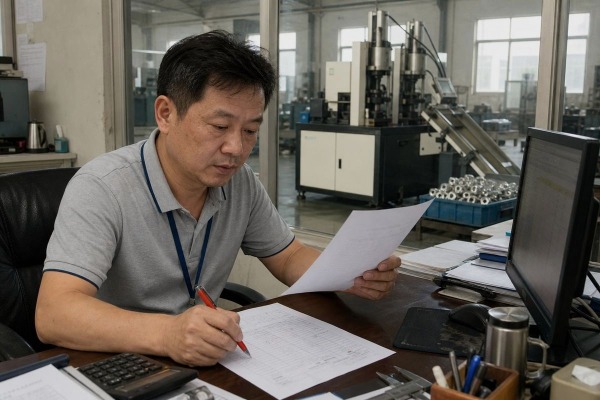
Unusually low [cable lug making machine quotes](https://yqunique.com/?p=5831) land in my inbox comparisons weekly. Buyers forward them to our Wenzhou team asking one thing: is this bargain real, or a trap?
To assess risks behind unusually low cable lug making machine quotes, background-check the supplier, verify factory capability, audit the quote line by line for scope gaps, confirm warranty, delivery, and payment terms, clarify who pays freight and packaging, and demand sample production before paying.
A cheap quote is not automatically a scam. But it always deserves structured scrutiny. Below, I break the assessment into four practical steps you can run before signing anything.
A buyer from Mexico once showed me a quote 30% below ours. It looked complete. Then we read it together and found no die sets, no training, and ex-works pricing only.
Hidden costs in cheap quotes typically include excluded tooling and die sets, ex-works pricing that omits freight and packaging, unlisted installation and commissioning fees, short or missing warranty coverage, paid operator training, and expensive proprietary spare parts billed after purchase.

The first question is never "Is this cheap?" It is "Cheap relative to what scope?" When we prepare quotations for our automated terminal assembly lines, we list every item explicitly. Many low quotes win attention by pricing a bare machine, then recovering profit through add-ons after the deposit clears. That is why I always tell buyers to read the quotation sheet itself with care: check the after-sales period, the warranty duration, the delivery time, and the payment conditions. Then confirm in writing who bears freight and packaging costs, and get written confirmation that no additional surcharges exist.
Landed cost means the total you pay to get a working machine on your floor: machine, tooling, packaging, freight, customs, installation, and training. A quote that looks 20% cheaper ex-works can end up more expensive landed.
| Cost Item | Often Hidden in Cheap Quotes? | Typical Impact |
|---|---|---|
| Die sets and tooling | Yes, listed as "optional" | Machine cannot produce your lug without them |
| Freight and packaging | Yes, ex-works only | 5–15% added to landed cost |
| Installation and commissioning | Frequently excluded | Weeks of delay, travel fees |
| Operator training | Often omitted | Scrap and human error early on |
| Spare parts kit | Rarely included | Emergency freight later |
| Warranty beyond 6 months | Often trimmed | Full repair cost falls on you |
Procurement guidance on abnormally low tenders 1 offers a useful benchmark: a bid more than 15% below the median price deserves formal clarification before acceptance. Apply the same logic here. If one quote sits far below the pack, ask the vendor directly to explain where the cost was removed. A credible supplier can answer. An evasive one just revealed the answer.
Before we ship any custom line from our workshop, we run the buyer's actual lug material through a full sample production. I recommend every buyer demand exactly that — because many low-quote vendors cannot pass it.
Verify real production capability through a supplier factory audit, a witnessed sample run using your actual lug drawings and copper material, documented machine cycle time and tolerance data, recent installation references in your region, and video evidence of the machine producing at rated throughput.

Background-checking the quoting company is the single highest-value step you can take, and it costs almost nothing. Before evaluating any machine, evaluate the factory behind it. Search the company name, check export records, review their Made-in-China or trade platform history, and look at real installation videos on YouTube rather than polished marketing renders.
In our experience exporting to markets like the United States, India, and Canada, serious buyers who follow this sequence filter out most risky quotes within a week. The vendors who refuse sample testing or dodge audit requests eliminate themselves.
The trade-off I weigh on every build is component grade versus price. Hardened tool steel dies cost several times more than soft ones. Buyers never see the difference at delivery — they see it six months later.
Suppliers cut costs by using non-hardened tool steel dies, lightweight frames prone to vibration, low-grade hydraulic and electrical components without brand traceability, no VFD energy control, weak thermal management in cabinets, and outdated controllers that block Industry 4.0 integration.

These downgrades are invisible in a quotation PDF. But each one produces a predictable failure pattern in copper terminal production. Here is where the money usually gets removed, and what it costs you later.
| Cost-Cut Area | What Budget Machines Use | Downstream Consequence |
|---|---|---|
| Punching and shaping dies | Non-hardened, low-grade tool steel | Rapid die wear, deformation, inconsistent lugs |
| Frame structure | Lightweight, thin-wall steel | Micro-vibrations misalign feeding, causing asymmetrical lug geometry |
| Hydraulic system | Undersized pumps, no VFD | Unstable hydraulic crimping force, high idle power draw |
| Control system | Basic relay logic or outdated PLC firmware | Human error in forming stages, no data logging, software lock-in |
| Electrical cabinet | No thermal management | Component overheating, premature circuit failure in high-volume runs |
| Certification | No CE, UL, or IEC compliance | Blocked customs clearance, workplace safety liability |
Inconsistent wall thickness and dimensional tolerance drift are classic symptoms of machines lacking precision-ground stamping dies. A lug with uneven walls creates increased joint resistance after crimping. In the field, that means overheating, weak mechanical strength, and in worst cases burning or short circuits. Your customers experience the failure; your brand absorbs the blame.
Ask which brands supply the PLC control system 4, hydraulic valves, and servo motors. Component brand reliability is verifiable; vague answers like "industrial grade" are not. Ask whether the die material is hardened and heat-treated, and what tooling and die durability the vendor guarantees in production cycles. Ask whether the controller supports data export for monitoring. When we specify our machines, we document component brands on the quotation itself — any serious supplier should be willing to do the same.
A lesson our sales team learned early: disputes almost never come from the machine itself. They come from terms nobody wrote down. So we now insist every commercial condition appears on the quotation before any deposit moves.
Before accepting a low-priced offer, confirm in writing the warranty duration, after-sales response time, delivery date with penalty terms, payment schedule, Incoterms defining who pays freight and packaging, included tooling and training, acceptance criteria, and a clause excluding additional surcharges.

This is where my strongest personal advice applies. Read the quotation sheet carefully and check the after-sales support period, warranty time, delivery schedule, and payment conditions one by one. Then clarify exactly who bears freight and packaging costs, and confirm — in writing — that no additional fees will appear later. Low-quote vendors count on buyers skipping this step.
| Contract Term | What to Confirm | Red Flag |
|---|---|---|
| Warranty | Duration, what parts are covered, who pays return freight | Under 12 months or "wear parts excluded" without a list |
| After-sales support | Response time in hours, remote support channel, on-site option | No committed response time |
| Delivery | Firm ship date, penalty for delay | "Approximately" with no consequence |
| Payment terms | Deposit percentage, balance trigger (pre-shipment inspection is safest) | 100% before production |
| Incoterms | FOB, CIF, or DAP clearly stated | Ex-works with no freight estimate |
| Scope | Dies, spares kit, manuals, training listed as included | Key items marked "optional" |
| Acceptance | Sample-based acceptance criteria with tolerance limits | Acceptance defined only as "machine powers on" |
| Documentation | CE certification standards where required, test reports, parts list | "Certificates available on request" |
The strongest protection is structuring payment around evidence. A reasonable pattern: a deposit to start production, balance released after a witnessed or videoed pre-shipment test run producing your lugs within tolerance. If a vendor resists inspection-linked payment on a machine already priced suspiciously low, you have learned something important about their confidence in the build.
Also confirm spare parts pricing and availability upfront. Minimal after-sales technical support plus unavailable proprietary spare parts is the classic pattern where downtime costs erase every dollar the low quote saved. Total cost of ownership lives in these clauses, not in the headline price.
Price is the first clue, not the verdict. Background-check the supplier, audit the quote scope, test real production, and lock every term in writing before paying anything.
1. Explains international procurement standards for identifying and managing bids that are suspiciously below market value. ↩︎
2. Official resource for researching international markets and verifying the legitimacy of foreign business entities. ↩︎
3. Technical reference for the material properties of high-purity copper used in electrical terminal manufacturing. ↩︎
4. Provides the international standard for quality management systems used to ensure consistency in manufacturing processes. ↩︎
