

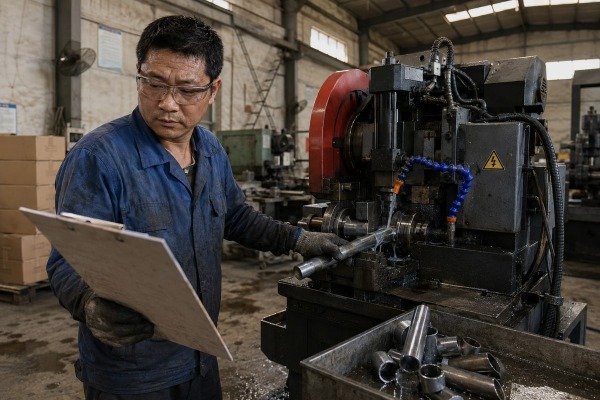
Buying a pipe cutting machine blind is risky. One bad cut can ruin a production run. On our Wenzhou production line, we learned that a sample test prevents expensive mistakes.
To request a sample from a pipe cutting machine supplier, send a written request stating your test purpose, exact pipe specifications, and required cut profile. Ship your real material, ask for a documented test plan, request a full production-style run, and demand recorded data on accuracy, burrs, and cycle time.
A sample can mean three different things. It can be a test cut on your own pipe. It can be a demo part made from equivalent stock. It can also be a full factory acceptance test at the supplier’s plant. This guide walks you through all three, step by step.
Last year, a procurement manager from Ohio messaged us on WhatsApp asking for a sample. We had to ask him twelve questions before we could even load material.
Before requesting a pipe cutting machine sample, prepare your test purpose, pipe outer diameter, wall thickness, material grade, coating, cut type, cutting precision tolerances, burr limits, target cycle time, and daily production volume. Also decide whether the supplier cuts your shipped material or an equivalent stock.

Preparation decides the value of your sample. A vague request gets a vague sample. A precise request gets a real answer about whether the machine fits your job. I always tell buyers to do three things before they write a single email.
First, clarify why you are testing. Are you checking edge quality for downstream welding? Are you verifying throughput for a new contract? Are you comparing CNC pipe cutting technology against your current manual saws? Your purpose defines what data the supplier must record. Without it, the test proves nothing.
Second, write a structured technical specifications sheet. Attach it to your Request for Quote (RFQ) 1 or send it as a standalone sample request document. Include your intended application, required daily volume, and any secondary operations like chamfering or deburring. Here is what we ask every buyer to fill in:
| Specification | Example Entry | Why the Supplier Needs It |
|---|---|---|
| Outer diameter | 25 mm copper tube | Sets clamping and tooling choices |
| Wall thickness | 1.5 mm | Affects blade selection and feed rate |
| Material grade | 304 stainless or C11000 copper | Enables material grade verification |
| Coating or finish | Bare, plated, or painted | Coatings react to heat and clamping |
| Cut type | Square cut, bevel, notch, or miter | Defines the machine configuration |
| Length tolerance | ±0.05 mm | Sets the objective pass-fail line |
| Burr limit | Maximum allowed burr height | Impacts assembly and deburring cost |
| Cycle time target | Pieces per hour | Confirms throughput fit |
Third, provide real sample information from your actual production stock. Descriptions lie; material does not. Shipping your own pipes removes variables and turns the trial into true material compatibility testing 2. If shipping is impossible, ask the supplier to source certified equivalent stock and confirm the grade in writing.
A trade-off sits behind every free sample offer. When we run a custom test cut, our engineers spend hours on programming and fixtures before the first pipe drops.
A standard sample cut on stock material is often free. Custom test cuts on your material usually involve programming fees, setup labor, and international sample shipping costs. Clarify who pays for freight, customs, and returns upfront, and negotiate a sample-to-purchase credit that rebates costs upon ordering.

Many buyers expect every sample to be free. I understand that instinct, but it misses how custom work actually happens. A standard demo part from stock is cheap for the supplier. A custom test cut on your material is engineering labor. It needs programming, fixture setup, trial runs, and inspection time. Serious suppliers treat it as a small project, not a giveaway. That is not a red flag. Refusing to explain the charges is.
Settle the money questions before any material moves. Here is the arrangement we see most often in international deals:
| Cost Item | Typical Arrangement | Negotiation Tip |
|---|---|---|
| Demo cut on supplier stock | Usually free | Ask for it early in the RFQ stage |
| Custom programming and setup | Often charged | Request an itemized fee list |
| Your test material | Buyer supplies it | Ship extra pieces for a full run |
| Sample shipping costs | Buyer usually pays | Use your own courier account |
| Customs duties on returned samples | Buyer covers them | Confirm paperwork and HS codes early |
| Sample-to-purchase credit | Negotiable | Get the rebate promise in writing |
The smartest structure is a sample-to-purchase credit agreement. You pay for programming, material handling, and freight upfront. If you buy the machine, the supplier rebates those costs against the final invoice. We offer this on our own equipment because it filters serious buyers and rewards them fairly.
Also clarify logistics responsibilities in advance. Decide who books international freight, who clears customs, and whether the processed samples return to your facility for inspection. Finally, ask for the sample's production lead times in writing. A supplier who cannot schedule a sample cut will struggle to schedule a machine delivery.
Our QC bench keeps a logbook for every sample run. Each entry records diameter, squareness, burr height, and cycle time, because memory fades but data settles arguments.
Check cut accuracy, squareness, edge finish, burr height, heat-affected zone, and dimensional consistency across a complete multi-piece run, never one cut. Request an unedited full-cycle video, machine data logs for cycle times, a yield report, and written measurement records against your agreed pass-fail tolerances.

Testing is where most buyers go wrong. They admire one shiny cut piece and sign a contract. In my own practice, I insist on a stricter sequence, and I recommend you demand the same from any supplier.
| Checkpoint | What to Measure | Why It Matters |
|---|---|---|
| Length accuracy | Every piece against agreed tolerances | Confirms repeatability |
| Squareness | Cut face versus pipe axis | Affects fitting and welding |
| Burr height | Inner and outer edges | Drives deburring costs |
| Heat-affected zone | Edge hardness or micro analysis | Protects coating and weld quality |
| Cycle time | Data logs, not brochure speeds | Validates real throughput |
| Material yield | Nesting and yield report | Reveals long-term scrap savings |
Years of exporting equipment to the US, Germany, and Japan taught me one lesson: how a supplier handles your sample request predicts how they will handle your machine order.
Evaluate supplier reliability by how they respond: strong suppliers ask technical questions, propose a written test plan, cut your actual material, document results, and offer a factory acceptance test. Weak suppliers send only price quotes, refuse samples, hide costs, or cannot explain their testing process.

The sample process is a low-cost audit of the supplier's engineering culture. Use a simple verification sequence. Send your real specifications. Ask how they would solve the job. Request the sample cut. Then review how they validated the results. Each step exposes something a catalog cannot.
Some buyers object that videos and catalogs already prove capability. They help, and we publish cutting videos on YouTube ourselves. But a polished video shows the supplier's best day. A documented cut on your material, or a witnessed equipment demonstration, shows their ordinary day. The strongest proof remains a factory acceptance test run against your written criteria before shipment.
Watch the response pattern closely:
| Signal | Strong Supplier | Weak Supplier |
|---|---|---|
| First reply | Asks about your downstream workflow | Sends only a price quote |
| Test plan | Written steps, tools, and criteria | Vague promise to run some cuts |
| Sample scope | Full run on your actual material | One polished showcase piece |
| Documentation | Data logs, spec sheets, quality assurance standards | Marketing photos only |
| Cost clarity | Itemized fees and credit terms | Evasive about who pays what |
| Final validation | Offers a factory acceptance test | Avoids any witnessed testing |
Two more red flags deserve attention. First, some suppliers outsource custom engineering but present it as in-house capability; ask directly who programs and builds the fixtures. Second, a supplier who cannot explain their prototype or testing process probably does not have one. In our own quoting process, we send a technical proposal with drawings and questions before any price, because a quote without engineering thought is just a number.
A wrong machine purchase drains budgets and schedules. A structured sample request prevents that. Define your purpose, ship real material, demand full-run data, and let evidence choose your supplier.
Interested in sourcing the products mentioned in this article? See details and request a quote here:
1. Alibaba.com is a major B2B sourcing platform where buyers commonly submit RFQs to equipment suppliers. ↩︎
2. Background on standardized methods for verifying material properties match production requirements before purchase. ↩︎
3. ISO establishes standardized quality benchmarks manufacturers use to define acceptance criteria for tests. ↩︎
4. Explains metallurgical changes from thermal cutting that can weaken welds or coatings on pipes. ↩︎
