

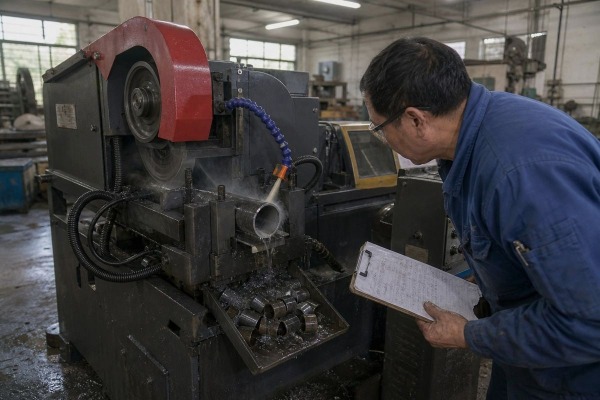
Pipe cutting machine specs confuse many buyers. I see it weekly on our Wenzhou production floor: brochures list twenty numbers, but few explain which ones predict real performance. Pick wrong, and you lose money on rework, missed tolerances, and stalled production lines. The fix is knowing which specs actually matter.
To explain a pipe cutting machine’s performance, focus on pipe diameter capacity, maximum wall thickness, cutting speed, positioning accuracy, repeatability tolerance, motor power, beveling angle range, and the CNC control system. Together, these specs predict processing capacity, precision control, and production efficiency.
Those three pillars—processing capacity, precision control, and production efficiency—are how I evaluate every machine we build or recommend. Let me break each spec down in plain terms.
A German distributor once sent me a spec sheet with thirty fields and asked which ones mattered. My answer fit on a sticky note. Our engineers use the same short list every time.
Before buying a pipe cutting machine, check pipe diameter capacity, maximum wall thickness, cutting method, cutting speed, positioning accuracy, repeatability tolerance, length capacity, loading weight, axis count, and beveling angle range. These ten specs predict throughput, cut quality, and job suitability.

Here is the framework I share with procurement managers. Every spec on a brochure falls into one of five buckets: capacity, precision, speed, automation, and material handling. If you sort the numbers this way, comparison gets easy. You stop drowning in marketing claims and start matching machines to real jobs.
| Spec | Bucket | Why It Matters | Example Ranges from Real Machines |
|---|---|---|---|
| Diameter capacity | Capacity | Defines what pipe sizes fit | 17–90 mm, 20–230 mm, up to 30″–48″ |
| Wall thickness | Capacity | Thin-wall vs heavy-wall ability | Under 15 mm, up to 5–101.6 mm |
| Cutting speed | Speed | Sets throughput ceiling | 50–1150 mm/min, up to 500 ipm |
| Accuracy | Precision | Signals fit-up quality | ±0.1 mm, ±0.05 mm, 0.002″ |
| Repeatability | Precision | Consistency cut after cut | ±0.03 mm, 0.001″ |
| Length capacity | Handling | Production planning | 2,000–6,000 mm tube length |
| Loading weight | Handling | Safe support of heavy pipe | 260 kg to 500 lbs/ft |
| Axis count | Automation | Complex cuts and bevels | 5-, 6-, and 7-axis options |
| Beveling range | Capacity | Weld-prep capability | Bevel cuts up to 45° |
| Motor power | Speed | Sustained cutting force | 5 HP main motors and up |
Notice something important. A machine can score high in one bucket and low in another. A heavy plasma system cutting 48″ pipe may hold looser tolerances than a laser tube cutter handling 230 mm stock at ±0.05 mm. Neither is “better.” One suits shipyard fabrication. The other suits precision furniture tubing. In our export work to the US, Japan, and Germany, the buyers who ask “which bucket matters most for my parts?” always make faster, better decisions than buyers who chase the biggest single number.
One more practical point. Ask suppliers how each spec was measured. Positioning accuracy 1 tested on cold, straight, clean pipe tells you the ceiling. Your shop floor sets the real number.
The trade-off I weigh most often when designing a custom cutter is chuck range versus rigidity. A wider pipe diameter capacity 2 sounds great, but it usually costs you clamping stability at the small end.
Cutting diameter and wall thickness range define the machine’s physical processing capacity. Diameter capacity sets which pipes fit the chuck and rollers, while maximum wall thickness determines whether the machine cuts heavy pipe at full speed or slows down and loses edge quality.

Think of diameter and thickness as the gatekeepers. If your pipe does not fit, nothing else on the spec sheet matters. Published machines cluster into clear tiers. Small-diameter systems handle roughly 17–90 mm. Medium CNC tube machines cover 20–230 mm. Large industrial plasma cutters reach 30″ or even 48″ outside diameter. Wall thickness follows a similar spread: under 15 mm for light tubing systems, 5/8″ to 1″ on heavy pipe plasma rigs, and up to 5–101.6 mm on heavy steel pipe cutters built for thick seamless tube.
Here is what brochures hide. Performance is strongest in the middle of the stated range. At the minimum diameter, clamping gets tricky and thin walls can deform under chuck pressure. At the maximum, the drive motor works hardest and cutting speed drops. When we run acceptance tests at our factory before shipment, we always cut samples at both extremes, not just the comfortable middle. I learned this after an early customer in India ran pipe at the top of the rated range all day, every day, and wear showed up faster than either of us expected.
Material hardness shifts everything. A heavy steel pipe cutter that holds deviation under 0.5 mm on one-circle cutting of thick seamless tube may struggle to keep that number on hardened alloy. Ask for cut samples in your material, at your thickness. That single request has saved our customers more disappointment than any other step.
Last year a US procurement manager asked me a sharp question over WhatsApp: “Your competitor quotes a faster feed rate. Why is your cycle time lower?” The answer changed how he read every spec sheet afterward.
Compare rated motor power, cutting speed in your material and thickness, and full cycle time including loading and clamping. A 5 HP motor with 22–26 cuts per minute often outproduces a faster-feed machine with slow part handling, because throughput depends on the whole cycle.

Speed numbers only mean something in context. Published cutting speeds range widely: 50–1150 mm/min on an auto pipe cutter, 50–762 mm/min on a heavy steel pipe cutter, 500 ipm on an industrial plasma pipe system, and even 350 mpm feed on a saw-based automatic line. A laser tube cutter may quote 100 m/min maximum rapid speed, but that is traverse speed between cuts, not cutting speed through metal. Buyers mix these up constantly, and suppliers rarely correct them.
Cutting speed falls as wall thickness rises. That is physics, not a defect. An auto pipe cutter rated for 5–100 mm thickness will run near the top of its 50–1150 mm/min range on thin wall and near the bottom on thick wall. So never compare two machines’ top speeds. Compare their speeds at your thickness, in your material.
Motor power buys sustained torque under load. A CNC pipe cutter with a 5 HP main motor holding 22–26 cuts per minute all shift is worth more than a higher-peak machine that overheats. On our own production line in Wenzhou, we size motors with headroom for continuous duty, because our export customers in the US and Germany run two shifts and cannot afford thermal derating at hour six. Energy use per cut also deserves a look; a right-sized motor wastes less power than an oversized one loafing.
| What to Compare | Weak Question | Strong Question |
|---|---|---|
| Cutting speed | “What is the max speed?” | “What speed at my wall thickness and material?” |
| Cycle time | “How fast is the cut?” | “What is cuts per minute including load and clamp?” |
| Motor power | “How many HP?” | “What is the continuous duty rating over a full shift?” |
| Energy use | Rarely asked | “What is energy consumption per cut at my settings?” |
The honest trade-off is precision versus throughput. Some machines advertise tight tolerances; others advertise raw speed and capacity. If your parts feed a welding line, fit-up quality wins. If you cut structural stock by the thousand, cycle time wins. Decide which one pays your bills before you compare numbers.
Early in our OEM work, we shipped a semi-automatic cutter to a customer who really needed servo feeding. The machine was fine. The match was wrong. That lesson shaped how we scope every automation project since.
Look for a CNC control system with a smart PLC, servo-driven feeding, automatic clamping, and an automatic loading system for continuous runs. Check positioning accuracy, repeatability tolerance, axis count, and CAD/CAM software compatibility, since automation drives consistency more than any single mechanical spec.

Automation is where precision control and production efficiency finally meet. Manual and semi-automatic machines depend on the operator for every cut. CNC and servo-driven systems repeat the same motion thousands of times without drift. The spec-sheet evidence backs this up. Systems with tight numbers—±0.05 mm positioning accuracy and ±0.03 mm repeatability on a laser tube cutter, or 0.002″ positional accuracy and 0.001″ repeatability on an industrial plasma system—are almost always CNC-controlled and servo-driven. A well-built CNC pipe cutter holding ±0.1 mm tolerance at 22–26 cuts per minute shows what automation buys: speed and precision at the same time.
| Level | Typical Features | Best For | Consistency |
|---|---|---|---|
| Manual | Hand feed, manual clamp | Repairs, one-off cuts | Operator-dependent |
| Semi-automatic | Powered cut, manual load | Small batches, mixed jobs | Moderate |
| Full CNC | Smart PLC, servo feed, auto clamp | Continuous production | High, ±0.1 mm class |
| Multi-axis CNC | 5-, 6-, or 7-axis motion | Bevels, saddles, complex geometry | Highest |
Axis count decides geometry. Three axes handle straight cuts. Five to seven axes add bevel cuts up to 45° and complex profiles, which matters if your parts go straight to welding and need edge prep built in. CAD/CAM software compatibility matters just as much; if the controller cannot import your drawings cleanly, programming time eats your speed gains. For thermal processes like plasma or a fiber laser source, also ask about kerf width and heat-affected zone 4 depth, because tight downstream tolerances can be ruined by a wide kerf or a deep HAZ even when positioning is perfect.
One caution from our side. More automation is not always the right answer. A shop cutting simple stock in modest volumes may get better payback from a solid semi-automatic saw than from a multi-axis system it never fully uses. When we quote a customized solution, we start from the customer’s parts and volumes, then add automation—automatic loading, remote monitoring, servo feeding—only where it shortens cycle time or removes an error source. That is how automation stays an investment instead of a cost.
Spec sheets overwhelm buyers, and a wrong pick costs real money. The escape is simple: judge every pipe cutting machine on processing capacity, precision control, and production efficiency.
Check pipe diameter capacity and maximum wall thickness first, because they gate everything else. Read cutting speed only alongside your material, thickness, and full cycle time. Demand positioning accuracy and repeatability tolerance numbers that match your fit-up needs. Then match the CNC control system 5 and automation level to your actual volumes, not to the fanciest brochure. Ask for cut samples in your own material at both ends of the rated range before you sign anything.
If you want help translating a spec sheet into a real production forecast—or need a customized cutting solution built around your parts—my team and I are happy to walk through your requirements together.
