

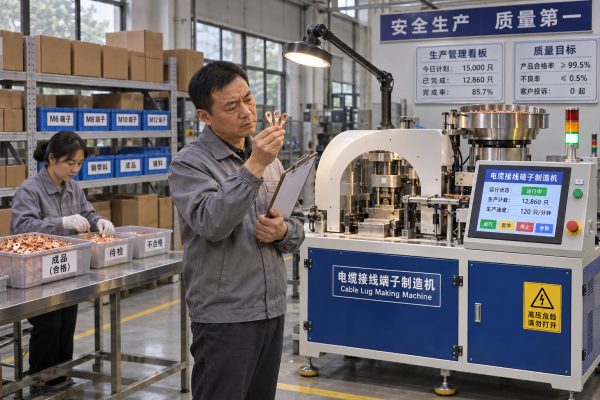
Buying a cable lug making machine looks like a price comparison until the first bad batch lands. I’ve watched that panic from our Wenzhou floor. Let me map the risks.
The major risk points when purchasing a cable lug making machine are capability mismatch, inconsistent crimp quality, exaggerated output, hidden tooling and spare-part costs, unverified suppliers, delivery delays, weak acceptance testing, and vague warranties. Manage them by setting checks at payment, production, acceptance, and transport stages.
A cable lug machine is a production system, not a press. The cheapest invoice is rarely the lowest cost. So I will walk through each risk in the order you meet it: before the contract, during production and shipping, after installation, and when you need customization. At each stage, I will show you what to check and what to demand in writing.
A buyer once sent us only his easiest copper lug for trial. Our engineers asked for the thick aluminum one too. That second sample changed the whole spec.
Before signing, watch for nominal range claims untested on your lugs, missing crimp force repeatability data, no pull-out force measurement, generic die sets, unverified material purity, and an acceptance clause that checks machine movement instead of finished lug quality against IEC 61238-1 or UL 486A.

A catalog that says "10–400 mm²" tells you the frame size. It does not tell you the machine will form your thinnest barrel without collapse and your largest barrel without cracking. On our line, we ask for four lugs before any quote is final: the smallest, the largest, the thickest wall, and the one with the strangest palm or hole. If a supplier only tests the easy one, you should worry.
Material purity verification belongs here too. Electrolytic copper and aluminum differ in hardness, ductility, and oxide behavior. Feed settings and die wear change with the alloy. So ship your real grade, with the real surface finish. Electro-tinning quality control is part of this picture. A plated barrel moves differently in the die than a bare one, and the plating can flake if the forming load is wrong.
"The machine runs" is not acceptance. We write acceptance around the part. That means dimensional checks 1, crimp appearance, crimp force repeatability across a sustained run, and pull-out force measurement 2 on random samples. Name the standard your market needs. IEC 61238-1 compliance covers Europe and most export markets. DIN 46235 governs lug dimensions. UL 486A/486B applies in North America. A generic die set with loose tolerance produces uneven barrel wall thickness. That is a high-resistance joint waiting to overheat in the field. Ask for die drawings and the expected die set service life in writing.
Convert quoted cycle time into good parts per shift. Include loading, die changes, scrap, and planned maintenance. A cycle under five seconds sounds strong, but ask whether it includes handling. Two useful signals from the industry: if your current process rejects more than 1.5% or averages over 45 seconds per lug, more automation is probably justified. Treat those as signals, not laws.
| Stage | What to check | Evidence to demand |
|---|---|---|
| Before deposit | Trial on your actual lugs and material | Measured samples, photos, video of the run |
| During production | Component brands, die alignment, hydraulic pressure stability | Component list with model numbers, progress photos |
| Factory acceptance | Continuous run of at least three hours, sampling per ISO 2859-1 | FAT report with critical, major, minor defect classes |
| Pre-shipment | Tooling complete, documents and software backups ready | Packing list, drawings, parameter backup |
Every quote I write forces a trade-off: promise the fastest date, or promise the date our engineering review supports. We choose the second, and buyers sometimes grumble.
To avoid delivery delays on an overseas cable lug making machine, break lead time into milestones, approve drawings before production starts, freeze specifications, verify the actual factory, tie milestone payments to inspected progress, and write delay remedies plus cancellation rights into the contract.

| Machine type | Indicative lead time | Why it takes longer |
|---|---|---|
| Standard semi-automatic | 15–30 days | Stock frames and common components |
| Automated with feeder and PLC | 25–50 days | Servo tuning, PLC programming, vibratory bowl 3 setup |
| Customized or non-standard | 60 days or more | Engineering review, custom dies, extended FAT |
These are benchmarks, not guarantees. Be suspicious when a supplier quotes the same date for all three. When we build a non-standard feeder for an odd lug geometry, the drawing approval alone can take two rounds with the buyer.
This is the approach I use on every export order, whether it ships to Germany or to India.
Unapproved drawings, late custom tooling, component shortages, power restrictions, shipping-document errors 4, and a failed FAT. Most of these are visible early if you are checking weekly. So define in the contract exactly when the lead time clock starts. Our standard is after both deposit and drawing approval. Add a written delay remedy and a cancellation right for extended delays. Without those, a late ship date is just a disappointment, not a lever.
On WhatsApp, a procurement manager from Mexico asked me why our quote listed a two-year consumables pack. His cheaper quote had none. That difference was the hidden cost.
Hidden after-sales costs include dies and tooling excluded from the quote, proprietary parts with long lead times, warranties that start at shipment instead of site acceptance, chargeable technician travel, missing software backups, and downtime from unstocked PLC or hydraulic spares. Request a priced spare-parts list upfront.

| Category | Examples | Risk to your line |
|---|---|---|
| Consumables | Hydraulic seals, filters, die inserts | Low cost, frequent replacement |
| Stocked spares | Proximity sensors, relays, solenoid valves, feeder coils | Cheap, but one missing part stops production |
| Repairable components | Pumps, cylinders, vibratory feeder drives | Need skilled repair and a clear procedure |
| Long-lead electronics | PLC CPU, servo drive, HMI touchscreen | Weeks to source if obsolete or proprietary |
Ask for a commissioning spares kit, a two-year consumables list, critical electronic spares, extra dies and wear parts, and part numbers with prices and stock locations. Fix die and spare-part pricing for an initial period. A proprietary die that only one factory can grind will cost you more over five years than a slightly higher machine price today.
"One-year warranty" sounds clear. It is not. A warranty that starts at shipment can lose three months to sea freight, customs, and installation. A warranty that starts at successful site acceptance keeps the full twelve months for real production. Our contracts name the covered components: hydraulics, motors, controllers, sensors. They also state remote-support hours, response time, who pays freight on replacement parts, and when on-site service applies. After-sales technical support is only useful if the supplier can read your fault remotely. That depends on PLC logging granularity. A controller that logs cycle counts, pressure, and error codes lets our engineers diagnose a problem before anyone books a flight.
Total cost of ownership equals machine price plus tooling, spares, energy, labor, training, scrap, and downtime. Downtime is the term buyers forget. One stoppage of several days while waiting for a servo drive can erase the entire saving on a cheaper machine. Hydraulic pressure stability also feeds this calculation. Unstable pressure shortens seal life, increases crimp variation 5, and raises scrap. So when you compare two quotes, compare the full line, not the invoice.
Years ago I learned that a glossy catalog says nothing about engineering depth. The real test is whether a supplier can redraw your feeder for an odd lug shape.
Verify OEM/ODM capability by requesting custom machine drawings and past non-standard projects, auditing the factory that will actually build your machine, matching business license, quotation, invoice and bank beneficiary, running trials on your materials, and confirming in writing that you own custom tooling and programs.

A real company can still lack the engineering to build a demanding machine. So I separate the two checks.
| Legitimacy check | Capability check |
|---|---|
| Business license matches the quotation, pro forma invoice, and bank beneficiary | Engineers can explain component brands, model numbers, and lead times |
| Factory inspection is welcomed, not refused | Drawings of past non-standard projects are shared |
| References from recent installations are offered | A documented sample-testing process exists |
| No undisclosed subcontractors | Written acceptance criteria are proposed before you ask |
Mismatched company names across documents and unrelated bank accounts are red flags. So is a refusal of inspection. Our Wenzhou team is ten people, and I say that openly. A small team with real engineers who answer technical questions on a video call will serve you better than a large trading office that forwards your drawings to an unknown workshop.
Automation is a fit decision. A high-volume single-product line may justify a fully automatic machine with a vibratory bowl, signal tower, and touchscreen recipes. A low-volume shop with many lug variants may be better served by flexible tooling and fast manual changeover. Ask concrete questions. How long is a changeover? Which settings are stored digitally? Can operators change recipes without calling you? What does the machine do on a misfeed? Can it restart safely after a jam? Servo feeder precision matters across the whole size range, not just the demo part. Hydraulic systems offer high force for heavy lugs. Servo-electric systems offer precision and programmability. Neither is automatically better. Our engineers design the configuration to match your product mix and volume, and we will tell you when automation is not worth it.
Custom tooling, PLC programs, recipes, and drawings must have a named owner in the contract. That owner should be you. Also list the deliverables: approved drawings, electrical and hydraulic schematics, parts lists, software backups, HMI passwords, maintenance schedules, troubleshooting guides, and training records. A supplier who hesitates on any of these is telling you how the relationship will go after payment.
A cheap cable lug making machine can cost you a production line. Set checks at payment, production, acceptance, and transport, and only buy what is proven on your own lugs.
1. Homepage of the International Organization for Standardization, providing global benchmarks for industrial dimensional inspection. ↩︎
2. Official site for the IEC, which establishes international standards for cable lug pull-out force testing. ↩︎
3. Wikipedia entry describing the mechanics and industrial use of vibratory bowl feeders in automation. ↩︎
4. U.S. government portal for international trade, providing guidance on avoiding common shipping documentation mistakes. ↩︎
5. Professional technical organization providing research on electrical connector reliability and crimping process variations. ↩︎
