

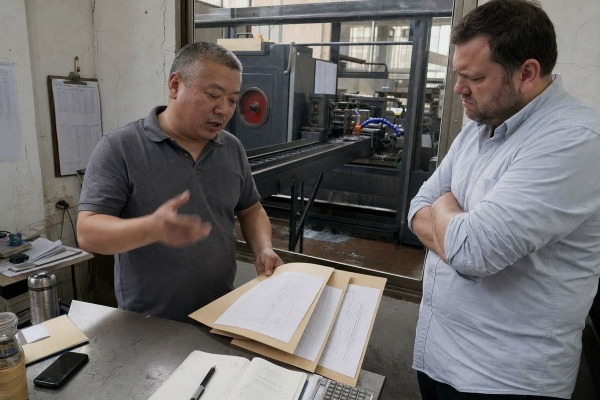
Verifying a fully automatic pipe cutting machine supplier is risky when you only see photos. Our Wenzhou workshop hosts buyers who were burned before finding us. One badge is never enough.
To verify a fully automatic pipe cutting machine supplier via third-party channels, layer four checks: confirm the business license and legal identity, validate ISO 9001 and CE certificates in public databases, commission an independent factory audit, and order a pre-shipment inspection with a live cutting trial.
Each layer proves something different. Below, I walk through all four steps in the order I recommend buyers follow, based on the questions our own overseas customers ask us.
A German buyer once asked me to email our registration documents before our first video call. I respected that. We now prepare a verification pack for every serious inquiry.
Check the supplier's business license through China's official National Enterprise Credit Information System or a paid credit report, then confirm the registered company name, address, and export scope match the entity on the quotation. Verify ISO 9001 certificates via IAF CertSearch or the registrar's public database.

The core question you are answering here is simple: does the legal entity selling you the machine actually exist, and do its papers match its claims? Business license verification is the cheapest check you can run, and it filters out the worst offenders in minutes.
A Chinese business license shows the registered name, the legal representative, the registered capital, the business scope 1, and the registered address. Compare every field against the proforma invoice. If the company on the invoice is different from the company on the certificate, stop and ask why. Sometimes a trading company borrows a factory’s documents. That mismatch is the single most common trick in machinery sourcing.
Also run an export license check. A real exporter has customs registration. If the seller asks you to wire money to a personal account or an unrelated third company, that is a hard red flag.
Scanned certificates are easy to fake or copy. Certification verification is now database-driven, and you should use public directories instead of trusting a PDF attachment.
| Document | Where to verify | What to confirm |
|---|---|---|
| ISO 9001 certification | IAF CertSearch 2 or the registrar's own database | Certificate number, accreditation body, expiry date, scope |
| CE Declaration of Conformity | Notified-body database (where applicable) | Notified-body number, product model coverage |
| Business license | Official government enterprise credit system | Legal name, address, business scope, status |
| Export registration | Customs records or credit bureaus like Dun & Bradstreet | Export scope, operational history, solvency |
One subtle trap deserves emphasis: a certificate can be genuine yet still not cover the exact machine model or factory site you are buying from. Always confirm the certificate scope names the actual production address and covers metal-cutting machinery, not just an unrelated product line.
There is a trade-off we weigh with every buyer: a platform badge is fast and cheap, while an independent audit is slower but far more conclusive. We recommend using both.
Trust established firms like SGS, TÜV Rheinland, Bureau Veritas, or Intertek for on-site verification, and use B2B platform audit reports from Made-in-China or Alibaba as a first screen. Platform badges filter fraud; independent inspection firms prove real production capability.

Not all third-party channels prove the same thing. I break them into three tiers, from weakest to strongest evidence.
Marketplaces label listings as "audited supplier" or "verified business license." Some, like Alibaba's Verified Supplier or Gold Plus programs, include on-site videos and financial background checks. Trade assurance programs add payment protection on top. These labels are genuinely useful as a screening signal. But here is the objection skeptical buyers raise, and they are right to raise it: badges can be outdated, incomplete, or too generic to prove the supplier can build the specific fully automatic pipe cutting machine you need. Treat them as a starting point, then cross-check independently.
SGS inspection services, TÜV Rheinland verified supplier programs, Bureau Veritas 3, and Intertek all offer standardized factory audit report packages. They check business registration, manufacturing status, machinery inventory, workforce size, and the quality management system on-site. Crucially, they confirm the audited site matches the address on the certificates and the business registration.
Virtual factory tours and live-streamed video audits have become standard for overseas machinery sourcing. We run them regularly from our Wenzhou floor. Ask the inspector to walk the line unscripted, film the CNC cutting cell, and zoom in on nameplates and serial numbers in real time.
| Channel | Cost | Evidence strength | Best used for |
|---|---|---|---|
| Platform badge / trade assurance | Free | Low–medium | Initial screening |
| Virtual live audit | Low | Medium | Quick capability check |
| SGS / TÜV / BV on-site audit | Medium | High | Pre-order due diligence |
| Pre-shipment inspection | Medium | High | Final quality gate |
A US procurement manager once messaged me on WhatsApp: "Your reviews look fine, but reviews can be bought. Show me shipments." That conversation changed how we present evidence.
Confirm export history through third-party trade intelligence platforms that analyze customs and bill of lading data, then cross-reference claimed customers and export destinations. Treat marketplace reviews as supporting evidence only, since ratings and testimonials can be manipulated or selectively displayed.

Reviews are the weakest form of proof in supply chain due diligence. Shipment records are the strongest. Here is how I suggest working from weak evidence toward hard evidence.
Trade intelligence platforms compile global customs records. Search the supplier's exact legal name. You want three things: export frequency, shipment volume over time, and destinations that match the supplier's claims. If a company says it ships to the United States, Germany, and Japan every quarter, the data should show it. Our own export map covers the United States, Japan, Germany, India, South Korea, Italy, Mexico, and France, and I encourage buyers to check that claim against records rather than take my word.
A supplier with zero export records under its own name may still be legitimate. Some ship through an export agent. But that explanation should come with the agent's name and documentation, not excuses.
Ask for two or three reference customers in your region, ideally repeat buyers. Long-term repeat business is far harder to fake than a five-star review. When you contact a reference, ask specific questions: delivery timeline versus promise, cutting accuracy after six months, and after-sales response speed. Also run a financial background check through an international credit bureau 4 like Dun & Bradstreet to confirm operational history and solvency, because a technically capable factory that is insolvent is still a delivery risk.
Finally, connect the dots. The export destinations, the references, and the credit report should all tell the same story. Contradictions between them matter more than any single data point.
Early on, we learned a hard lesson: a buyer's inspector arrived with a generic checklist and missed the points that mattered. Now we help buyers write machine-specific audit scopes.
Instruct the inspector to verify manufacturer status, production capacity, and the quality management system; witness a live fully automatic cutting cycle; audit critical components like PLCs and servo motors for genuine brands; and confirm the factory address matches all certificates and registration records.

A generic factory audit answers generic questions. For a fully automatic pipe cutting machine, you need a scope written around the machine itself. These are the four questions every audit should resolve: Is this the actual manufacturer? Is there real production capacity? Is the export experience genuine? Is the quality system reliable? I structure the inspector's brief around exactly those four.
Two newer checks are worth adding for automated machinery. First, if the machine has Industry 4.0 connectivity, commission a cybersecurity assessment of its remote diagnostic ports so they do not open vulnerabilities in your plant network. Second, have the third party independently contact the supplier's claimed local service partners and test their responsiveness. A pre-shipment inspection should then close the loop by checking dimensions, cutting accuracy, safety guards, packaging, and serial numbers before the machine leaves the factory.
| Audit item | What it proves | Failure signal |
|---|---|---|
| Shop floor walkthrough | Real manufacturer, not a trader | No machining equipment on-site |
| Live automatic cutting cycle | Performance claims are real | Manual intervention mid-cycle |
| PLC and servo nameplate check | Genuine critical components | Unbranded or relabeled parts |
| QC records review | Working quality management system | Blank or backdated logs |
| Address cross-match | Certificates cover this site | Different address on documents |
One badge proves little. One certificate proves little. Layer identity checks, database verification, factory audits, and pre-shipment inspection, and a dishonest supplier has nowhere left to hide.
1. U.S. government resource providing guidance on verifying international business licenses and trade compliance. ↩︎
2. Official global database for verifying the validity of ISO management system certifications. ↩︎
3. Global leader in testing, inspection, and certification services for manufacturing and supply chains. ↩︎
4. Authoritative source for global business data, credit reports, and company risk assessments. ↩︎
