

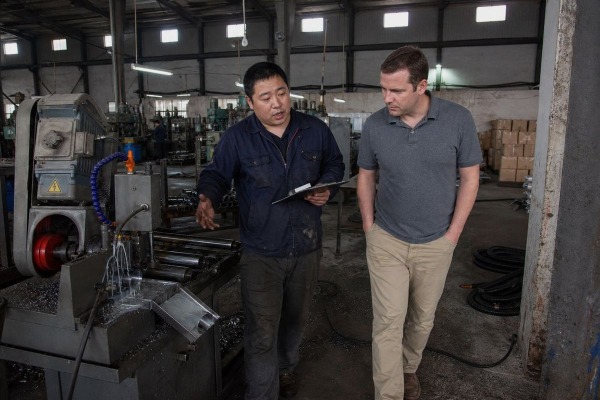
Verifying a pipe cutting machine supplier’s factory qualifications sounds simple until a “factory direct” seller misses your deadline CE compliance documentation 1. On our own production line in Wenzhou, I’ve seen why buyers get burned.
To verify a pipe cutting machine supplier’s factory qualifications and capacity, request the business license, ISO 9001 certification, and export license verification; audit the production floor on-site or by live video; review the manufacturing equipment list, output records, and quality control process documents before ordering.
That is the short answer. Below, I break it into four practical steps you can follow before signing any purchase order. Each step includes documents to request, questions to ask, and red flags to watch.
A German buyer once asked me for eleven separate documents before his first order. I sent all of them within two days. That exchange taught me which papers actually matter.
Request the business license, tax registration, export license verification, ISO 9001 certification, CE compliance documentation, a manufacturing equipment list, and sample third-party inspection reports. Then verify each certificate directly through the issuing body's online database to confirm it is authentic, current, and covers pipe cutting machinery.

Documents are your first filter. They separate a legal manufacturer from a trading company before you spend money on travel or third-party audits. But documents only work if you check them properly, not just collect them.
Here is the document set I recommend every buyer request. This matches what professional supplier qualification audits review: factory profile, licenses, certificates, production lines, and equipment records.
| Document | What It Proves | How to Verify It |
|---|---|---|
| Business license | Legal registration and scope | Check the national registry; confirm "manufacturing" is in the scope |
| Export license verification | Right to export directly | Cross-check with customs records or ask for past export declarations |
| ISO 9001 certification | A documented quality management system | Search the certificate number in the issuing body's online database |
| CE compliance standards documents | Machine safety for the EU market | Confirm the certificate covers the exact machine model, not a general category |
| Manufacturing equipment list | Real in-house production capability | Match it against photos, video, or an on-site factory audit |
| Organization chart | Engineering depth and an R&D technical team | Ask to speak with a named engineer, not only sales staff |
Some buyers stop at the certificate stage. I understand the temptation, but this is a mistake. A certificate confirms a management system exists on paper. It does not prove the factory can build your pipe cutting machine consistently or at scale. Intertek's supplier verification framework treats legal entity review, ISO 9001 verification 2, and supply-chain capacity verification as separate checks for exactly this reason. When we prepare documentation for our own overseas clients, we always attach real inspection records and procedures behind the certificate. If a supplier hands you a certificate but cannot show the working procedures, calibration records, or inspection data behind it, treat that as a warning sign. Also confirm the factory address on the license matches the actual operating site. Trading companies often borrow certificates from partner factories, and an address mismatch exposes this quickly.
The trade-off I weigh most often with new clients is speed versus proof. A buyer wants machines fast; I want him to see evidence first, because rushed capacity claims cause the worst delays.
Verify production capacity by reviewing the number of active assembly bays, CNC machining centers, and specialized engineers; requesting daily output records and recent order history; confirming which processes run in-house; and comparing quoted production lead time against realistic norms for custom industrial equipment.

Capacity is where suppliers exaggerate most. The three questions I tell every buyer to answer are simple: does this company really produce, can it deliver continuously, and can it guarantee quality across a whole batch of equipment? Those three questions drive everything below.
Many buyers count machines and workers, then assume capacity. Modern auditors reject this shortcut. Real annual production capacity depends on equipment uptime, maintenance condition, labor skill, workflow, material availability, and rework rates. A factory with ten aging CNC centers and no maintenance records may produce less than one with five well-kept machines and disciplined planning.
| Evidence Type | What to Request | What It Tells You |
|---|---|---|
| Output records | Daily or monthly production logs | Actual throughput, not brochure numbers |
| Order history | Recent packing lists or shipping records | Proof of continuous delivery to real customers |
| Workload transparency | Current backlog and scheduling plan | Whether your order fits without hidden delays |
| Equipment condition | Machine models, age, maintenance logs | Uptime reliability behind the equipment list |
| Staffing | Headcount of technical engineers and assemblers | Skill depth, not just body count |
Watch for vague statements like "we make 100 sets monthly" with no supporting records. Watch for a production lead time that is unrealistically short compared with custom industrial equipment 3 norms. And ask directly: which steps are subcontracted? Hidden outsourcing is a major risk. If key parts or whole assemblies go to undisclosed subcontractors, your supply chain reliability depends on companies you have never evaluated. In our own quoting process, we state clearly which components we source externally and from which approved suppliers. Also check the Tier 2 supply chain: critical components like servo motors and control systems should come from reputable brands, and they should not be subject to regional trade sanctions if you export to sensitive markets.
Last year, an American procurement manager asked us for a live, unscripted video walkthrough before he would discuss pricing. We walked the floor with a phone camera for forty minutes. He placed the order the following week.
During an on-site factory audit or video inspection, verify the production floor size versus showroom space, watch core processes like machining, welding, and electrical assembly in progress, inspect test areas and calibrated instruments, and confirm the address matches the registered legal entity.

An audit turns paper claims into physical evidence. More buyers now expect third-party supplier audits 4 rather than relying on website claims, and firms like SGS or TÜV can inspect production lines, assembly precision, and quality checkpoints on your behalf. But you can also learn a lot yourself, remotely or in person.
Follow this order during any inspection, whether on-site or over video:
Remote verification works best as a screening tool. Insist the video is live and unscripted, not pre-recorded. Some buyers now request AR-assisted glasses walkthroughs to inspect real-time production status and specific machine tolerances without traveling. That is a reasonable ask. During the walkthrough, direct the camera yourself: ask the guide to open a control cabinet, show a nameplate, or zoom in on a serial number. A genuine factory complies easily. A polished showroom with a strong sales team means little if the production floor behind it is small, quiet, or off-limits. For serious capital purchases, follow a good remote screening with an on-site factory audit or an independent third-party inspection report before final payment.
Early in our export business, a Japanese client rejected a shipment over a tolerance issue we thought was minor. That lesson reshaped how we document every inspection stage, and it taught me what serious buyers check.
Confirm the quality control process by reviewing documented IQC protocols for incoming materials, in-process inspection checkpoints, final machine calibration procedures, calibration records for measuring instruments, sample FAT reports, and defect-handling records. Cross-check these documents against what you observe during the audit.

Quality control is where batch consistency is won or lost. One good sample machine proves little. What you need is evidence that the tenth and fiftieth machines will match the first.
A credible quality control process for pipe cutting machines covers three stages. Ask for written procedures and real records at each one.
| QC Stage | What Happens | Evidence to Request |
|---|---|---|
| Incoming inspection (IQC) | Raw materials and purchased components are checked against specs | IQC protocols, supplier approval list, rejection records |
| In-process checks | Machining tolerances, weld quality, and wiring are verified during build | Inspection checklists, operator sign-offs, rework logs |
| Final inspection and FAT | The complete machine is calibrated and test-run before shipping | FAT records, cut-sample measurements, commissioning documents |
Buyers today pay more attention to traceability and documented controls than to raw production volume. Ask two pointed questions. First: can the factory trace a finished machine back to its component batches? Second: are the measuring tools themselves calibrated? Calibration records for micrometers, gauges, and test instruments are easy for a real factory to show and nearly impossible for a fake one to invent on the spot. In our workshop, every measuring tool carries a calibration label, because our smart PLC-controlled equipment must hold precision through continuous production.
Also test the after-sales side, since QC extends past shipment. Ask about installation support, operator training, spare parts inventory, and response times. A supplier with real after-sales service support and an R&D technical team can fix problems fast; a trading company usually cannot. Finally, request reference customers and completed installation cases in your material type and volume range. If your market requires it, also ask about workplace safety, social compliance, and even energy efficiency documentation, as ESG procurement standards increasingly reach industrial equipment buying.
Verifying a pipe cutting machine supplier means checking legal identity, manufacturing capability, and real capacity together. Combine document review, audits, and QC evidence, and treat qualification as ongoing risk management.
1. Official European Commission guide on CE marking requirements for machinery and products sold in the EU. ↩︎
2. Official ISO page defining the 9001 standard for quality management systems and its verification requirements. ↩︎
3. Federal program providing resources for manufacturing excellence, supply chain management, and industrial equipment standards. ↩︎
4. U.S. government resource providing guidance on performing due diligence and verifying international business partners. ↩︎
