

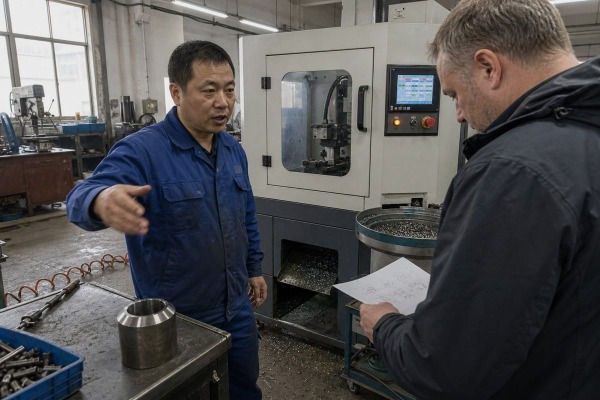
Choosing the wrong chamfering machine supplier costs European pipe fittings makers months of rework. I have seen buyers learn this the hard way on our factory floor in Wenzhou.
A supplier who understands the European pipe fittings industry asks about fitting type, EN standards, material grades, and tolerances before quoting. They discuss CE certification compliance, offer drawing-based customization, provide sample application cases, and let you speak directly with their engineers.
That is the short answer. But how do you actually test a supplier before you send money? Let me walk you through the checks I recommend, one section at a time.
Last year, a Slovak buyer asked our team one question before anything else: "Is your machine CE-ready?" That single question told me he had been burned before.
Look for CE marking under the EU Machinery Directive (2006/42/EC), a signed Declaration of Conformity, and evidence of interlocked guarding, dual-channel emergency stops, and compliant electrical systems. Also check whether motors meet the EU Ecodesign Directive (2009/125/EC) for energy efficiency.

Certifications sound like paperwork. In reality, they are the fastest filter you have. A chamfering machine supplier who cannot explain CE certification compliance 1 in plain terms has probably never shipped into the European Economic Area. When we prepared our first automated pipe processing line for a customer in Serbia, we learned that European customs and factory inspectors do not negotiate on this point. The machine either carries a valid CE mark with supporting technical documentation, or it does not run legally.
Here is a distinction many buyers miss. There are two layers of compliance, and a knowledgeable supplier separates them clearly.
| Compliance Layer | What It Covers | Key References |
|---|---|---|
| Machine compliance | Safety, market access, legal operation | Machinery Directive 2006/42/EC, CE marking |
| Part/fitting compliance | Whether the chamfered pipe end meets the drawing | EN 10253, EN 10216, EN 10255, DIN standard fittings |
| Energy compliance | Motor efficiency and running cost | Ecodesign Directive 2009/125/EC |
Machine compliance gets the equipment through the door. Part compliance is what keeps your customers happy. A supplier who only talks about one of these does not see the full picture.
Ask specifically about interlocked guarding 2 on access doors, dual-channel emergency stops, and electronic motor braking. On our own machines, the hinged cabinet doors carry keyed locks and transparent viewing windows precisely because European buyers expect operators to see the tooling without opening a live enclosure. A supplier who has never fielded these questions will hesitate. One who exports regularly will answer without pausing.
Also ask about documentation. Localized technical manuals, exploded views, and a spare parts logistics plan for Europe are strong signals. So is a design philosophy built on standardized, non-proprietary components — the "Right to Repair" approach — which lets your maintenance team stay independent for the machine's whole service life.
Whenever a serious buyer visits our workshop, I do the same thing: I open the sample cabinet. Real parts tell the truth faster than any brochure ever can.
Ask to see physical sample parts and their application cases, then speak directly with the supplier's engineers. Test their knowledge of EN 10253 fittings, EN 10216 pressure pipes, DN versus NPS sizing, and stainless grades like 1.4301 and 1.4404.

This is my strongest personal advice, and it comes from years of watching buyers get it right or wrong. Look at the supplier's sample cabinet products first. Then ask about the application case behind each sample. Who was it made for? What fitting family? What tolerance? A supplier with real experience in butt-welding fitting production 3 can tell you the story behind every part on the shelf. A trader cannot.
The second step matters just as much: communicate with the supplier's professional engineers, not only the sales contact. Sales staff repeat catalog language. Engineers reveal depth. When our engineers discuss pipe end preparation with a European customer, the conversation naturally covers weld prep angles, land width, and end-face squareness — because those details determine whether the fitting seals or leaks.
Use this short test in your first call or email. Any supplier claiming European experience should pass it easily.
| What You Ask | What a Real Expert Says | What a Generic Seller Says |
|---|---|---|
| "Which standard covers butt-welding fittings?" | EN 10253, with the relevant type and testing category | "We can chamfer any pipe" |
| "What about DN65 outside diameter?" | Explains the 73 mm vs. 76 mm overlap between systems | Gives one number or avoids the question |
| "Can you machine 1.4404?" | Discusses work hardening, tool selection, and feed rates for 316L | "Yes, stainless is fine" |
| "Do you know EN 10255?" | Identifies it as the standard for threaded steel tubes | Silence or a vague answer |
The Nominal Diameter versus Nominal Pipe Size discrepancy trips up suppliers who have only served one regional market. DN65 fittings can arrive at 73 mm or 76 mm outside diameter depending on the system in use. If a supplier's clamping tooling and CNC pipe beveling technology 4 cannot handle that overlap, you will discover it on your production floor — at the worst possible moment. In my experience, suppliers who raise this issue themselves, unprompted, are the ones who have genuinely processed European work before.
The best inquiry I received last quarter opened with a drawing, an annual volume figure, and a target cycle time. I knew instantly that buyer understood machines — and I answer such buyers differently.
Ask what information they need before quoting. A knowledgeable supplier requests your fitting type, drawings, material, wall thickness, tolerances, batch size, and target cycle time. If they quote from motor power and price alone, they do not understand your process.

Here is the uncomfortable truth: the questions a supplier asks you matter more than the answers they give you. When a customer sends us an inquiry about pipe end preparation, our first response is always a list of questions. What fitting family — compression, hydraulic, pneumatic, or welded? What material and hardness? What is the annual volume? Suppliers who skip this step are guessing, and you will pay for their guesses.
Run your candidate suppliers through this checklist. Score them honestly.
A supplier scoring six or more is thinking about your process. A supplier scoring two or three is selling a box.
European buyers rarely ask "can the machine chamfer?" They ask whether it holds a repeatable chamfer angle, face width, and end-face quality across a full production run. This is where I push back on a common objection: some buyers assume a faster spindle means better output. It does not. On our equipment, we spend far more engineering time on ball-screw drives, linear guides, and rigid clamping than on headline speed, because repeatability is what keeps a batch of ten thousand fittings inside tolerance. If bevel geometry drifts, welds built to Eurocode 3 (EN 1993) structural requirements can fail inspection — and that cost lands on you, not the machine seller.
A Mexican customer once sent us a fitting drawing that no catalog machine could handle. Our engineers redesigned the clamping and tooling around it. That project taught me what customization really demands.
Test their engineering process, not their promises. A capable supplier reviews your drawings, proposes custom tooling solutions, confirms diameter and material range, runs sample testing on your actual parts, and provides technical after-sales support with commissioning help — before you commit.

Customization is where the European pipe fittings industry differs most from general pipe machining. Fittings work involves customer drawings, special geometries, and application-specific tolerances. Catalog machines rarely fit perfectly. In our OEM and ODM projects, the process always starts with the customer's product drawing and production flow, not with our machine list. That order matters. A supplier who solves your process is worth more than one who sells you a machine and disappears.
| Stage | What the Supplier Should Do | Red Flag If Missing |
|---|---|---|
| Inquiry | Request drawings, material, tolerances, volume | Quotes instantly from a price list |
| Engineering | Propose tooling, fixtures, and cycle time for your part | Offers only standard models |
| Sample testing | Chamfer your actual parts and send them back with measurements | Refuses to run samples |
| Delivery | Provide manuals, exploded views, spare parts plan | No documentation for Europe |
| After-sales | Remote commissioning support, responsive engineers | Slow or absent technical response |
Check the honest capability envelope. Some suppliers position their pipe chamfering machines for tube outside diameters from 6 mm to 200 mm across steel, stainless, copper, and aluminium alloys. OEM fitting makers, meanwhile, describe specialized solutions up to 168.3 mm (DN 150). If your parts sit near the edge of a supplier's range, demand sample proof, not assurances.
Also probe how they think about the process chain. The industry trend is moving toward integrated cutting 5, chamfering, beveling, and end-facing workflows in one machine family, plus feeding automation. Our machines pair with vibratory bowl feeders for exactly this reason: unattended loading turns a chamfering step into part of a line, cutting labor cost and handling damage. A supplier with true industry understanding will talk about DIN standard fittings, downstream assembly, and line integration — not just the machine standing alone.
A qualified chamfering machine supplier sells outcomes, not horsepower. Check certifications, inspect sample cabinets, question their engineers, and demand sample testing. Get this wrong, and every fitting you ship carries the risk.
1. Official European Commission portal detailing legal requirements for CE marking and safety compliance under the Machinery Directive. ↩︎
2. European Union agency responsible for providing technical information and guidance on workplace safety and machinery guarding standards. ↩︎
3. Official European organization responsible for developing technical standards for industrial components, including butt-welding pipe fittings. ↩︎
4. Global federation of national standards bodies providing international specifications for CNC machinery and industrial manufacturing technologies. ↩︎
5. World’s largest technical professional organization dedicated to advancing technology and automation standards in industrial manufacturing processes. ↩︎
