

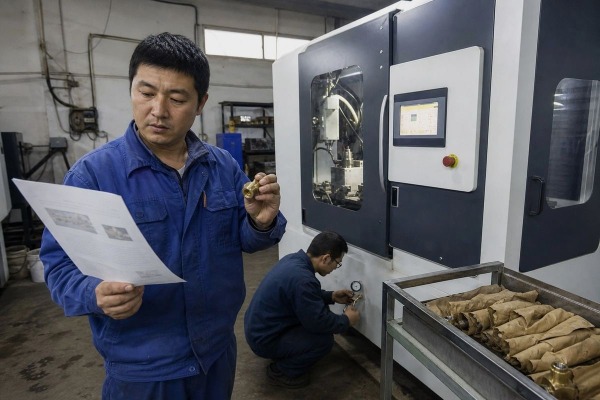
Evaluating a chamfering machine supplier’s cases is where most buyers go wrong. In our Wenzhou workshop, I have seen glossy case studies hide serious technical mismatches that cost buyers months.
To evaluate a chamfering machine supplier’s cases with similar connector manufacturers, compare the case study’s part geometry, material, tolerances, and cycle time against your own drawings, verify results through references and sample tests on your parts, and confirm factory evidence like a Factory Acceptance Test.
That is the short answer. The longer answer involves knowing what “similar” really means, what proof to demand, and which questions expose weak claims. Let me walk you through each step.
A procurement manager from the US once sent me a competitor's case study and asked, "Is this real?" Our engineering team reviewed it and found the part geometry did not match his connector at all.
Look for case studies that match your connector family, base material, wall thickness, chamfer angle, tolerance band, and production volume. A relevant case includes measurable data such as cycle time, burr height, and repeatability — not just photos of a finished machine and a happy customer quote.

The core mistake buyers make is treating a case study as a credibility check instead of a fit assessment. A supplier may have built excellent machines for automotive fittings. That tells you almost nothing about how their equipment handles a thin-walled brass connector shell with a plated mating face. Small differences in geometry, alloy, coating, or fixturing can change chamfering results materially.
I recommend sorting every case study a supplier shows you into one of four buckets:
| Fit Level | What It Looks Like | How Much Weight to Give It |
|---|---|---|
| Best fit | Same connector family or nearly identical geometry | Strong evidence — dig into the data |
| Acceptable fit | Comparable material and tolerance challenge, different part | Useful — verify with sample testing |
| Weak fit | Unrelated applications, no similar fixturing or finish needs | Treat as marketing only |
| Red flag | No drawings, no test data, no references, refuses trials | Walk away |
"Similar" should mean similar in the ways that affect chamfering outcomes. Check whether the case involved the same connector type — circular, rectangular, or high-density industrial. Check the alloy. Connector-grade materials like phosphor bronze 1, beryllium copper, and lead-free brass each demand different spindle speeds and tool geometries. Check the quality risk, too. If your part has a sealing surface or a cosmetic face, a case study on a rough hydraulic fitting proves nothing about burr-free edge quality.
Finally, from my own buying and selling experience, I always start with three simple moves: evaluate the supplier's website in depth, ask related suppliers in the same supply chain what they know, and question the sales team directly. These three checks filter out most weak candidates before you spend time on drawings.
There is a trade-off we discuss with every buyer: a case that matches your part but not your volume, or one that matches your volume but not your part. Neither is enough alone.
Verify a match by overlaying the supplier's documented case specifications onto your own part drawings and production plan. Confirm diameter range, wall thickness, hardness, chamfer angle adjustability, tolerance, and cycle time, then demand a witnessed trial on your actual connector samples before signing.

Verification means moving from claims to numbers. When we prepare a technical proposal at our factory, we start with the customer's drawing, not our brochure. Any serious supplier should do the same. If their past project data cannot be laid side by side with your specification sheet, the case is unverifiable.
Ask the supplier to fill in a table like this for their referenced connector project and for your part:
| Parameter | Their Case Study | Your Requirement |
|---|---|---|
| Workpiece diameter / size range | ? | Your drawing |
| Wall thickness range | ? | Your drawing |
| Material and hardness | ? | Your spec |
| Chamfer angle and adjustability | ? | Your spec |
| Tolerance and repeatability (Cpk) | ? | Your QC standard |
| Surface roughness 2 (Ra) achieved | ? | Your finish spec |
| Cycle time per part | ? | Your takt time |
| Tooling life under continuous duty | ? | Your TCO model |
Request quantitative sample test data — Cpk values 3, burr height measurements, and Ra readings — because these numbers prove long-term machine repeatability, not just one lucky part. If your line runs 24/7, ask specifically whether precision drifted during high-volume production cycles in the referenced project. Drift under continuous duty is where cheap machines fail first.
The single most persuasive verification is material compatibility testing on your own samples. Ship the supplier fifty to a hundred parts. Ask them to run all of them, on video or witnessed live, and return the parts with measurement reports. One perfect sample proves nothing; consistency across a batch proves the process. Judge chamfer-angle stability, edge quality, production cycle time, and whether plated mating surfaces stayed intact. For gold, silver, or tin coatings, check plating integrity closely — delamination or micro-cracking on an expensive plated pin can wipe out your ROI on automation instantly.
Finally, insist on a documented Factory Acceptance Test before shipment. We build FAT into every contract because it protects both sides.
One lesson our export team learned early: buyers who call references almost never ask about the machine. They ask about the honeymoon period. The real story starts six months after installation.
Ask references about long-term repeatability, precision drift during continuous operation, changeover time between connector geometries, spare-parts lead time, remote debugging speed, and whether the supplier delivered custom fixtures on schedule. Focus on what happened after month three, not the installation week.

Reference project verification is where personal insight pays off. My own three-step habit — study the website, ask related suppliers, and interrogate the sales staff — works because each source reveals something different. The website shows what the supplier wants you to see. Related suppliers in the connector supply chain tell you what the market actually thinks. And the sales team's answers to hard technical questions reveal whether real engineers stand behind them.
Here is the script I would use when calling a reference at a similar connector manufacturer:
Listen for hesitation on the support questions. A reference who praises the machine but goes quiet on service response is telling you something. Also ask whether the reference's operating conditions match yours. A client running one shift with a dedicated technician will have a very different experience from your unattended night-shift plan. Weight every answer by how similar their production context is to your own — that is the whole point of choosing references from similar connector manufacturers in the first place.
When buyers visit our workshop in Wenzhou, I always show them the assembly stations and QC records before the finished machines. Machines can be staged for photos. A working factory cannot.
Real expertise shows up as engineering process, not machine photos: drawing review by engineers, custom tooling and fixture design, documented sample testing, in-house machining capability, calibration records, transparent component brands, and knowledge of connector-specific challenges like micro-chamfering, debris management, and plating protection.

A supplier's case history can look strong on paper while hiding a trading company that never touched a spindle. The question is whether the supplier has genuine capability, and there is a clean way to separate machine capability from supplier capability.
| Evidence Type | Machine Capability | Supplier Capability |
|---|---|---|
| Demo video of chamfering | Yes | No |
| Engineer-led drawing review | No | Yes |
| Custom fixture design for delicate pins | Partly | Yes |
| Factory Acceptance Test records | Yes | Yes |
| Calibration logs and inspection tools | No | Yes |
| Commissioning and operator training plan | No | Yes |
A machine can perform beautifully in a demo and still be the wrong purchase if the supplier cannot support fixturing, commissioning, or precision deburring solutions tailored to your part. For connector work, fixturing and machine repeatability often matter more than spindle power.
Probe the supplier on connector-specific topics. Do they understand micro-chamfering for sub-millimeter components, where standard industrial tolerances are far too loose for modern miniaturized connectors? Can they describe integrated debris management, so metallic dust never contaminates your assembly and testing areas? Have they worked with automated edge rounding on plated surfaces without damaging coatings? Do they know your surface roughness standards for mating faces? If they mention real-time torque and vibration monitoring for predictive tool-wear detection, that Industry 4.0 depth is a strong positive signal.
If travel is possible, visit the factory. Check in-house machining, assembly stations, component brands, and spare-parts inventory. If travel is not possible, combine a live video tour, a third-party audit, and documented FAT results. In our experience exporting to markets from the United States to Slovakia, buyers who did a live video inspection almost never faced surprises at delivery.
Weak case studies waste money and months. Match the part, demand data, test your own samples, call real references, and audit the factory — then choose the supplier who proves repeatable results.
1. Wikipedia is a stable, authoritative source for material properties and industrial applications of phosphor bronze in electrical connectors. ↩︎
2. International standards for surface texture and roughness measurement. ↩︎
3. Statistical measure of process capability and machine repeatability in manufacturing. ↩︎
4. Explanation of workholding devices used to ensure consistency in machining. ↩︎
