

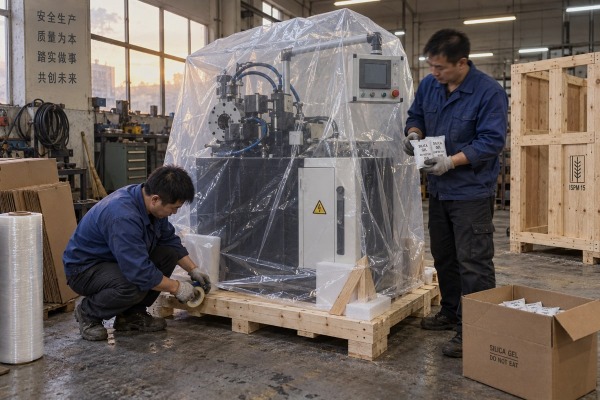
A cable lug making machine can leave our Wenzhou workshop perfect and arrive rusted or cracked. Moisture-proof, shock-proof export packaging is the only thing standing between those two outcomes.
Require moisture-proof, shock-proof export packaging as a written specification: a cleaned, VCI-protected machine sealed in a moisture barrier bag with calculated desiccant, bolted to a shock-absorbing skid inside an ISPM 15 compliant wooden crate, with packing drawings, shipping marks, photos, and pre-closure inspection as contract deliverables.
That sentence is the whole article in short form. Below, I break it into four questions that buyers ask us most often. Each answer gives you words you can paste into a purchase order.
A procurement manager in Mexico once sent me a one-line packaging request: export standard. That phrase means nothing. So we replaced it with a specification we could both check.
Include the scope of each shipping unit, cleaning and corrosion protection method, moisture barrier and desiccant calculation, skid anchoring and blocking design, cushioning at contact points, ISPM 15 wood status, international shipping marks, container loading plan, and required documents: drawings, weights, center of gravity, photos, and packing list.

The first mistake I see is treating packaging as one item on a quotation. It is not one item. It is a system that protects several very different components. Our terminal crimping lines carry a steel frame, pneumatic cylinders with coiled hoses, a pressing head, cutting and stripping tooling, an electric motor, a stainless steel feeding chute on leveling feet, pressure regulators with gauges, and an electrical cabinet with a PLC and a touchscreen mounted on an articulated arm. Each part fails in its own way.
| Component | Main vulnerability in transit | What to specify |
|---|---|---|
| Steel frame and machined surfaces | Flash rust under condensation | Clean, dry, corrosion protection 1 with VCI |
| Electrical cabinet, PLC, touchscreen | Humidity, salt air, impact | Sealed barrier, desiccant, screen guard, doors locked |
| Dies and precision tooling | Dents, misalignment, contamination | Separate boxes, oiled, blocked, labeled |
| Pneumatic cylinders and hoses | Movement, hose chafing, fitting damage | Restrained, capped, protected from frame contact |
| Stainless chute and leveling feet | Bending, scratching | Removed or braced, padded contact points |
| Spare parts and documents | Loose items striking the machine | Fastened separately, listed by crate number |
Our standard export pack is simple. We use stretch film, shock-absorbing foam, a fixed wooden frame, and a pallet. Each layer does one job. The stretch film keeps out dust and splashes. The foam sits at every contact point and absorbs shock. The wooden frame is screwed to the pallet and holds the machine so it cannot shift. The pallet gives forklift access. For road transport to a nearby port, this works well. For a long sea route 2 into a humid climate, I tell buyers plainly that stretch film is not a vapor barrier. Then we add VCI, a sealed barrier, and desiccant on top of that base. The buyer should decide this upgrade based on route, not on price alone.
The words moisture-proof and shock-proof should describe a result. The package must keep the machine dry and still from our loading dock through port handling, sea transit, customs, warehouse storage, and your installation. Here is a clause we have accepted in contracts:
Supplier shall provide seaworthy export packaging suitable for the complete transport route and a minimum agreed storage period. The machine shall be cleaned, dried, corrosion-protected, immobilized, and secured to an engineered skid. Exposed metal shall receive compatible VCI protection. The machine and moisture-sensitive components shall be enclosed in a sealed moisture barrier with desiccant sized for the enclosed free volume and expected climate exposure. All applicable solid-wood packaging shall comply with ISPM 15 and bear the required mark. Supplier shall provide packaging drawings, weights, center-of-gravity information, lifting instructions, packing photographs, crate identification, and a complete packing list before shipment.
An early shipment to New Zealand taught me that damage is cumulative. Nothing dramatic happened. Weeks of vibration simply loosened a pneumatic cylinder bracket that had been strapped, not blocked.
Secure the machine to a load-rated skid with bolts and blocking, cushion contact points with sized foam, immobilize cylinders, feeders, and dies, keep clearance from crate walls, then brace the crate inside the container following CTU Code principles so it cannot slide, tip, or touch condensing steel walls.

Ocean shipping is not one hazard. It is a chain of small hazards that add up. I list them in the order the machine meets them.
The skid carries everything. We design it around the real machine weight and the real center of gravity. Our machines are heavier on the pressing head side, so the skid runners and the forklift pockets are positioned for that. The machine is bolted through its own leg plates to the skid timbers. Then we add hardwood blocking against the base so the bolts do not carry side loads alone. Tall sections get diagonal bracing to the frame. The stainless chute is either removed and crated separately or braced so it cannot flex.
Buyers often ask us to add more foam. More foam is not always better. Foam that is too soft lets a heavy machine bottom out on the skid, and the shock passes straight through. Foam that is too rigid transmits the shock directly. We select foam density by the load at each contact point. High-density EPE blocks or rubber pads sit between the machine feet and the skid. Softer foam protects the touchscreen, gauges, and painted panels from contact with timber.
| Hazard | Control we specify | How you can check it |
|---|---|---|
| Sliding on skid | Bolts plus hardwood blocking | Blocking visible in photos, bolts torqued |
| Tipping | Bracing to frame, low center of gravity | Center of gravity marked on crate |
| Vibration loosening | Positive anchoring, cylinders and arm strapped | No parts free to move by hand |
| Forklift puncture | Reinforced panels at fork pockets | Pockets marked and reinforced |
| Movement in container | Dunnage, chocks, lashing | Container loading photos |
| Wall condensation contact | Clearance from container walls | Loading plan shows standoff |
A strong crate can still fail if it is loaded badly. We follow CTU Code principles 3 for cargo transport units. The crate sits with its weight spread across the container floor, not over one point. We block and brace against the corrugations and use chocks that stay tight when the vessel rolls. We keep the crate away from the container walls, because steel walls sweat. International shipping marks are stenciled on at least two sides: This Side Up, Center of Gravity, Forklift Here, Keep Dry, Do Not Stack, and gross weight. If a buyer wants container loading supervision by a third party, we welcome it. ISTA test methods can also frame how we judge industrial machinery crating 4, but the test severity must match the mass and route of the actual machine.
Stretch film, foam, wooden frame, pallet: that is our standard pack. It unpacks fast. For a long sea route into monsoon humidity, I weigh adding a sealed barrier.
Request VCI anti-rust film or paper on all exposed metal, a sealed polyethylene or aluminum-laminated moisture barrier bag with heat-sealed seams, silica gel or clay desiccants sized to the enclosed free volume and transit time, humidity indicator cards, and sealed cabinet glands, hose ends, and connectors.

Most buyers picture moisture damage as rain getting into a crate. In my experience, the bigger problem is condensation. A closed container holds humid air. When the ship moves from a warm port into cooler water, or when the box sits on a cold yard at night, that moisture condenses on the coldest surfaces. Those surfaces are your steel frame, your dies, and your cabinet terminals. People call it container rain. FEFPEB industrial packaging guidance treats this as a temperature and humidity problem, and it recommends both runoff protection and control of internal humidity. A roof keeps rain out. Only a barrier and desiccant handle the air inside.
| Material | What it does | What it does not do | When we use it |
|---|---|---|---|
| Stretch film | Blocks dust, dirt, light splash | Does not stop water vapor; tears on edges | Baseline, every shipment |
| Polyethylene barrier bag, heat-sealed | Slows vapor ingress strongly | Not fully vapor-tight for very long storage | Sea freight over several weeks |
| Aluminum-laminated bag (MIL-PRF-131 type) | Near-zero vapor transmission | Costs more, harder to repair, heavier disposal | Humid climates, long storage, high-value controls |
| Vacuum sealed packaging | Removes free air and oxygen | Impractical for a whole machine; suits tooling boxes | Dies, spare terminals, PLC spares |
Buyers sometimes ask whether VCI alone is enough. It is not. VCI anti-rust film protects metal surfaces by creating an inhibiting atmosphere 5 around them. Silica gel desiccants lower the humidity in the free air volume. A heavy machine on a multi-week voyage usually needs both. Another buyer asked us to simply double the desiccant. I declined. Desiccant quantity must come from a calculation based on the free volume inside the barrier, the barrier material, the route climate, and the transit plus storage time. Too little fails. Too much adds cost and may be placed where it touches electronics. Our supplier statement lists the type, unit count, calculation basis, duration assumption, and placement. The acceptance target we agree on is to hold the enclosed air below the humidity level the inhibitor needs, and some industrial guidance points to below 40% relative humidity.
Our cabinets house the PLC, drives, and the touchscreen. This is the most expensive and most moisture-sensitive part of the machine. We lock the doors, cap connectors, remove or secure loose items, and wrap the screen in foam. The cabinet gets its own moisture barrier bag and desiccant even when the frame does not. Some buyers also request a temporary hydrophobic coating on terminals as a second line of defense. I treat that as optional. It never replaces a sealed barrier.
Before we close any crate, I photograph the inside myself. Once the plywood goes on, nobody can see whether the desiccant was placed or the bolts were torqued.
Verify by requesting a packaging drawing with weight and center of gravity, checking IPPC marks on ISPM 15 wood, asking for ISTA-style or CTU Code-based restraint rationale, reviewing pre-closure photos or a live video inspection, and installing shock and tilt indicators on the crate.

Verification has two parts. The first part is knowing what each standard actually covers. The second part is inspecting at the right moment. Buyers get the first part wrong more often than the second.
The IPPC stamp on a crate confirms the solid wood was heat-treated or otherwise treated against pests. ISPM 15 applies to pallets, crates, dunnage, blocks, and skids made of raw wood 6 used in international trade. It helps customs clearance. It says nothing about strength, corrosion protection, desiccant quantity, or restraint design. I have seen buyers relax when they saw the stamp and then find a loose frame inside. ISPM 15 compliant wooden crates are necessary. They are not sufficient. We also check the destination rule, because some countries require treatment paperwork beyond the mark.
| Reference | What it covers | What it does not cover |
|---|---|---|
| ISPM 15 and IPPC mark | Pest treatment of raw-wood packaging | Structure, moisture, restraint |
| CTU Code | Safe packing and securing inside containers | Internal crate design |
| ISTA test methods | Simulated distribution performance testing | Route-specific engineering judgment |
| MIL-PRF-131 type barrier | Vapor transmission performance of barrier material | Desiccant sizing or seal workmanship |
| Sea freight standards from carriers | Container payload, dimensions, lashing | Machine-specific protection |
For high-value lines, I recommend a live video walkthrough with me or a third-party inspector before the last panel goes on. We do this over WhatsApp for buyers in the United States and Canada who cannot travel. It takes twenty minutes and removes most disputes later.
Some buyers ask for finite element analysis of the crate. For a standard crimping line of moderate weight, our engineering drawings and load-rated skid design answer the question without FEA. For a very heavy custom line lifted by crane, FEA on the lifting points is reasonable. Others ask for IoT environmental sensors that log shock, humidity, and temperature through the voyage. These give real data and settle insurance claims fast. They also add cost and need someone to read the data. A simpler shock indicator and tilt indicator on the crate exterior covers most cases. Pick the tool that matches the value and the route.
A crate is not what you buy. You buy a dry, restrained, documented machine that arrives ready to run. Write the requirement so it cannot be interpreted loosely.
Interested in sourcing the products mentioned in this article? See details and request a quote here:
1. ISO provides global standards for corrosion protection and environmental testing. ↩︎
2. The IMO sets global standards for the safety and security of international shipping. ↩︎
3. Official UN/IMO/ILO guidelines for safe packing of cargo transport units. ↩︎
4. Authority on testing protocols for transport packaging and industrial machinery crating. ↩︎
5. Technical explanation of how volatile corrosion inhibitors protect metal surfaces. ↩︎
6. Official IPPC repository for international standards on wood packaging materials. ↩︎
