

Buying a cable lug making machine without validated samples is a gamble tensile strength testing 1. I have watched buyers lose months over skipped trials, so our Wenzhou team built a safer process.
To request samples for a cable lug making machine, send your physical lug samples, drawings, and material specs to the supplier, confirm who pays freight and test-run material fees, then negotiate an itemized quote separating machine price, tooling, shipping, training, and deposit terms before committing.
That single paragraph hides a lot of detail. Sample requests fail for specific reasons. Fee negotiations go wrong at specific points. Below, I walk through each stage the way we handle it with real buyers, so you can copy the process step by step.
A procurement manager in Germany once emailed us two blurry photos and asked for a firm quote on a terminal crimping machine. Our engineers simply could not price it from that.
Include physical product samples, dimensional drawings, material type and thickness, target output rate, lug sizes, power requirements, acceptance criteria, and delivery date. Suppliers calibrate machine parameters from your actual samples, so accurate quotes depend on complete technical information, not photos alone.

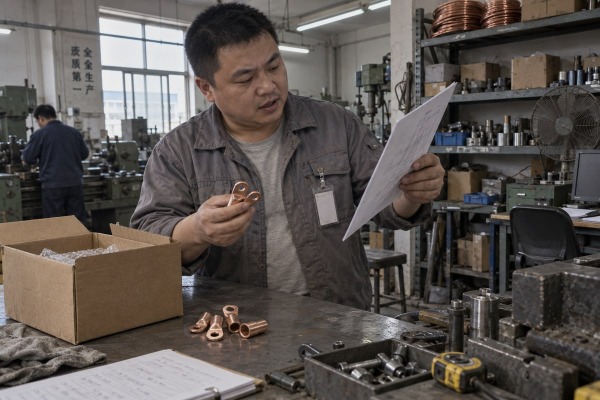
Here is the point most first-time buyers miss. For customized machines 2, samples are not optional. The customer must ship physical product samples to the supplier first. Only then can the supplier study the dimensions, specifications, model, and material, and use them to debug the machine and set the working parameters. Our team in Wenzhou does exactly this for every non-standard project. A drawing tells us what you want. The physical copper tube lugs tell us how your material actually behaves in the cold forging process.
An incomplete request forces the supplier to guess. Guessing inflates the quote, because the factory pads the price to cover unknowns. A complete request does the opposite. It lets the supplier quote tight and commit to real numbers.
| Item to Include | Why It Matters |
|---|---|
| Physical lug samples | Used to debug the machine and set parameters |
| Dimensional drawings with tolerances | Defines the tooling and die sets required |
| Material grade and thickness | Copper vs aluminum changes press force and dies |
| Material certification | Confirms alloy consistency for repeatable results |
| Target output per hour | Determines machine class and production capacity |
| Power supply and voltage | Avoids costly rewiring after delivery |
| Acceptance criteria | Sets the pass/fail standard before payment |
| Target delivery date | Lets the supplier confirm a realistic schedule |
Before anything ships, ask the supplier what kind of sample they will return. A finished lug sample, a machine-produced sample, and a custom tooling sample are three different things. Only a sample produced on the actual configured machine proves the equipment can handle your specification. We always tell buyers which type we are sending, and you should demand the same clarity from any supplier.
Every week I weigh the same trade-off: match a competitor’s low headline price, or protect the specifications that keep a machine running for years. Price cuts have real limits.
Negotiate an itemized quote that separates machine price, tooling, freight, installation, and training. Push for lower deposits on standard models, sample fees credited against orders, bulk order discounts, and a final 15% payment held until the machine passes a 24-hour production trial.

Some procurement teams negotiate price first and validate the machine second. Experienced buyers do the reverse, and they are right to. A cheap machine that produces out-of-spec lugs is not a deal. So before any negotiation, understand what the market actually charges, then negotiate structure instead of just hammering the unit price.
| Machine Class | Typical Price Range | Negotiation Leverage |
|---|---|---|
| Hydraulic crimping-type | From around $3,000 | Low; margins are thin |
| Computer-controlled multi-die | $15,000–$40,000 | Medium; negotiate tooling and terms |
| Fully automatic sets | $22,000–$25,000 per set | Medium; negotiate training and spares |
| Copper/aluminum lug lines | $26,400–$33,700 | Higher; some vendors offer 10% off at 10+ units |
Here is where buyers gain the most without touching quality. Deposits for custom equipment typically run 30–70%, but a supplier who already builds a standard model has less risk, so push for the lower end there. Structure the payment schedule so the final 15% is released only after the machine completes a 24-hour continuous production trial at your facility. Ask for a scrap rate guarantee in the contract, so material waste during setup stays under an agreed threshold.
Two clauses protect you long after delivery. First, require non-proprietary PLC components and full software access codes, or you become dependent on expensive proprietary maintenance. Second, negotiate a complete after-sales technical support package: extended warranty plus a pre-packed kit of high-wear spare parts like dies and punches. Confirm CE or ISO compliance 3 too, because certifications smooth customs clearance and workplace safety audits. On our mid-to-high-end lines, we would rather extend the warranty or add spare tooling and die sets than strip cost out of the machine frame, and any serious supplier will say the same.
Years ago, a client approved our sample plan enthusiastically, then balked at the freight invoice for shipping his own lugs to us. That moment taught me to spell out every cost upfront.
Yes. Ask about two-way freight for samples, test-run material fees, custom tooling charges, installation, training, spare parts, and import duties. Freight and trial materials are the largest sample costs, and in most contracts the customer bears both, so confirm responsibility in writing first.

Let me be direct about the two costs that surprise buyers most, because I deal with them on nearly every project. The biggest expenses in the sample stage are the freight for shipping samples and the material cost consumed during machine trials. You must confirm with the supplier who bears the freight and who bears the test material cost before anything moves. In general practice, both are borne by the customer. That is not a supplier trick. It is the industry norm, because trials consume real copper, real labor, and real machine hours. The problem is only when nobody states it clearly, and the invoice lands as a surprise.
| Cost Item | Typical Bearer | What to Confirm in Writing |
|---|---|---|
| Freight for your samples to the factory | Customer | Courier account and declared value |
| Test-run material during machine debugging | Customer | Quantity of material consumed per trial |
| Return freight for machine-made samples | Customer (often negotiable) | Whether supplier will split the cost |
| Custom tooling and die sets | Customer, sometimes credited | Whether tooling fees offset the final order |
| Installation and operator training | Varies | On-site vs remote, and who pays travel |
| Import duties and local taxes | Customer | FOB vs CIF terms and duty estimates |
Marketplaces are full of listings offering free lug samples. Do not confuse a free finished lug with a free machine trial. A stock lug costs cents. A configured trial run on a terminal crimping machine consumes tooling time and material. Also compare FOB against CIF carefully; a low FOB price can hide expensive freight, insurance, and duties that a CIF quote would surface. Finally, ask whether sample and tooling fees are credited against your final order. We offer that credit on confirmed projects, and it is one of the easiest concessions to win.
Last spring, our QC team filmed a complete remote acceptance test for a US distributor. He approved his machine from Chicago without ever boarding a plane.
Inspect samples for dimensional accuracy, surface finish, and burrs, then run tensile strength testing on crimped joints. Ship your own raw material for trial runs, request remote factory acceptance testing on video, and withhold final payment until a 24-hour continuous trial succeeds.

Evaluation is where validation-first buyers separate themselves from price-first buyers. A sample that merely looks good proves very little. You need a structured pass/fail process, and you need it agreed before you pay. Here is the sequence we recommend, and the one we run on our own lines in Wenzhou.
Only after all five steps pass should bulk commitments or multi-unit orders enter the conversation. At that point, your leverage for volume pricing is also strongest, because the supplier knows the technical risk is already resolved.
Send real samples first, confirm freight and trial material responsibility, demand itemized quotes, and validate quality before price talks. That sequence protects your cable lug making machine investment.
Interested in sourcing the products mentioned in this article? See details and request a quote here:
