

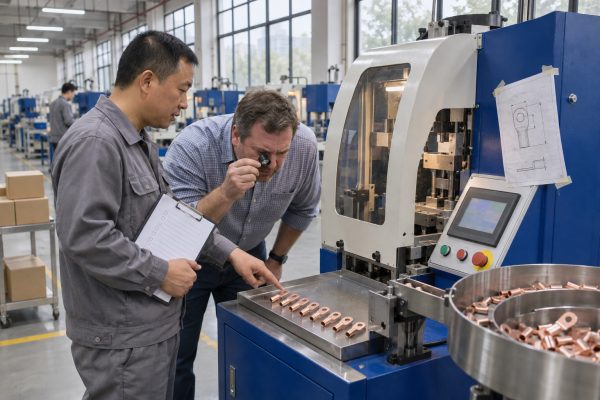
Language barriers when buying a cable lug making machine cost money. A buyer once showed our Wenzhou team a rival quote. It covered a crimper, not a lug line.
To overcome language barriers when buying a cable lug making machine, replace talk with evidence: unified terminology, dimensioned drawings, physical samples, a bilingual specification sheet, numbered repeat-back confirmations, photos and videos, a written communication record, and a witnessed factory acceptance test before final payment.
That near-miss was not a vocabulary problem. Both sides used the same words. They simply meant different machines. The sections below show how I fix that gap at each stage of a purchase.
A US procurement manager once asked me for a heavy-duty automatic machine. I asked back: which operations, which lug sizes, which output? That question changed his whole inquiry.
Describe the production process, not the machine name. Send dimensioned drawings, physical samples, and a bilingual technical specification sheet with units, tolerances, and output stated numerically. Mark mandatory versus optional items, and ask the supplier to confirm each operation on a process diagram.

The phrase cable lug making machine is a commercial label. It is not a technical definition. Inside our factory it can mean a stamping press, a forming unit, a punching station, a copper tube feeding system 1, or a full line with a vibratory feeder bowl and inspection camera. To a buyer, it may mean an automatic terminal crimping station that attaches purchased lugs to wire. Those are different products with different prices.
So I ask every buyer to write the process first. List what enters the machine and what leaves it. Then list each step in between.
| Term the buyer may use | What it often means in practice | What you must confirm |
|---|---|---|
| Cable lug making machine | A full line or a single operation | Which operations are included |
| Crimping machine | Joins a finished lug to a conductor | Whether lug production is needed at all |
| Stamping press | Blanks lug shapes from strip with dies | Hydraulic press capacity in kN or tons-force |
| Forming machine | Bends tube or strip into a barrel | Barrel ID and OD range |
| Punching station | Creates bolt holes | Hole diameter and tolerance |
| Complete line or turnkey | Marketing term unless defined | Every excluded item, in writing |
The supplier should mark each step on your diagram as automatic, semi-automatic, manual, or excluded. A simple yes to a long email proves nothing.
Next I recommend a User Requirement Specification 2 laid out as a two-column table. One column holds your language. The other holds the supplier's working language. Each row has a requirement, a unit, an acceptable range, the supplier's proposed value, and a confirmation status.
| Item | Unit | Required range | Supplier value | Status |
|---|---|---|---|---|
| Bolt-hole diameter | mm | 10.5 ±0.10 | Mandatory | |
| Conductor cross-section | mm² | 2.5–16 | Mandatory | |
| Material thickness | mm | Mandatory | ||
| Output | pieces/hour | Mandatory | ||
| Power supply | V / phase / Hz | Mandatory | ||
| Burr limit | mm | Preferred |
This is where unified terminology pays off. When the salesperson and the factory engineer read the same row, their summaries cannot drift apart.
Write millimeters, not metric. Write kilonewtons for press force, kilowatts for installed power, pieces per hour for output, and Celsius for annealing temperature. Ask whether each value is nominal, maximum, or recommended. Words like capacity, precision, universal, and free tooling are marketing until a number sits beside them.
Some buyers object that drawings are too much effort for a simple part. I understand the objection. But a ring lug carries several critical dimensions: overall length, hole-to-edge distance, barrel inner diameter, wall thickness. Perspective in a photo distorts all of them. A drawing plus a physical sample removes the argument before it starts.
Early in our export work to Germany, we learned that a perfect quotation means little if the electrical schematic arrives in Chinese only. Documentation now ships bilingual by default.
Request translated versions of the quotation with scope and exclusions, the technical specification sheet, product drawings, the Bill of Materials and tooling list, electrical and pneumatic schematics, the operating manual, alarm-code list, factory acceptance test procedure, warranty terms, and the contract with Incoterms.

Not every document needs the same translation effort. A chat about shipping dates can go through a translation app. A safety warning on the press guard 3 cannot. I split the document set into two levels of care.
| Document | Why it matters | Translation level |
|---|---|---|
| Quotation with scope and exclusions | Defines what you actually pay for | Human-reviewed |
| Technical specification sheet | Becomes the contract reference | Human-reviewed, bilingual |
| Approved product drawings | Fixes dimensions and tolerances | Bilingual title block and notes |
| Bill of Materials and tooling list | Prevents the tooling included dispute | Human-reviewed, with part numbers |
| Electrical and pneumatic schematics | Needed for local maintenance | ISO/IEC symbols plus bilingual labels |
| Operating and maintenance manual | Daily use after the salesperson leaves | Human-reviewed |
| Alarm-code list | Fast troubleshooting on the shop floor | Human-reviewed, posted at the panel |
| Factory acceptance test procedure | Defines pass and fail before payment | Human-reviewed |
| Warranty and contract, including Incoterms | Legal protection | Professional legal and technical review |
International trade Incoterms deserve special attention. FOB, CIF, and DAP shift risk and cost at different points. A mistranslated clause here can move thousands of dollars of freight responsibility.
Here is a lesson I repeat often. Translation does not improve content. If the source specification says fast cycle and good precision, the translation will say the same vague thing in another language. Get the numbers right first. Then translate.
The same applies to certification claims. A supplier may say the machine is CE or ISO. Ask for the specific document, the issuing body, and the model number on it. If your customers require UL certification for the finished lugs, or test performance against IEC 61238-1 standards for compression connectors, write that into the product acceptance criteria rather than assuming the machine supplier knows your market.
Some buyers tell me a professional translator is unnecessary because AI tools are good enough. For routine messages, I agree. For contracts, schematics, and safety text, I do not. Machine translation still stumbles on decimal notation, unit abbreviations, and qualified phrases like only with separate dies. A hybrid approach works best: machine speed for daily exchanges, human expertise for anything that touches money or safety. A sourcing agent with press-machinery experience can also serve as that human layer.
One more habit from our own workflow: every important document gets a second check. One person translates. A different person compares the numbers against the original drawing. That double check has caught swapped tolerances more than once.
During a pre-shipment check on one of our lug lines, the HMI still held a hole diameter the customer had revised two weeks earlier. The numbered email trail caught it.
Verify understanding by requiring a numbered repeat-back: the supplier restates every requirement in its own words with values, tooling, and tolerances. Then confirm with a sample run on your material, a witnessed factory acceptance test, and a signed drawing set attached to the contract.

Asking do you understand always gets a yes. It is polite and it is useless. Instead, I send a numbered list and require answers in the same numbering. The supplier must restate each item in its own words.
| Your requirement | Weak response | Strong repeat-back |
|---|---|---|
| 1. Ring lugs with a 10.5 mm bolt hole | Yes, OK | Confirmed; punch tooling included; tolerance ±0.10 mm |
| 2. Process 2.5–16 mm² copper conductors | Yes, can do | Confirmed only with separate dies for each size; six die sets quoted |
| 3. Copper tube feeding system, automatic | Yes, automatic | Vibratory bowl feeder with sensor; operator loads hopper every 40 minutes |
The strong column exposes conditions, exclusions, and operator intervention. Those are the places where language differences hide.
A machine can make one beautiful sample and then struggle at continuous speed. Before I accept any demonstration, I ask what material and dimensions were used, how long the machine ran, the actual cycle time, the scrap rate, and whether parts were measured before and after the run. Then I ask the supplier to run the buyer's exact part from the buyer's material.
Some buyers argue that a video of the machine running is enough proof. Video is useful evidence. It is not sufficient evidence. A clip cannot show measurement accuracy, continuous performance, or whether the operator intervened off camera. Physical samples, measured results, and a signed test record provide stronger protection.
The factory acceptance test is the main defense against language disputes. Our customers in Japan and Italy usually define it with us before the deposit. The protocol should state the exact drawings, approved raw material, tooling configuration, sample quantity, output rate, maximum scrap rate, dimensional tolerances 4, surface criteria, safety checks, continuous run duration, required documents, who witnesses, how failures are corrected, and whether final payment depends on acceptance.
Remote FAT by live video call works well when a technical interpreter joins. An independent quality control inspection company 5 or a local technical representative adds another layer. We also photograph the HMI parameter screens and record software versions during the test. That record becomes the baseline for commissioning.
Tooling included is not a specification. The quotation must list every die, punch, fixture, feeder, and guide by part number. Confirm whether tooling is dedicated or interchangeable, the expected tool life, replacement cost, changeover time, and whether dies ship with drawings.
Speed versus traceability is the trade-off I weigh every week. WhatsApp gets a US buyer an answer in minutes, but only email keeps the decision. We use both, on purpose.
Use email for formal requirements and approvals, messaging apps only for quick clarification, and video calls for pointing at tooling and controls. Annotate photos and videos, send a written summary after every call, keep one controlled communication record, and verify critical translations with a human expert.

Each tool has a job. Mixing them is where errors creep in.
| Channel | Best use | Risk if misused | Our rule |
|---|---|---|---|
| Requirements, quotations, revisions, approvals | Slow for small questions | All decisions live here | |
| WhatsApp or WeChat | Quick clarification, photos, short videos | Decisions get lost in chat | Copy any agreement into the email file the same day |
| Video call | Factory inspection, pointing at tooling, HMI walkthrough, remote FAT | Nothing recorded | Written summary with open questions sent after every call |
| Shared document folder | One controlled version of drawings and specs | Old versions circulating | Revision number on every file |
| Sourcing agent on site | Face-to-face negotiation, factory visits | Agent paraphrases instead of translating | Agent works from the numbered specification |
Pictures beat paragraphs. When a buyer in Mexico questioned our feeder bowl orientation, a 30-second screen recording with arrows settled it faster than three emails. Annotated photographs, process diagrams, and layout drawings reduce ambiguity because they do not need translation. But a picture is still not a record. After the video call I send a summary: what was agreed, what remains open, who acts next. The buyer replies with confirmation. That exchange is the communication record we rely on months later.
The hardest translation problem starts when the machine lands and the salesperson is gone. So I make the machine interface part of the purchase decision. Check the available HMI languages, whether alarm messages can be customized, whether an English manual and alarm-code list are included, and whether remote diagnostics 6 are available for the PLC.
Buyers sometimes assume an English HMI solves everything. It helps, but the interface is one layer. Manuals, schematics, maintenance steps, and tooling labels must also be readable. Three practices go further:
Some teams now use augmented reality remote assistance to overlay translated labels on the physical machine during pre-shipment inspection. We have found it useful when internet access is stable and access policies are clear.
Finally, put language into the contract. State the language for the HMI, manuals, and training. State who corrects translation errors and within what time. A low price with thin documentation is a false saving. Delays, wrong tooling, and operator errors show up later as cost. Compare total landed and operating cost, not the quotation line alone.
Better evidence beats better vocabulary. Define the part, measure the spec, confirm in writing, test before payment. Contact our Wenzhou team for a bilingual specification template.
1. ASTM International provides technical standards for materials like copper used in industrial feeding and manufacturing systems. ↩︎
2. Wikipedia entry defining the User Requirements Specification (URS) used in systems engineering and equipment procurement. ↩︎
3. OSHA provides safety standards and guidelines for machine guarding to protect operators from industrial machinery hazards. ↩︎
4. Wikipedia page explaining engineering tolerances, which are critical for ensuring manufactured parts meet technical specifications. ↩︎
5. The International Trade Administration provides resources on quality standards and inspection services for international commerce. ↩︎
6. The IEEE is a global authority on industrial automation and communication standards for remote diagnostics and control. ↩︎
