

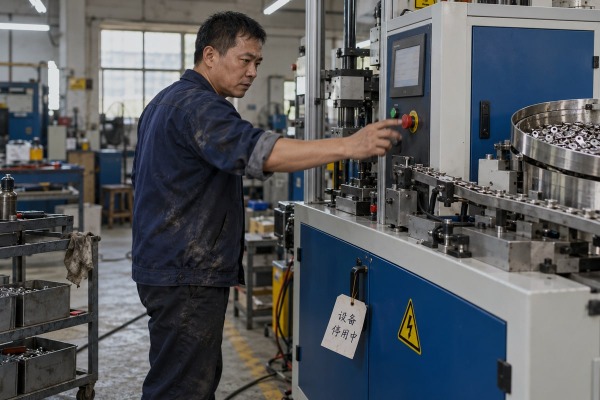
A warranty claim for a faulty cable lug making machine 1 often fails on paperwork, not the fault. Lines stop, orders slip, and buyers call our Wenzhou service team panicking.
To file a warranty claim for a faulty cable lug making machine, stop the machine safely, confirm the warranty period and exclusions, document the fault with photos, videos, and logs, submit the claim through the contract’s designated channel, and obtain RMA authorization before any repair or shipment.
I keep the whole process down to three things. Preserve the evidence of the fault. File the claim the way the contract says. Pin down the supplier’s repair and compensation duties in writing manufacturer’s defects 2. Everything below hangs on those three points.
Last year a distributor in Germany sent us a claim with one blurry photo and no serial number hydraulic pumps 3. We spent days just confirming which machine it was.
Prepare proof of purchase, the product serial number, the warranty certificate or contract clause, delivery and commissioning records, maintenance logs, photos and video of the fault, exported PLC diagnostic logs, and a written symptom description with operating conditions and troubleshooting steps already completed.

A complete claim packet does two jobs. It proves the machine is yours and still under cover. It also proves what happened. Most delays I see come from missing one of those two halves. So I treat the packet as evidence, not as a form.
| Document | Why it matters | Where to find it |
|---|---|---|
| Proof of purchase (invoice, purchase order) | Confirms buyer, date, model, and price | Accounting file or sales contract |
| Product serial number photo | Ties the claim to one specific machine | Nameplate on the cabinet, near the control panel |
| Warranty certificate or contract clause | Shows period, exclusions, and claim channel | Sales contract annex |
| Delivery note and commissioning report | Fixes the warranty start date | Logistics file or installer's report |
| Maintenance logs | Proves scheduled service was actually done | Workshop records |
| Fault photos and video | Shows the symptom, not an opinion | Taken at the machine |
| PLC diagnostic log export | Timestamped record of the machine state | Exported from the HMI to USB |
| Environmental sensor data 4 | Shows temperature and humidity stayed in tolerance | Workshop monitoring system |
The best fault description is factual and reproducible. Write down the date the problem started, the cycle count, the cable size and lug type, the tooling, and the settings on the touchscreen. Then say what the machine does. "The ram stops halfway through the cycle under normal load" is useful. "The hydraulic valve is defective" is a guess. Our engineers need the first sentence before they can confirm the second. Take wide photos of the whole machine, then close photos of the crimping head, the hydraulic unit, the bowl feeder, and any leak. A short video is the single best tool for intermittent noise, failed actuation, or inconsistent crimps.
Follow the troubleshooting guide in the manual and note each result. Check that the power supply is stable and correctly phased. Check the die for obstructions or stray lugs. Check air and hydraulic pressure against the nameplate. Do not go further than that. Unauthorized disassembly or third-party parts give the supplier an easy reason to say no.
A short claim summary can look like this: "Machine [model], serial number [number], was purchased on [date] and commissioned on [date]. On [date], after approximately [cycles] of normal operation, the machine began [symptom]. The machine is now isolated. Attached are the invoice, serial plate photo, video, PLC log export, and maintenance logs. Please confirm warranty coverage and provide inspection instructions."
There's a trade-off I weigh on every claim: answer fast with a guess, or answer later with a real diagnosis. Our engineers choose the diagnosis.
Response time depends on the contract, not an industry rule. As a working benchmark, a complete claim can expect a case number within one to three business days, remote diagnosis within about a week, and a repair, replacement, or coverage decision in roughly two weeks.

I want to be honest here. There is no universal deadline for machinery warranties. Each contract sets its own rhythm. What I can give you is a tracking framework we use internally, plus the things that genuinely shorten the wait.
| Day | What should happen | Who acts |
|---|---|---|
| Day 0 | Fault observed, machine isolated under lockout procedure | Buyer |
| Day 1 | Evidence collected, warranty terms checked | Buyer |
| Day 2 | Claim submitted through the designated channel | Buyer |
| Day 3 | Case number and acknowledgement issued | Supplier |
| Day 5 | Supplier requests extra records or logs | Supplier |
| Day 7 | Remote diagnosis or on-site inspection | Both |
| Day 14 | Repair, replacement, or written coverage decision | Supplier |
Treat this as a benchmark for chasing progress, not as a promise. Freight time, customs, and part availability can push the final step further out.
The clock that worries me most is not the response clock. It is the notice clock. A common contract term requires visible defects to be reported within 14 days of delivery. Latent failures must usually be reported immediately upon discovery. Your own contract may use different numbers, so read it. Late notice is the easiest rejection a supplier can write. File first, even if the packet is not perfect, then add the detail.
If you have no case number after three business days, send a second message and quote the contract clause. If you still hear nothing, escalate to a named manager. A formal written notice under the purchase contract protects your rights and usually gets attention.
A procurement manager in Mexico once asked me why his worn crimping die was not covered. That conversation shaped how we now write our coverage clauses.
A machine warranty normally covers manufacturer's defects in factory-installed components such as motors, hydraulic pumps, cylinders, PLC controllers, sensors, and structural parts that fail under rated conditions within the warranty period. It excludes wear parts, misuse, overload, unauthorized modification, poor maintenance, and transport damage after delivery.

Coverage questions come down to one word: cause. The supplier asks whether the part failed because it was built wrong, or because of how it was used. Both sides can disagree in good faith. Records settle it. The table below reflects how our own warranty terms, and most industrial terms I have read, divide the two sides.
| Usually covered | Usually excluded |
|---|---|
| Premature failure of a motor, pump, cylinder, controller, or sensor | Normal wear of dies, blades, punches, seals, belts, and filters |
| Manufacturing defects in frame, guards, or assemblies | Operation beyond rated cable size, force, pressure, or duty cycle |
| Incorrect factory assembly or calibration | Incorrect installation or commissioning by an unqualified party |
| Repeated failure under normal, documented operation | Unauthorized rewiring, software changes, or third-party parts |
| Parts that miss the stated performance specification | Voltage surges, water, dust, accidents, or poor storage |
| Failures inside both the calendar and operating-hour limits | Damage during transport after delivery |
Take a hydraulic pump failure. A pump that seizes a few weeks after commissioning, with clean oil and the pressure set to spec, points to a manufacturer's defect. A seal that weeps after a long stretch of three-shift production is wear. The same component can land on either side of the line. That is why cycle counts and maintenance logs matter more than the part name.
I understand the worry. Suppliers do need to keep operator error, consumable wear, and unauthorized work out of the warranty budget. But a buyer with records has real leverage. Show the input voltage, air pressure, and cable range were inside the nameplate values. Show environmental sensor data for temperature and humidity. Show approved lubricants and spare parts. If the supplier still says misuse, ask for the exact clause and the inspection evidence in writing. For a high-value machine, an independent engineer's report is cheap compared to the downtime.
Replacement parts coverage usually means the defective component, not a new machine. Repair or replacement of that part is the normal remedy. On-site service, recalibration, and freight may or may not be included. Clarify who pays labor, travel, packaging, insurance, and customs before anyone moves. I put this in writing on every claim, because a vague answer here turns into a second dispute later.
One lesson from exporting to eight markets: a machine's useful life runs far past its warranty, so our after-sales support has to as well.
Yes. After warranty period expiration you can still get paid repair services, genuine replacement parts, remote troubleshooting, firmware updates, and technical support documentation from the manufacturer. Latent defects reported before expiry, contract claims, and extended service agreements may also keep certain remedies open.

Expiry changes who pays. It does not end the relationship. Before you accept that the clock has run out, check two things: when it really started, and whether a non-warranty route still applies.
| Start trigger used in the contract | Practical effect |
|---|---|
| Shipment date | Shortest effective cover; transit time eats into it |
| Delivery date | Common for export sales; needs the delivery note as proof |
| Commissioning or acceptance date | Longest effective cover; needs the signed commissioning report |
| Invoice date | Can start before the machine even arrives |
Many industrial warranties also pair the calendar period with an operating-hour or cycle limit. Whichever ends first governs. Pull the delivery note, commissioning report, and cycle counter before you assume the period is over. I have seen claims revived simply because the buyer found a signed acceptance form dated later than the invoice.
| Option | What it usually involves |
|---|---|
| Paid repair or on-site service | Quoted labor, travel, and parts at agreed rates |
| Genuine replacement parts | Dies, seals, sensors, pumps, and controllers matched to the serial number |
| Remote troubleshooting 5 | Video or AR session using the PLC logs and HMI screens |
| Firmware or software update | Remote correction of control faults where applicable |
| Extended service agreement | Defined response times and parts pricing for a fixed term |
A warranty claim is only one type of claim. A contract claim covers failure to meet specification or acceptance criteria. A misrepresentation claim covers sales promises that never reached the contract. A product-liability claim covers injury or property damage. An insurance claim covers fire, surge, or transport events. These depend on governing law and liability limits, so get professional advice when downtime or safety is serious. I will not promise any buyer a refund or consequential damages. I will promise clear technical support documentation and a straight answer on what we can fix.
Downtime hurts, and a weak claim prolongs it. Preserve the evidence, claim under the contract, and pin down the supplier's repair and compensation duties. That is how claims close.
Interested in sourcing the products mentioned in this article? See details and request a quote here:
1. IEC provides international standards for electrical connectors and the machinery used in their production. ↩︎
2. ISO standards define the quality and safety requirements for identifying manufacturer’s defects in industrial equipment. ↩︎
3. Statista offers market data and industry statistics regarding the global hydraulic pumps sector. ↩︎
4. Trade.gov provides resources on documenting technical environmental sensor data for international trade compliance. ↩︎
5. IEEE establishes technical protocols and best practices for remote troubleshooting of automated manufacturing systems. ↩︎
