

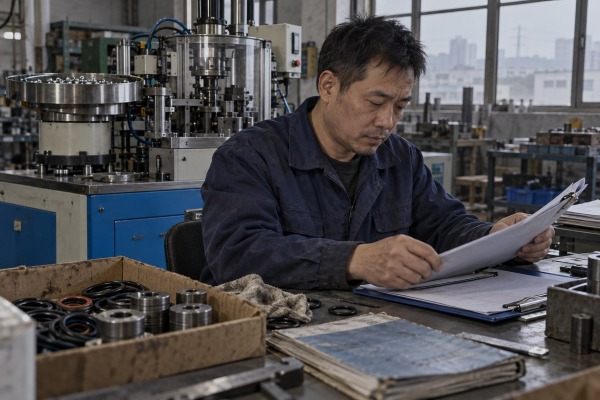
Too often, a cable lug making machine arrives on time, then idles because one die or seal was missing factory acceptance 1. At our Wenzhou plant, a signed spare parts list prevents that.
To confirm a spare parts list with your cable lug making machine supplier, record the exact model and configuration, request a signed, itemized schedule with part numbers, quantities, prices, and lead times, test die compatibility with your real lugs, and attach the schedule to the purchase contract before payment.
The rest of this guide walks through the four questions buyers ask us most. I will show you what to request, how to check it, what to read before signing, and how to protect yourself for years after delivery.
A US procurement manager once asked me for "the standard spares." I sent back a question instead: which lug sizes, how many shifts, and which control cabinet?
Request tooling and dies for every lug size, hydraulic seals and O-rings, pump and valve kits, sensors, relays, PLC batteries, cutting blades, bearings, belts, and a consumable parts list with oils and filters. Separate commissioning spares from 12–24 month operating stock, and mark which items are included in price.

The single most useful habit I can pass on is this: before shipment, ask the supplier for a complete list of the spare parts packed with the machine, and confirm four things for each line. Quantity. Model or part number. Purpose. And whether it is included in the equipment price. We do this for every copper tube terminal production line we export, and it removes most of the arguments that happen later.
"Spare parts available" is not "spare parts included." Your list should split parts into clear groups.
| Category | Typical items | Why it matters |
|---|---|---|
| Tooling and dies | Crimper and anvil sets, punching dies and molds, terminal locators, quick-change cassettes, setup gauges | These decide crimp quality. A die that fits may still crimp wrong. |
| Hydraulic / pneumatic | Pump, hydraulic seals and O-rings 2, hoses, relief valves, solenoid valves, cylinder repair kits, regulators | Leaks and valve faults stop production instantly. |
| Electrical / PLC control system 3 | Fuses, contactors, proximity sensors, HMI, PLC modules, backup battery, servo drives, parameter files | Proprietary modules need supplier involvement. |
| Mechanical wear and tear parts | Bearings, bushes, springs, belts, guide rails, bowl feeder springs, fasteners | Standard hardware, but you need exact grades and dimensions. |
| Consumables | Hydraulic oil, grease, filters, thread-lock, cutting blade replacement sets | Ask for brand, grade, viscosity, and interval. |
On a machine built for copper lugs, the die set is the heart of the spare parts list. One electric hydraulic crimper example covers sizes from 10 mm² through 630 mm². That is a wide range, so ask for a die for every lug size you actually run. Each die needs a part number, a drawing, the compatible lug series, the conductor range, and a replacement price. If the machine supports quick-change modular tooling cassettes, list those too. They cut downtime when switching between lug sizes.
Do not accept arbitrary numbers. A simple rule for critical parts works well:
Recommended stock = expected consumption during supplier lead time + safety stock
For non-consumable items, think about failure risk and downtime cost instead. One spare proximity sensor may be fine. A proprietary HMI may justify two. For machines running two or three shifts, ask for a basic commissioning package plus a separate preventive maintenance kit covering 12–24 months. Negotiating this "first-fill" package at purchase usually secures better pricing than ordering piecemeal later.
Last year our QC team rejected a batch of punching dies before shipment because the crimp profile measured off the drawing. The lugs looked fine. The numbers did not.
Verify spare part quality by cross-referencing machine technical specifications—voltage, thread size, pressure rating, material grade—against each item, requesting OEM part numbers and nameplate photos, and testing every die with your actual lugs during factory acceptance. Measure crimp dimensions and pull-out force, then inspect the shipment on arrival.

That rejected die batch taught me something simple. Visual similarity proves nothing. Quality is confirmed on paper first, then on the bench.
Ask for a Bill of Materials 4 that lists both the machine builder's internal part number and the original component manufacturer's number. A relay labeled "24V relay" tells you very little. The OEM number tells you the coil voltage, contact rating, and footprint. Do the same for hydraulic seals and O-rings: material, hardness, and dimensions. For fasteners and shafts, ask for the material grade. High-resolution photos of nameplates and mounting faces help your technician confirm hole patterns before anything is ordered.
A common buyer objection comes up here: "Why not just use OEM parts for everything and skip the checking?" OEM-only protects compatibility and warranty, but it raises cost and lead time. The opposite objection is "we will source locally to save money." That works for standard sensors and bearings, but an unapproved substitute on a die, a safety relay, or a programmed PLC module can damage lugs or defeat guarding. Our position is a balanced one. Allow approved equivalents for standardized components with full specs stated. Keep OEM control over dies, tooling, software, and safety-critical parts.
Send the supplier samples or full data for the lugs and cables you will run. One tool manufacturer warns that commercial lugs from other suppliers may not crimp correctly, and that dies with the same code can differ by material suitability. So ask for a compatibility matrix and insist it be tested with your material.
| Lug series | Material / plating | Cable cross-section | Die part number | Pressure or program | Acceptance criteria |
|---|---|---|---|---|---|
| Example copper tube lug | Tinned copper | 16 mm² | Supplier to fill | Supplier to fill | Crimp height 5, pull-out force |
| Example aluminum lug | Bare aluminum | 70 mm² | Supplier to fill | Supplier to fill | Crimp width, no barrel cracks |
Repeat the first-piece check after every die change or maintenance event. Keep a job record linking terminal, conductor, die, and result. At delivery, match every carton against the signed schedule, photograph labels, and check dies for chips or corrosion before storing them clean and dry.
Every quotation forces a trade-off between a lower headline price and a thicker spares annex. We price our machines mid-to-high, so I want that annex complete.
Before signing, check that the spare parts list names the exact model and serial revision, gives every item a part number, separates included from optional spares, shows installed versus supplied quantities, states unit prices and lead times, defines wear limits, flags OEM-only parts, and carries the supplier's signature.

A spare parts list is part of the machine technical specifications, not an after-sales afterthought. I treat it as a contract annex. Here is how I read one before it goes to signature.
Record the manufacturer and legal supplier name, exact model and version, serial number if assigned, manufacturing year, control voltage, hydraulic or pneumatic system, cable cross-section range, lug types and materials, number of stations, and all options such as feeders, punching units, or automatic positioning. On our automatic forming lines, the vibratory bowl feeder and the PLC control system are configured per order, so a generic list covering "similar models" is a warning sign. Ask the supplier to mark every line as applicable, not applicable, or optional for your configuration.
A good schedule is a spreadsheet, and the columns matter as much as the parts.
| Column | What it protects you from |
|---|---|
| Supplier part number and OEM number | Ordering the wrong revision |
| Machine assembly | Technicians searching the wrong area |
| Quantity installed / quantity supplied | Hidden downtime exposure |
| Wear classification and expected life | Warranty disputes on wear and tear parts |
| Unit price and price validity | Surprise quotes after installation |
| Lead time (typical and maximum) | "Available" meaning months from a subcontractor |
| OEM-only / approved equivalent / local | Unsafe substitutes or forced dependency |
| Drawing or photo | Misidentification during a breakdown |
| Supplier confirmation and date | Unsigned promises |
The list should say when a part must be replaced, not only what it is called. Ask for maximum die wear, acceptable crimp dimensions, hydraulic pressure tolerance, permitted leakage, bearing play limits, and blade sharpness criteria for cutting blade replacement. Tooling guidance recommends die inspection at least monthly, adjusted for use and operator skill, with replacement when dies show flattening, chipping, cracking, or breakage.
If any of these appear, fix the annex before the deposit.
The lesson that reshaped our after-sales technical support: a machine is only as serviceable as its oldest proprietary part. Now we plan lifecycle support before a machine ships.
Ensure long-term support by writing lead times, price validity, obsolescence notice, and a legacy support guarantee into the contract, obtaining 3D CAD files for non-standard parts, keeping offline PLC program and parameter backups, scheduling cycle-based preventive maintenance, and agreeing a named after-sales technical support contact with response times.

Long-term support is built from three things: contract terms, documentation, and maintenance discipline. Let me take them in order.
Write these into the purchase agreement, not an email.
For non-standard mechanical parts, ask for a Legacy Support Guarantee or access to 3D CAD files so a local shop can fabricate an emergency replacement if the model is discontinued. Some suppliers limit user-replaceable components to dies and require qualified technicians for other repairs. Know which category each part falls into before you need it.
Digital spare parts catalogs with QR-coded components and mobile ordering are becoming common. They are helpful. But request offline copies of the illustrated parts catalog, electrical schematics, hydraulic and pneumatic diagrams, lubrication chart, die-selection chart, calibration procedure, troubleshooting guide, and the full PLC program with parameter files. If the supplier's portal goes down, your maintenance team should still be able to identify and order a part. Ask the supplier to demonstrate the ordering process during training, and make sure training covers safe isolation of electrical, hydraulic, and pneumatic energy before any repair.
Spare parts planning works best when linked to preventive maintenance. Some machine builders specify service by production cycles; one example recommends after-sales service every 400,000 cycles. Pair that with monthly die inspection and a stocked preventive maintenance kit of seals, filters, and oil. If budget allows, IoT-enabled sensors monitoring vibration and heat on the main drive and hydraulic system can flag a bearing or pump before it fails, turning a breakdown into a planned swap.
A cable lug making machine without a signed spare parts list is a gamble. Confirm model, parts, quantities, prices, and compatibility before you pay, and production starts on day one.
Interested in sourcing the products mentioned in this article? See details and request a quote here:
1. Explains the standard industrial process for verifying equipment meets specifications before shipment. ↩︎
2. ISO provides international standards for fluid power systems and sealing devices like O-rings. ↩︎
3. The International Society of Automation is the leading authority on industrial control systems and PLC standards. ↩︎
4. The International Trade Administration offers guidance on manufacturing documentation and supply chain management. ↩︎
5. The IEC sets global standards for electrical terminal connections and crimping quality. ↩︎
