

Evaluating a pipe cutting machine supplier’s R&D capabilities is where most buyers go wrong. I have watched our workshop in Wenzhou fix machines that buyers bought from traders with zero engineering depth. The result? Downtime, scrap, and after-sales bills nobody budgeted for. The fix is a structured evaluation process, and I will walk you through the exact one we recommend to our own customers.
To evaluate a pipe cutting machine supplier’s R&D capabilities, assess the size and structure of its engineering team, verify independent design ownership, review patents and custom OEM/ODM case studies, check ISO quality standards and testing labs, and examine its product release timeline and innovation roadmap.
That is the short answer. Now let me break each piece down so you can run this evaluation yourself, step by step, before you sign anything.
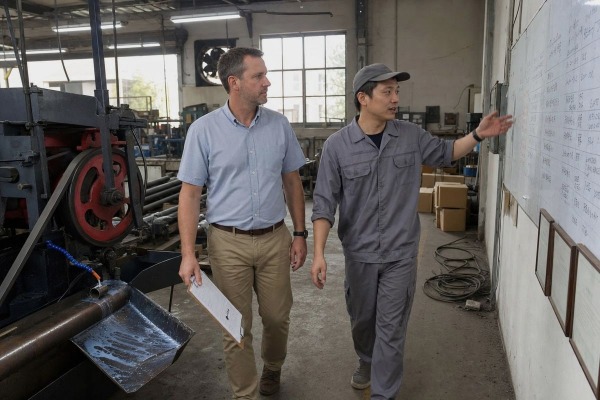
A German distributor once asked our team a simple question during a factory audit: "Which of these ten people actually designs machines?" That single question exposed more than any brochure ever could.
Look for the R&D team's size relative to total headcount, dedicated pipe-cutting specialists rather than generalists, in-house mechanical and software engineers, proven automation control development skills, and evidence of independent design ability instead of reliance on third-party blueprints.

When we evaluate partners for co-development projects, the first thing we check is the R&D team's structure, not just its size. A supplier with ten employees where three are real engineers can outperform a fifty-person assembler with zero designers. The ratio matters more than the raw number. Ask what percentage of the engineering staff works specifically on pipe and tube machines. A team focused on flat-sheet lasers may struggle with rotating chucks, tube supports, and variable wall thicknesses.
Independent design ability is the core test. Ask the supplier to open their CAD files, explain their clamping system logic 1, and show their motion-control code. A true engineering company can explain why every design choice was made. A reseller cannot. In our experience exporting to the US, Germany, and Japan, buyers who ask these questions early avoid ninety percent of bad suppliers.
Automation control capability deserves its own check. Smart PLC control, servo tuning, and CNC software integration 2 are where cutting precision actually lives. Our engineers spend more time refining control logic than machining frames, because that is where consistency comes from in continuous production.
| Evaluation Point | Strong Signal | Weak Signal |
|---|---|---|
| R&D headcount ratio | Engineers are 20–30%+ of staff | Only sales and assembly staff |
| Specialization | Dedicated pipe/tube engineers | Generalists adapted from sheet metal |
| Design ownership | Own CAD files, own control code | Licensed or copied designs |
| Automation depth | In-house PLC and servo programming | Outsourced control cabinets |
| Material knowledge | Staff who understand reflectivity, hardness | Price-and-power talk only |
Last year, a US procurement manager sent us a copper bar profile that no standard chamfering machine on the market could handle cleanly. That inquiry became a three-month non-standard project, and it taught me exactly what proof buyers should demand.
Verify OEM/ODM capability by reviewing documented non-standard project case studies, requesting the supplier's prototype development process timeline, asking for sample cuts on your exact material, and confirming they own the custom engineering solutions rather than subcontracting the design work.

Past non-standard cases are the single best evidence. At our facility, we keep records of every custom project: the original customer problem, the design iterations, the test data, and the final acceptance report. Ask your candidate supplier for the same. If they cannot show at least a handful of documented custom engineering solutions with different pipe diameters, materials, or workflow integrations, their "ODM capability" is probably marketing language.
One caution I share with every buyer: a broad catalog can indicate strong R&D, but it can also just be marketing. Some suppliers list fifty models while genuinely engineering five. The question is never "how many machines do you sell?" It is "which of these did you design, and can you adapt it to my pipe profile?" When we develop automated production systems for cable lug and terminal manufacturing, roughly half the value comes from adapting the machine to the customer's exact material flow, not from the base platform itself.
There is a trade-off I weigh constantly: certification paperwork is easy to display, but hard testing infrastructure is expensive to build. Buyers should learn to tell the two apart.
ISO quality standards, CE compliance for target markets, a documented material testing laboratory, vibration and stress testing on prototypes, controller compatibility documentation, and recorded factory acceptance test protocols together prove a supplier's R&D reliability beyond marketing claims.

Let me be direct about something the research also confirms: certifications are baseline qualification, not proof of innovation. ISO quality standards tell you the supplier follows a documented process. They do not tell you the machine was engineered for your pipe application. Treat certificates as the entry ticket, then dig into how the supplier actually tests.
Sophisticated suppliers maintain in-house testing facilities. The strongest ones run high-speed vibration analysis on spindle and chuck assemblies and metallurgical stress testing 3 on cut samples. A dedicated material testing laboratory, even a modest one, shows the supplier validates performance with data. When we run acceptance tests on our metal processing machines before export, we log cut dimensions across a continuous production run, because our buyers in the US and Germany audit consistency, not just a single perfect sample.
Also check forward-looking testing methods. Some advanced suppliers now use Digital Twin technology to simulate complex cutting cycles and predict mechanical wear before the machine is built. Not every supplier needs this, but asking about it reveals how modern their engineering process is.
| Proof Type | What It Confirms | What It Does NOT Confirm |
|---|---|---|
| ISO quality standards | Documented, repeatable processes | Application-specific engineering |
| CE / market compliance | Legal export eligibility | Cutting performance |
| Material testing laboratory | Data-driven validation culture | Custom design capability |
| Vibration / stress testing | Mechanical durability under load | Software usability |
| Factory acceptance test records | Consistency across production runs | Long-term service quality |
| Digital Twin simulation | Modern predictive engineering | Real-world field results |
My advice: request the actual test reports from a recent machine, not the certificate frames on the wall. A supplier confident in its R&D reliability will hand them over without hesitation. One who hesitates is telling you something important.
A lesson I learned early in exporting: the machine you buy today matters less than the supplier's trajectory over the next five years. Long-term contracts are bets on innovation momentum, not on a single model.
Assess the innovation track record by analyzing the patent portfolio for core versus incremental improvements, tracking the product release timeline over the past 24 months, reviewing the technological innovation roadmap, checking academic partnerships, and verifying remote support and firmware update capability.

Start with patents and intellectual property, but read them critically. A patent portfolio full of minor cosmetic tweaks signals defensive filing, not real invention. Look for patents covering core cutting mechanics, chuck systems, feeding automation, or control algorithms. Then remember the caution: patents alone do not guarantee operational excellence. I have seen well-patented machines with clumsy software that operators hated. Always pair patent review with hands-on testing of software usability and service response.
Ask what features or machine revisions were released in the last 12–24 months, and what customer problems shaped them. A living technological innovation roadmap shows the supplier converts field feedback into engineering changes. Also investigate strategic alliances with universities or external technology labs, since these partnerships often signal long-term fundamental research rather than quick copies.
Software deserves equal weight to hardware here. Machine value increasingly lives in nesting algorithms, CNC software integration, and connectivity. Audit whether their proprietary software offers open API standards for Industry 4.0 integration 4 with your MES and ERP systems. Check for IoT-enabled remote diagnostics and Over-the-Air firmware updates that improve performance after installation. Sustainability-focused R&D, such as eco-modes and scrap-minimizing nesting, is another marker of a supplier engineering for the next decade. Strong after-sales technical support and spare-part continuity complete the picture, because innovation that abandons installed machines is not innovation you want to fund.
| Criterion | Suggested Weight | How to Score |
|---|---|---|
| In-house pipe-specific R&D | 20% | Team ratio, specialization interviews |
| Proprietary hardware/software | 15% | Design ownership, source code control |
| Patents or research participation | 10% | Core vs. incremental filings |
| Application-specific product fit | 15% | Match to your pipe sizes and materials |
| Sample-cut quality and consistency | 15% | Test on your own material |
| Upgrade roadmap and software support | 10% | OTA updates, release history |
| Automation and integration maturity | 10% | MES/ERP connectivity, open APIs |
| References and after-sales capability | 5% | Customer calls, response-time records |
Score each criterion from 1–10, multiply by the weight, and compare suppliers on weighted totals. This turns a gut feeling into a defensible procurement decision.
Weak R&D hides behind glossy brochures until your production line pays the price. Combine team audits, custom case reviews, testing evidence, and a weighted scoring matrix, and choose engineering partners, not machine traders.
1. Provides technical context for the mechanical clamping and workholding logic mentioned in the engineering evaluation section. ↩︎
2. Authoritative technical organization for the automation and software integration standards required for precision pipe cutting machines. ↩︎
3. ASTM International is the leading authority for the metallurgical and stress testing standards mentioned for material validation. ↩︎
4. Official NIST topic page for smart manufacturing, which encompasses Industry 4.0 technologies and integration. ↩︎
