

Shipping costs for a cable lug making machine often surprise buyers. At our Wenzhou factory, we have watched good deals turn sour when freight arrived as an afterthought.
Shipping costs for a cable lug making machine are calculated from final packed dimensions, gross weight, origin, destination, transport mode, and Incoterm, then summed as a landed logistics total. Compare the supplier’s freight booking against independent forwarder quotes with identical scope before deciding.
The machine price is not the delivered price. Below, I will walk you through the data you need, the math, the booking choice, and the costs that hide at the destination.
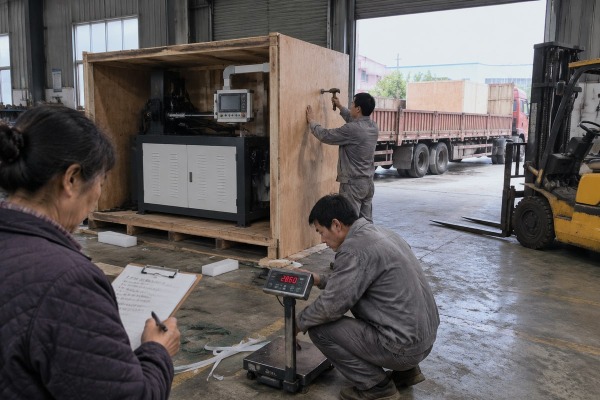
Last year a crate for a crimping machine grew taller than the machine itself after we added vapor-barrier wrap, desiccants, and timber bracing. The freight quote changed with it.
The shipping cost of a cable lug making machine depends on packed dimensions, gross weight, number of crates, pickup location, destination port, transport mode, container type, Incoterm, insurance, customs fees, and destination handling. Packing, oversize handling, and surcharges can change the total significantly.

The first thing I tell every buyer is simple. Shipping is a landed logistics cost, not one ocean freight line. A working formula looks like this:
Total shipping cost = export packing + supplier pickup + origin trucking + export documentation + terminal handling + ocean or air freight + special equipment charges + insurance + customs-related fees + destination handling + import delivery + taxes and duties.
Every term in that formula moves when the cargo data changes. So the data must be right before anyone requests a quote.
Our export team fills in this list for every machine we ship. If a supplier cannot provide it, the quote is a guess.
| Data item | Why it matters |
|---|---|
| Machine model and quantity | Sets the number of crates and total volume |
| Unpacked and packed L × W × H | Packed size controls the booking, not bare size |
| Gross packed weight | Decides trucking equipment and payload limits |
| Number of crates or packages | Each package is priced separately for LCL |
| Crate material and fumigation or heat treatment | Wood packaging rules at the destination |
| Center of gravity and lifting points | Determines crane or forklift method |
| Skid, pallet, or closed wooden case | Affects handling and protection |
| Pickup address and loading conditions | Can the factory load with its own forklift? |
| Destination port or door address | Fixes the route and destination charges |
| Required delivery date | Sea, rail, or air decision |
| Dies, spare parts, tooling, manuals | Often forgotten, then shipped as a second LCL lot |
Packing adds real weight and volume. One freight guide notes that a 24-metric-ton machine may become about 24.8 to 25 metric tons after timber, steel supports, and securing materials are added. Our cable lug machines are far lighter than that, but the ratio still holds. A compact machine with a stainless chute and an articulated control arm needs a crate larger than its footprint. The packing list should show each package separately. Bare machine dimensions are not enough.
For a typical cable lug making machine, containerized sea freight 1 is the starting point. Air freight only makes sense for urgent dies, spare parts, or control components. Rail or multimodal routes can help on specific corridors, such as China to Europe. Road freight covers factory pickup and final delivery. Flat rack or open-top equipment applies only if the crate is over-height or over-width. RoRo and breakbulk rarely suit a crated, skid-mounted machine like ours.
Our engineers weigh a trade-off on every export order: a smaller crate saves cubic meters, but tighter packing leaves less room for bracing around the control cabinet.
Calculate freight charges by measuring each crate's length by width by height to get cubic meters, summing all crates, and comparing total volume against gross weight. Carriers bill LCL by the greater of volume or weight, while FCL is priced per container regardless of fill.

The math itself is easy. The judgment around it is where buyers slip.
Volume per crate = length × width × height. Total volume = the sum of all crates.
Take a machine packed in a crate measuring 2.4 m × 1.5 m × 1.8 m. That is 6.48 cubic meters. Add a second crate for dies and accessories at 1.0 m × 0.8 m × 0.7 m, which is 0.56 cubic meters. The shipment totals 7.04 cubic meters before any carrier allowances.
LCL vs FCL is the next decision. In LCL, the carrier charges on the greater of volume or weight. Many sea LCL tariffs treat one cubic meter as roughly equal to one metric ton. A 7 cubic meter machine that weighs 2 tons is billed on volume. In FCL, you pay for the whole container whether it is full or not. FCL also removes co-loading risk. Other shippers' cargo cannot shift into your control cabinet.
Here is how published container data compares. These are approximate figures from one machinery-shipping table, not carrier guarantees.
| Container | Approx. internal volume | Approx. gross payload | Typical fit for a cable lug machine |
|---|---|---|---|
| 20-foot standard | 24–26 cbm | ~17.5 t | One compact machine plus dies |
| 40-foot standard | ~54 cbm | ~22 t | Multiple units or heavy spare part lots |
| 40-foot high cube | Extra height | Similar | When crate height is the limit; may add several hundred dollars on some China–US lanes |
Do not compare 7.04 cubic meters to 24 cubic meters and stop there. Door opening, floor loading, and crate shape decide the real fit.
One trick we use at our factory is simple. We pack heavy dies and spare parts inside the main frame where it is safe to do so. That lowers total billable CBM and avoids a separate LCL shipment for accessories.
All numbers below are assumptions drawn from published ranges. Sea freight rates change with season, fuel, and capacity.
| Component | Assumption | Illustrative amount (USD) |
|---|---|---|
| Export crating and vapor barrier | Two crates, heat-treated wood | 350 |
| Factory to Ningbo port trucking | Short inland distance, forklift load | 250 |
| Origin documentation and terminal handling | Standard FCL | 400 |
| Ocean freight, 20-foot FCL to US West Coast | Published range $1,500–$4,000 | 2,500 |
| Documentation, terminal, customs extras | Published range $800–$1,500 | 1,000 |
| Marine insurance | 110% of invoice value | 300 |
| Final delivery, 500 miles | Published range $2.50–$7.00 per mile | 2,000 |
| Illustrative landed logistics total | Duties and VAT excluded | 6,800 |
Now change one assumption. If the crate is over-height, a high cube adds a few hundred dollars. If it needs a flat rack, published heavy-equipment guides show oversized shipments often exceed $10,000. If delivery needs a crane truck, the last mile can double. That is why packed dimensions come first.
A procurement manager in Mexico once asked me why our CIF freight line looked higher than a forwarder's email quote. The forwarder had quoted port-to-port only.
Use supplier freight booking when you value one point of contact and consolidated pickup, but always compare it against at least one independent freight forwarder quote with identical scope. Neither option is automatically cheaper; transparent line items and a confirmed Incoterm decide the better choice.
Here is how I frame the choice for buyers.
| Factor | Supplier booking | Independent booking |
|---|---|---|
| Coordination | One contact, supplier knows the crate | Buyer manages two parties |
| Rate visibility | Can be bundled with markup | Line items usually visible |
| Pickup | Supplier loads with own forklift | Forwarder's truck must match loading dock |
| Consolidation | Easy to add dies and spare parts | Separate planning needed |
| Tracking and claims | Depends on supplier's forwarder | Buyer selects service level |
| Destination charges | Often incomplete on quotes | Buyer's broker sees them clearly |
I will share what we actually do. Before we put a freight figure on any quotation, we confirm the price with several freight forwarders we work with and compare them against each other. We do not rely on one forwarder's number. This takes a day or two, but it protects both sides. A buyer who sees us doing this usually relaxes about markups.
Objection one: "Supplier booking always hides a markup." Not always. A supplier with regular volume on a lane may hold contracted rates a small buyer cannot get. The fix is to request the forwarder name and the booking number, then verify.
Objection two: "Booking myself is always cheaper." Also not always. A buyer may save on the ocean leg and then pay more for origin trucking, storage while waiting for the truck, or a crane the forwarder did not plan for.
Objection three: "EXW is the cheapest term." EXW lowers the machine price but moves export handling, pickup, and risk to you. FOB or FCA is a fair middle ground if you already have a trusted freight forwarder.
Incoterms assign who pays, not how much.
| Incoterm | Supplier pays | Buyer pays |
|---|---|---|
| EXW | Nothing beyond the factory gate | Pickup, export, freight, everything |
| FOB | Export clearance, delivery onto vessel at origin port | Ocean freight, insurance, destination |
| CFR | Ocean freight to destination port | Insurance, import clearance, delivery |
| CIF | Ocean freight plus minimum cargo insurance | Import clearance, duties, delivery |
| DAP | Delivery to named destination | Import clearance, duties, taxes |
| DDP | Nearly everything, including duties where possible | Unloading at site, usually |
FOB vs CIF is the most common comparison we see. CIF is convenient when you want us to arrange the ocean leg. FOB suits buyers with their own forwarder. A very low DDP number should raise a flag. It may rest on incomplete customs valuation.
Then normalize the scope. A $2,000 ocean freight quote cannot be compared to a $3,200 quote that includes trucking, terminal handling, documentation, and insurance. Ask for the Bill of Lading or sea waybill details once booked, and ask who pays if the carrier reweighs or rolls the cargo.
One lesson stuck with us after a shipment to Serbia sat at the terminal during a customs inspection: free time runs out faster than anyone expects.
Hidden import costs include destination terminal handling charges, customs clearance fees, import duties and VAT based on the HS Code, demurrage and detention, port storage, fumigation compliance, insurance shortfalls, crane hire, and emission or fuel surcharges. Request every inclusion and exclusion in writing before paying.

Hidden costs are rarely secret. They are just omitted from the first estimate. Here is where they usually sit.
Destination Terminal Handling Charges and port entry fees 3 are the most common omission. A supplier quote that ends at the destination port leaves these to you. Ask your broker for them in advance. Add port storage too, in case the container waits for an inspection.
Customs Clearance depends on the right HS Code 4, an accurate description, declared value, and country of origin. I will not give you a definitive tariff code here. The correct code depends on the exact functions of the machine and the destination country. Verify it with a customs broker or the customs authority. Import Duties and VAT are calculated from that classification and the declared value.
The commercial invoice must say what the machine is. "Industrial equipment" is a red flag to customs. Use the model, quantity, unit value, total value, currency, origin, and sale terms. The packing list must show marks, dimensions, gross and net weight, and contents. If the weight on the Bill of Lading does not match the packing list, expect a delay.
Demurrage covers the container sitting at the port. Detention covers the container out of the port but not yet returned. Both bill daily. Negotiate extended free time with the carrier through your supplier or forwarder before sailing. An inspection you cannot control should not become a storage bill you cannot predict.
Carrier liability is not Marine Insurance. Standard practice is to insure at 110% of the total invoice value 5, so freight and duties are covered along with the machine. Ask whether the policy covers electrical and mechanical damage, partial loss, concealed damage, and survey costs. Our machines carry touchscreen controls, pneumatic cylinders, and precision tooling heads. Condensation during sea transit is a real risk. We use desiccants and vapor-barrier wrap, and we recommend an independent IoT data logger for humidity and shock on long routes. The log also supports a claim.
Wood packaging must meet the destination's heat-treatment or fumigation rules 6, commonly the ISPM 15 mark. Confirm whether the supplier or buyer is responsible. Watch for fuel, peak-season, war-risk, and emergency surcharges. Emission Trading System fees and other green freight surcharges now appear as separate lines on some European quotes.
We photograph and video the machine at packing, loading, and container sealing. We record the serial number, crate condition, seal number, and container number. These files settle disputes about when damage occurred.
Freight surprises can erode a good machine deal. We urge buyers to confirm packed data, compare supplier booking against independent forwarder quotes, and fix Incoterm and scope before paying.
Interested in sourcing the products mentioned in this article? See details and request a quote here:
1. UNCTAD provides authoritative data and analysis on global maritime transport and containerized trade logistics. ↩︎
2. Official US government agency providing regulations and guidance on the role of customs brokers in international trade. ↩︎
3. US federal agency responsible for regulating the international ocean transportation system and terminal operator practices. ↩︎
4. The World Customs Organization manages the Harmonized System used to classify traded products worldwide. ↩︎
5. The ICC defines Incoterms, which provide the legal basis for calculating the total invoice value in trade. ↩︎
6. Official site for the International Plant Protection Convention which regulates wood packaging materials in international trade. ↩︎
