

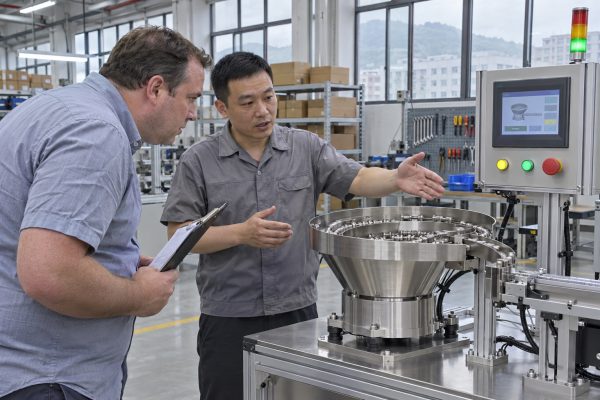
A buyer in Mexico once told me his automatic assembly machine from China sat idle for months after delivery. On our Wenzhou floor, we hear that story far too often.
To control risk when ordering an automatic assembly machine from China, verify the supplier’s legal identity, freeze a measurable technical specification in the contract, test with your real parts, pay in evidence-based milestones, inspect before shipment, and assign after-sales responsibility in writing.
The idle machine was not cheap in the end. It cost production time, rework, and a second supplier. The fix is not to avoid China. The fix is to treat the purchase as an engineering project with checkpoints. I will walk through the eight steps we use with our own customers: supplier background check, technical annex, sample test, staged payment, contract terms, factory acceptance, shipping control, and after-sales responsibility.
A procurement manager from Germany once asked us for our business license before he asked for a price. I respected that. It is exactly the order we recommend.
Verify a Chinese automatic assembly machine supplier by checking its exact legal name, unified social credit code, and business scope; confirming the bank beneficiary matches the contracting entity; auditing the factory in person or through a third party; and reviewing comparable machines running on real production parts.

Supplier background investigation is step one in our own process, and it comes before any technical talk. The reason is simple. If the company behind the quotation is not the company that builds the machine, every later promise is weaker than it looks.
The name on a website can belong to a factory, a system integrator, a trading company, or a one-person broker. Each one controls a different amount of the work. Ask the supplier directly what it designs, machines, assembles, programs, tests, and outsources. We tell buyers plainly which parts of a custom automation engineering job happen on our floor and which we source from partners. A supplier who cannot answer that question clearly is a red flag.
| Supplier type | What they usually control | Main risk for you |
|---|---|---|
| Direct factory | Design, assembly, PLC programming, testing | Some machining or castings may still be subcontracted |
| System integrator | Design and integration; buys machines and components | Warranty split across several parties |
| Trading company | Sales and export paperwork only | Limited influence on engineering changes or repairs |
| Broker or agent | Introductions and commission | No technical accountability after payment |
Request the exact Chinese legal name, the unified social credit code 1, the registered address, and a copy of the business license. Check that the registered business scope covers machinery. Then compare the contracting entity with the bank account beneficiary on the proforma invoice. They must be the same legal entity. A mismatch, or a sudden request to change bank details, should stop the order until explained.
A live video call is useful. Ask the supplier to walk to the machine that is closest to your project and show it running. Ask who is standing at the PLC. Still, for a high-value project, an independent factory audit is stronger. Third-party quality inspection firms can confirm floor space, staff, equipment, and whether the work is done in-house or sent to a lower-tier workshop. Choose an inspector with automation experience, not a consumer-goods checker.
Ask for references for machines with similar products, output, and tolerances. A bowl feeder that handles cable lugs tells you little about one that must orient tiny plastic clips. The reference should match your part, not just your industry.
During a bowl feeder build for a terminal line, our technician caught a part orientation issue only because we ran the customer's actual terminals, not our samples.
Require a frozen Technical Specification Document with approved drawings and bill of materials, written change control, in-process inspection of mechanical and electrical assembly, a sample test on your real parts, and a sustained Factory Acceptance Test at full speed, witnessed by you or an independent inspector.

Quality control for a custom machine does not start on the loading day. It starts the moment the technical requirements are written into a contract annex. That is our second step, and it is where most risk is either removed or locked in.
Most buyers compare quotations before they define the machine. A supplier can then quote low by assuming easier parts, looser tolerances, fewer sensors, or cheaper controls. Your Technical Specification Document, sometimes called a User Requirement Specification, should cover product drawings and 3D models, materials and tolerances, output per hour, target cycle time, acceptable defect rate, feeding orientation, assembly force or torque, inspection and reject handling, floor space, utilities, safety, and documentation deliverables.
| Weak requirement | Measurable requirement |
|---|---|
| High speed | At least 60 accepted assemblies per minute using approved production parts |
| Reliable | No more than 1% rejects during a continuous two-hour test |
| Fast changeover | Changeover between part A and part B in under 15 minutes by one operator |
| European standard | Guarding, interlocks, and emergency stops documented in a risk assessment aligned with CE Certification Compliance 2 for the destination site |
| Good components | Named brands and models listed in the bill of materials |
For complex layouts, ask for a 3D kinematic simulation during design. It reveals mechanical interference and cycle-time bottlenecks before steel is cut. We find this cheaper for everyone than fixing a collision on the bench.
A Component Brand Specification protects you for years. List approved brands for PLCs and HMIs 3, servo motors and drives, vision cameras, sensors, pneumatic valves and cylinders, linear guides, safety relays, and breakers. Any substitution should need your written approval. An undocumented controller that stops your line later is the most expensive part on the machine.
The machine is not successful when it runs once. It is successful when it repeatedly makes acceptable product. Define how many units, how long, how many rejects, how downtime is counted, and how measurements are taken. The test should cover output rate, accepted-product percentage 4, cycle time, changeover, alarm handling, safety devices, reject mechanisms, vision checks, manual and automatic modes, recovery after a jam or power loss, and documentation completeness. Confirm site voltage and frequency before the cabinet is built, because China-standard equipment often uses 380 V/50 Hz three-phase power. Inspection firms such as SGS, Bureau Veritas, Intertek, TÜV, or QIMA can witness the FAT, but check that the assigned inspector understands PLC and pneumatic systems.
Every deposit we quote is a balance. We need cash to buy servos and PLCs early, and the buyer needs leverage until the machine proves itself.
Protect yourself by signing a contract that attaches the technical specification, drawings, component list, and acceptance procedures; defines delay penalties, warranty, and dispute terms; and pays only the verified entity in milestones, holding a meaningful balance until the Factory Acceptance Test and commissioning pass.

Steps four and five in our own process are payment arrangement and contract terms. We put them together here because they work together. A strong contract with full prepayment still leaves you weak. Milestone payments with a vague contract leave you arguing about what each milestone means.
Full prepayment removes your influence if delivery slips or the machine fails acceptance. The better structure ties each payment to evidence, not to a promise, a photo, or a calendar date. The percentages below are a negotiation framework, not an industry standard. The right split depends on how much custom tooling is involved, how strong the supplier is, and your bargaining position.
| Milestone | Example share | Evidence that triggers payment |
|---|---|---|
| Supplier verified and contract signed | 10–20% | Business license checked, beneficiary matched, annex signed |
| Drawings and bill of materials approved | 20–30% | Buyer-approved layout, schematics, component list |
| Mechanical and electrical assembly completed | 20–30% | Inspection report with photos or third-party visit |
| Factory Acceptance Test passed | 20–30% | Signed FAT record on buyer's parts |
| Shipment, site acceptance, or commissioning | 5–10% | Machine running at the buyer's site, punch list closed |
Pay only the contracted entity. Treat any change in bank details as a fraud attempt until verified by phone with a known contact. For large or high-risk orders, a letter of credit shifts the trigger to documents and inspection certificates. Verified escrow is another option where practical. Keep retention money for open punch-list items. Define currency, bank fees, taxes, refund rules, rework rules, and termination rights in advance.
A common objection from suppliers, including us, is that components must be bought early and capacity must be reserved. That is true. The fair answer is a reasonable deposit, then later payments that follow approved engineering and inspected progress. A supplier who refuses any milestone structure is telling you something.
Your contract should not rely on the supplier's standard quotation. It should name the exact contracting entity, define scope boundaries, set a delivery date with delay consequences, state the Incoterm and the point of risk transfer 5, specify packaging, assign installation and commissioning, state performance guarantees, define FAT and Site Acceptance Test procedures, fix the warranty start date, set support response times, and lay out change-order, confidentiality, dispute resolution, and governing law terms. Translate vague words such as automatic, high precision, European standard, or turnkey into measurable obligations.
Secure the software you are paying for. Require modular PLC code, delivery of uncompiled source code, HMI and vision programs, robot programs, and administrative passwords upon final payment. In return, respect the supplier's design know-how with a confidentiality clause. We have no problem handing over programs to a customer who paid for a custom machine; we do ask that the designs are not resold to a third party.
One shipment to the United States taught me to confirm site voltage before the electrical cabinet is built, not after the crate lands.
Check the Incoterm and risk transfer point, export packaging and labeling, insurance, customs documents, site voltage and utilities, a Pre-shipment Inspection, and a written after-sales plan covering Site Acceptance Test, training, remote access, critical spares, response times, and warranty start date.

The last three steps in our process are factory acceptance before shipment, early control of transport and customs, and a clear answer to one question: once the machine reaches your plant, who is responsible? A machine that passed its FAT can still arrive damaged, incomplete, or impossible to restart without the right person on the phone.
The Pre-shipment Inspection is not a repeat of the FAT. It checks that the machine that passed the test is the machine going into the crate. Confirm disassembly and labeling of every sub-assembly, shock and moisture protection, corrosion prevention, export-grade crates with marked lifting points, crate dimensions and weights, a packing list, spare parts packed separately, and reconnection instructions for electrical and pneumatic lines. Our bowl feeders ship with the bowl removed from the drive base and the tooling protected, because a bent track is a slow and expensive repair on the far side of the ocean.
| Incoterm | Risk transfers | Who arranges main freight | Who handles import customs |
|---|---|---|---|
| EXW | At the supplier's factory door | Buyer | Buyer |
| FOB | When loaded on the vessel | Buyer | Buyer |
| CIF | When loaded on the vessel, supplier buys insurance | Supplier | Buyer |
| DAP | At the named destination, before unloading | Supplier | Buyer |
Read the Incoterm as a map of who pays for what and when risk moves. Then build a total landed cost: machine price, tooling, engineering changes, inspection, freight, insurance, duties and taxes, customs brokerage 6, inland transport, unloading equipment, installation, engineer travel, training, spare parts, translation, electrical adaptation, transformers or frequency converters, and production downtime during commissioning. Compare quotations on this number, not on the equipment line.
Support risk tends to appear after the final payment. Put the plan in writing before the order. It should state remote-response time, remote diagnostic capability, spare-parts response time, software backup availability, training format and duration, included service days, travel-cost responsibility, warranty exclusions, on-site repair obligations, obsolescence notice, and preventive-maintenance instructions. Pre-installed industrial remote-access hardware such as an eWON or Tosibox unit lets our engineers look at a PLC fault in real time instead of guessing from a photo. After-sales Technical Support without remote access is mostly email delay.
Before you order, describe a simulated fault. Ask the supplier how it would be diagnosed, what data would be read remotely, and how quickly a replacement part could be shipped. Negotiate a critical spares package based on a 24-month maintenance schedule, with part numbers, quantities, prices, and lead times. Custom-machined parts are the ones that hurt most, so stock those first.
The Site Acceptance Test repeats the key FAT measurements under your real utilities, operators, and parts. Tie the warranty start date to SAT completion, not to the shipping date. For an automatic assembly machine from China, this is the moment the risk you have managed all along finally becomes a running line.
Price got you a quotation. Evidence, control, and retained leverage get you a machine that runs. Verify, specify, test, pay in stages, and assign support before the deposit leaves.
1. Official US government resource explaining Chinese business registration and credit systems for due diligence. ↩︎
2. European Commission’s official guide on safety and health requirements for machinery sold in the EU. ↩︎
3. Leading professional organization for industrial automation standards and technical documentation for control systems. ↩︎
4. Standard industry definition of performance metrics used to verify equipment functionality during acceptance testing. ↩︎
5. International Chamber of Commerce’s official rules for allocating risk and responsibility in global trade. ↩︎
6. Official US Customs and Border Protection resource for managing import duties and trade documentation. ↩︎
