

A machine that fits on paper can jam at your dock, stall your line, and burn cash technical drawings 1. So we verify equipment dimensions and weight before every shipment leaves Wenzhou.
To verify equipment dimensions and weight before purchasing an assembly machine, request serial-number-specific technical data sheets, general arrangement and transport drawings, net and gross weights, crate dimensions, center of gravity, and lifting points. Then confirm them with photos, video, or pre-shipment inspection, and write every figure into the contract.
That is the short version. The long version is what follows. I will walk through what to ask for, how to check it, why it matters for your floor and your freight, and what to do when the numbers do not match.
A US procurement manager sent me a brochure page and asked if that was his machine's actual size. It was not. His machine had two extra bowl feeders.
Match every figure to the exact model and serial number on the data plate, not the catalog. Request a configuration list of installed, removed, and separately packed modules, then compare operating, transport, and packed dimensions plus net and gross weights against the manufacturer's spec sheet line by line.

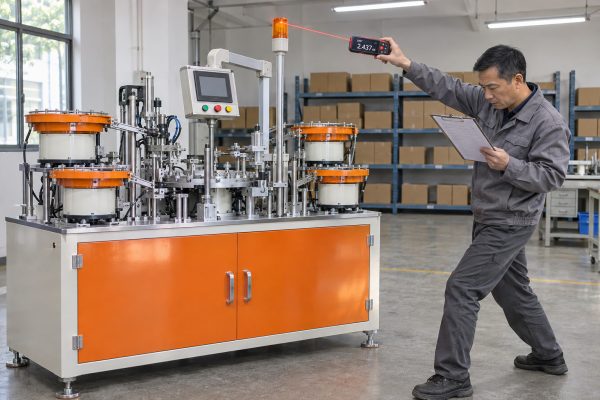
A brochure describes a product family. A data plate 2 describes one machine. Our assembly machines are built to order. A two-bowl version and a four-bowl version share the same brochure photo. They do not share the same width. The control panel on its articulated arm adds length. The orange signal tower adds height. A separate feeder stand adds a second package. So the first thing I ask a buyer to do is record the model, the serial number, and the build year from the plate, and then tie every document to those three items.
Some buyers push back here. They say the manufacturer's documentation is enough for a new, standard machine. I agree with them in one case: the machine is standard, the technical data sheets are current, and the supplier confirms the configuration in writing. Our equipment rarely meets that first condition. Non-standard automation is our core business. One added hopper or one retrofitted guard changes the envelope. For used, modified, or imported machines, documentation alone is not defensible. The cost of a failed delivery is far higher than the cost of one extra check.
| Term | What it includes | Why it matters to you |
|---|---|---|
| Operating dimensions | Assembled machine, ready to run, feeders and cabinets attached | Decides your production footprint and clearances |
| Transport dimensions | Machine with hoppers, conveyors, guards, or panels removed or folded | Decides whether it fits the truck and your doors |
| Shipping dimensions | Transport size plus pallet, skid, wooden crate, and packaging | Decides container choice and freight cost |
| Net weight | Machine only, often without fluids, tooling, or accessories | Useful for floor loading estimates |
| Gross weight | Everything on the truck, including crate, loose parts, and rigging | Decides forklift, crane, and payload limits |
| Center of gravity 3 | The point where the mass acts | Decides sling angles, trailer loading, and tip risk |
Two more terms cause confusion. The footprint is the floor area under the base. The overall envelope is the maximum length, width, and height, including handles, control panels, cable trays, and open doors. Equipment footprint analysis must use the envelope, not the frame.
Before the contract is signed, ask the supplier for the machine's outer dimensions, net weight, packaging dimensions, and gross weight. Then confirm the wooden crate dimensions, the center of gravity, and the lifting positions. That is the minimum I provide on every quotation, and I ask our buyers to insist on it from any supplier. On top of that, request the general arrangement drawing, the foundation drawing, the transport drawing, the packing list 4, the anchor-bolt layout, the floor-load requirement, the utility drawing, and the disassembly instructions. Finally, ask one plain question: do the published dimensions include the control cabinet, the safety guarding, the vibratory bowls, the conveyors, the pallet, and the packaging? If the answer is vague, the figure is not verified.
Last month we crated a twin-bowl assembly machine for Germany. The crate came out taller than planned because of the signal tower. We caught it with a tape measure.
Use calibrated tape measures and laser distance meters at the widest and tallest points, a certified weighbridge or crane scale for gross weight, scaled photographs and live video for remote checks, 3D CAD models for clash detection, and a formal measurement step during the Factory Acceptance Test before shipment.

| Tool or method | What it verifies | Best stage to use it |
|---|---|---|
| Tape measure and laser distance meter | Envelope at widest and tallest points, crate size | FAT and after packing |
| Crane scale, load cells, or weighbridge | Gross weight and weight per module | Lifting and loading |
| Scaled photographs with a tape in frame | Protrusions, feet, skids, lifting points | Remote buyers, any stage |
| Live video inspection | Whether conveyors fold, guards remove, cabinets separate | Used or customized machines |
| STEP or IGES CAD model | Virtual clash detection in your plant layout | Before order confirmation |
| Augmented reality footprint projection | Line-of-sight and ergonomic bottlenecks on the real floor | Before order confirmation |
| Third-party pre-shipment inspection | Independent record of dimensions, weight, and configuration | High-value or high-risk orders |
Weight depends on configuration. A machine with empty lubrication reservoirs and no tooling weighs one thing. The same machine with full reservoirs, dies, magazines, and a crate weighs another. That second figure is the dynamic reality the trailer and the floor must carry. So I ask our team to weigh each transport module on its own and then the full crate. The inspection report should state the configuration, fluid levels, accessories installed, date, equipment used, and tolerance. For high-speed assembly modules, I also provide center-of-gravity coordinates. A tall, top-heavy unit on four small leveling feet can walk across a floor under vibration if the mass sits high and off-center.
The Factory Acceptance Test is the last moment the machine is standing uncrated where someone can still fix a problem. We measure the as-built envelope during the FAT and compare it with the approved submittal drawing. A buyer can attend in person, join by video, or send an inspector. Pre-shipment checks that confirm dimensions and weight also reduce paperwork errors on packing lists and bills of lading. That cuts the chance of a secondary customs inspection, which saves days at the port.
Every layout we draw faces one tension: squeeze in more stations, or leave room to service them. Our bowl feeders need more clearance than their frames suggest.
Accurate dimensions and weight decide whether the machine clears your doors and corridors, whether the floor handles its point loads, which trailer, container, crane, or forklift you need, and whether permits, insurance, and customs paperwork are right. Errors cause rebooking, storage fees, and failed installs.

Supplier data only has value when you compare it with your site. I ask buyers to survey the whole route: gate width, road turning radius, dock capacity, door width and height, threshold height, corridor width, ceiling height, elevator size and rating, ramps, columns, fire doors, and sprinkler heads. Measure at the narrowest and lowest points. Do not trust the architectural drawing. Hinges, seals, and half-opening door leaves eat clearance. Then compare the largest shipping dimension with the smallest usable opening and keep an engineering margin. Photograph everything and sketch a simple site plan. The route for future removal matters too.
| Envelope | What it adds | Who needs it |
|---|---|---|
| Machine body | Frame, cabinet, feeders, and panels at rest | Layout designer |
| Operating envelope | Open doors, moving arms, loaded conveyors | Operators and safety |
| Maintenance envelope | Full door swings, pull-out drawers, technician working space, thermal airflow gap | Maintenance team |
| Transport envelope | Crate, skid, protective frame, loose packages | Rigging and drayage crew |
Thermal clearance is easy to forget. A control cabinet needs airflow for heat dissipation. The gap is often wider than the frame suggests. The utility drop zone 5 also needs mapping in 3D so overhead drops for air, power, and data do not cross a crane path or a robotic reach. CAD layout integration handles this well. Load the STEP model into your plant drawing, run clash detection, and check material flow constraints before you fix the position.
A machine of moderate total weight can still crack a slab. The load passes through four small leveling pads, not the whole base. So the useful question is the maximum load per foot, not the average weight per square meter. Ask for the number and position of support points, the static and dynamic loads 6, foundation thickness, anchor-bolt details, vibration-isolation needs, and flatness tolerances. If the slab is old or the machine is heavy, order a structural engineering assessment of the floor load-bearing capacity before purchase, not after delivery.
Carriers need length, width, height, weight, center of gravity, lifting points, photos, and loading conditions before they quote. In some European road contexts, standard limits sit around 2.55 m vehicle width and roughly 4 m overall height. Legal limits differ by country and route, so confirm them with the carrier and the authority. A machine that passes on dimensions can still exceed payload or axle limits once crated. Container doors, internal width, floor strength, and lashing points can be tighter than the nominal box size. A crane's rated capacity falls as the working radius grows, so a crane that is adequate on paper may fail at the actual unloading spot.
Buyers often ask me whether to ship fully assembled or partially disassembled. Fully assembled cuts reassembly and commissioning risk, but raises transport size, permits, and unloading complexity. Disassembly lowers freight cost, but risks lost parts, misalignment, wiring, calibration, and warranty disputes. My answer is to decide module by module on the transport drawing, with responsibility for reassembly written down. The same logic applies to clearance versus floor space. Set separate minimum clearances for delivery, operation, maintenance, and removal. That is real facility layout optimization, not guesswork.
The hardest lesson I learned came from an early shipment where the crate outweighed the packing list. The port forklift was not rated for it.
Stop, document the gap with photos and measurements, and notify the supplier in writing before moving or installing anything. Check the contract's agreed figures, tolerance, and remedy clause, then agree on a fix: re-measure, modify packaging, adjust rigging, revise freight, credit the cost, or reject delivery.

A wrong figure is not a technical slip. It is a commercial event. It can trigger rebooking, storage charges, a cancelled crane, a customs query, or a site modification. So the contract has to carry the numbers. After that early mistake, we changed how we quote, and I now ask every buyer to check these clauses:
| Clause | What to state | Why it protects you |
|---|---|---|
| Identity | Exact model, serial number, build year | Links all documents to one machine |
| Scope | Included and excluded accessories and modules | Stops "the brochure did not show that" arguments |
| Figures | Agreed operating and transport dimensions, net and gross weights, crate size, center of gravity | Creates a measurable standard |
| Tolerance | Allowed deviation in millimeters and kilograms | Separates a nuisance from a breach |
| Responsibility | Packaging, disassembly, loading, permits, unloading, Incoterm and named place | Assigns cost before a dispute |
| Verification | Independent inspection right, FAT measurement, re-weighing at carrier | Gives you evidence, not opinion |
| Remedy | Steps, timelines, and cost allocation for a mismatch | Removes guesswork under pressure |
The Seller confirms that Machine Serial No. ____ will be delivered with the operating dimensions, transport dimensions, crate dimensions, net weight, gross weight, center of gravity, and lifting points stated in Annex A. Deviations beyond ± __ mm or ± __ kg entitle the Buyer to re-measurement at the Seller's cost, an adjustment of freight and handling charges, and, where delivery or installation is prevented, rejection or repair at the Seller's expense.
Most disputes I have seen trace back to five habits. Someone used brochure dimensions for a machine with options. Someone reported net weight instead of gross. Someone measured the frame and ignored the signal tower, the feeder stand, or the control arm. Someone mixed inches and millimeters and then rounded. Someone accepted a verbal confirmation on a call. The fix for all five is the same. Keep every figure in the supplier's units and your own, check the conversion independently, avoid rounding near tight clearances, and accept nothing that is not on paper with a serial number attached. Concise WhatsApp messages are fine for speed, but the agreed figure must land in the purchase order.
A spec-sheet surprise can cost more than the freight itself. Verify the machine as a shipment, not just a product, and put every confirmed figure in writing.
1. Authoritative government source listing technical drawings as essential export documentation for machinery. ↩︎
2. ISO standards define the requirements for machinery identification and safety data plates. ↩︎
3. The center of gravity is a fundamental physical concept critical for safe machinery lifting and transport. ↩︎
4. CBP requires accurate packing lists to verify equipment dimensions and contents for customs clearance. ↩︎
5. NIST supports standards for digital factory layouts, including spatial mapping for utility drop zones. ↩︎
6. OSHA provides safety guidelines for managing static and dynamic loads on industrial floor surfaces. ↩︎
