

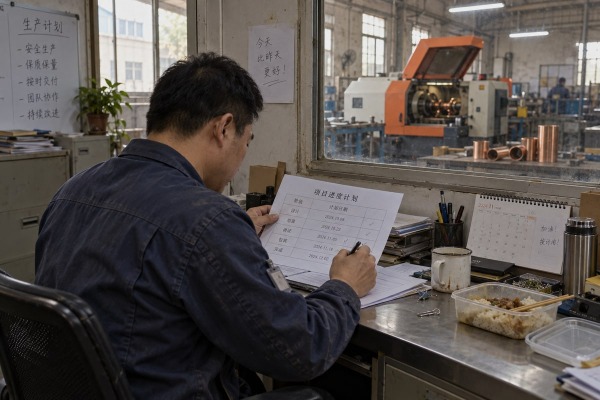
Buyers who ask only “when can you ship?” often lose months. On our Wenzhou production line, we build a pipe cutting machine production schedule as a dated document instead.
To request a detailed production schedule for a pipe cutting machine, send the supplier your machine specs, output targets, site data, and required dates, then ask for a dated milestone table covering design, assembly, debugging, packing, and completion, with assumptions, long-lead parts, and a named project owner.
That is the short answer. The rest of this article shows you what to send, what to ask, how to check the dates, and how to follow the build once it starts.
Last year a procurement manager in Canada sent us a two-line inquiry for a CNC pipe cutting machine. We replied with a question list before we quoted anything.
Include the cutting method, pipe diameter and wall-thickness range, materials, cut types, tolerances, pieces per shift, number of shifts, automation level, electrical standard, installation country, required ship date, and production start date. Then ask for a stage-by-stage schedule listing design, assembly, debugging, packing, and completion dates.

A supplier cannot plan a build it does not understand. The quality of the schedule you receive depends almost entirely on the quality of the input package you send. I treat the request as a technical procurement document, not a casual email.
| Input group | What to send | Why it changes the schedule |
|---|---|---|
| Machine requirements | Cutting method (cold saw, band saw, laser, orbital), manual or CNC, diameter and wall range, max and min length, pipe material, cut types (square, miter, bevel, notching), tolerance, loading and unloading needs, electrical voltage and frequency, safety and chip handling | Custom tooling, guarding, and control programming add design and debugging days |
| Production requirements | Pieces per shift, target cycle time, number of shifts, batch sizes, changeover frequency, product mix, required uptime, future capacity expansion | Machine throughput targets decide drive sizing, automation level, and how long trial cutting takes |
| Commercial and site data | Installation country, desired ship date, required in-service date, budget stage, payment terms, Incoterm, warranty length, local service needs | Shipping method, customs, and payment timing all shift the start and end dates |
One point from search results is worth stressing. State your throughput and cycle time for each diameter and wall-thickness combination, not one average. A machine that cuts thin copper tube fast may slow down on thick carbon steel. If you use material nesting software or need the controller to sequence jobs for low scrap, say so up front. That logic affects software work, and software work affects the debugging stage.
This is the part I insist on. Ask the supplier to lay out the schedule by time nodes with the detailed work content under each node. In our own project sheets, we break every build into five stages: design, assembly, debugging, packing and pre-delivery, and completion date. We then hold ourselves to that sheet.
| Stage | Work content to list | Completion evidence |
|---|---|---|
| Design | Drawing review, general arrangement drawings, electrical drawings, buyer approval | Signed drawings |
| Assembly | Frame fabrication, mechanical assembly, wiring, purchased parts installed | Dated photos |
| Debugging | Software loading, no-load run, trial cutting, internal QC | Test report |
| Packing and pre-delivery | FAT punch-list closed, cleaning, crating, documents | Packing photos and list |
| Completion | Ex-works date, shipment booking | Bill of lading |
A buyer may object that this is too much paperwork for a standard machine. My answer is simple. Ask the supplier to quote the standard baseline 1 and optional automation separately. The standard unit gets a short schedule. The custom options get their own line items. You then see exactly where the extra weeks come from, and your production capacity planning stays honest.
Every quote forces a trade-off between a short number that wins the order and an honest number that survives the project. Our engineers always argue for the honest one.
Confirm a realistic lead time by asking when the clock starts, whether days are working or calendar days, which components are long-lead or in stock, what the current backlog is, and whether testing, packing, and buyer approvals are included. Then compare the answers against the supplier's milestone table.

A manufacturing lead time is only a number until you know its boundaries. "Twelve weeks" can start at purchase order, at deposit receipt, or at final drawing approval. Those three starting points can sit a month apart. I ask every buyer to pin the start and the finish down in writing before they compare offers.
| Question to ask | What a weak answer looks like | What a solid answer looks like |
|---|---|---|
| When does lead time begin? | "After order" | "After deposit and signed drawings, whichever is later" |
| Working days or calendar days? | No distinction | Working days stated, holidays and factory shutdowns listed |
| Which parts are long-lead? | "All in stock" | Named controller, drives, or saw head with supplier and procurement date |
| Is debugging included? | Not mentioned | Trial cutting and FAT shown as dated stages |
| Is packing and freight included? | Silent | Ex-works date separate from transit estimate |
| What is your current backlog? | Refuses | States machines in progress and available capacity |
Search results also recommend asking for a lead-time breakdown that separates raw material procurement 2, machine setup, actual build time, and post-process handling. I agree. When those four blocks are visible, you can see which one is thin.
An offer that beats everyone else by weeks is rarely faster. It is often missing something. Watch for these signs:
A buyer may push back here. "If I demand a buffer, won't suppliers just pad every date?" That is a fair worry. The fix is to ask for a risk register instead of an unexplained long duration. Each risk gets a probability, an impact, an owner, and a mitigation step. We also build scheduled maintenance 3 and small downtime buffers into our internal plan. Resource allocation across several builds is easier when those buffers are visible to the buyer rather than hidden inside a round number.
Finally, ask the supplier to classify every milestone as firm, target, or dependent. Firm dates bind the supplier. Target dates are estimates. Dependent dates move when you move.
During a trial run in our workshop, a stainless tube cut square for ten pieces and drifted on the eleventh. That drift is why we test before packing.
Ask for the dates, duration, and pass criteria of each checkpoint: incoming material inspection, mechanical assembly check, electrical and safety test, no-load dry run, trial cutting with sample pipe, and factory acceptance test. Request test piece counts, tolerances, cycle-time method, a punch-list procedure, and the condition that authorizes shipment.

Quality checkpoints belong inside the schedule from day one. If they are added later, they push the ship date and create arguments. I ask buyers to write the checkpoints into the milestone table so that each one has a date, an owner, and a piece of evidence.
| Checkpoint | Stage | What to ask for |
|---|---|---|
| Incoming parts inspection | Assembly | Confirmation that drives, controller, and cutting head match the approved spec |
| Mechanical assembly check | Assembly | Alignment and clamping verified, dated photos |
| Electrical and safety test | Debugging | Emergency stop, guard interlocks, and alarms tested |
| No-load dry run | Debugging | Axis motion, feed, and software screens run without pipe |
| Trial cutting | Debugging | Cuts on your pipe spec or an equivalent, with measured results |
| Factory acceptance test | Pre-delivery | Witnessed test against written criteria, punch list, shipment release |
| Site acceptance test | Commissioning | Repeat key tests on your floor before final acceptance |
For trial cutting, define the inputs. State the number of test pieces, the diameters and wall thicknesses to cut, the tolerance on length and squareness, and how cycle time will be measured. Cycle time optimization during debugging is normal, but the final test must run at the speed you plan to use in production.
Buyers ask this often. Travel costs money and a witnessed test adds days. My answer is to make the FAT risk-based, not to skip it. Test the features that could stop production, hurt cut quality, or break integration. Leave cosmetic items for the punch list. If you cannot travel, ask for a remote FAT by live video with your sample drawings on screen. We have run witnessed video tests for buyers in India and the United States, and the recordings became part of the handover file.
Two points from current search results fit well here. First, if you cut pipe for pressure applications, ask how the machine and its software will keep the cutting sequence aligned with material heat numbers so every piece stays traceable to its certificate. Second, ask for a tooling life forecast. Blades and nozzles wear. A schedule that shows expected blade or nozzle replacement intervals helps your maintenance team plan consumables before the first high-volume run.
One lesson from shipping machines to Mexico and Slovakia stuck with us: silence after the deposit makes buyers nervous. So we now send dated photo updates at every stage.
Track progress by tying every update to the milestone table: request a named project manager, weekly status reports, dated photos or videos at design, assembly, debugging, and packing stages, early notice of any slip with a recovery plan, and a shared tracker you can import into your ERP system.
Tracking only works if there is something to track against. That is why the stage-by-stage schedule from the first section matters so much. Each update should reference a stage, state whether it is on time, and attach evidence. A message that says "going well" tells you nothing. A message that says "assembly stage complete two days early, photos attached, debugging starts Monday" tells you everything.
| Timing | Update content | Evidence |
|---|---|---|
| Weekly | Status of current stage, next stage start date, any open issues | Short report by email or WhatsApp |
| At each stage close | Design, assembly, debugging, packing confirmed complete | Dated photos or video |
| On any slip | Cause, new date, recovery plan | Revised milestone table |
| Before shipment | FAT report, packing list, crate photos | Signed documents |
Many of our buyers prefer WhatsApp for quick photos and email for formal reports. Both are fine. What matters is that the stage names in the update match the stage names in the schedule.
The supplier's schedule covers what the supplier controls. Your integrated project schedule must also cover your side. Floor space, foundation or leveling, power supply, compressed air, extraction, network cables, forklift or crane for unloading, operator hiring, and trial material are all buyer tasks. Good shop floor management means those tasks have dates too. A machine that arrives before the power is ready is not "delivered" in any useful sense. I ask buyers to build a two-column responsibility matrix so both sides see the full fabrication workflow from order to first production shift.
Search results point to ERP system integration 4 for real-time status updates. Even without a direct connection, ask the supplier for the milestone table in a spreadsheet format you can load into your planning tools. Once the machine is running, the same thinking applies to production tracking. Some buyers want IoT data from the machine to adjust schedule buffers in real time when material or thermal conditions change. Others simply want the cutting plan aligned with downstream welding or assembly stations so the cutter does not flood the next workstation. Both goals start with the same habit: tie every date to a named stage and a named person.
Dates slip for reasons on both sides. Late drawing approval, late payment 5, and spec changes are buyer-caused. Supplier-caused delays come from component shortages or test failures. Agree in advance how each type is reported, who absorbs it, and what the recovery plan looks like. That agreement turns a slip into a managed event instead of a dispute.
Stop asking only for a ship date. Send a complete input package, demand a stage-by-stage dated schedule, verify assumptions, test before packing, and track every milestone until handover.
Interested in sourcing the products mentioned in this article? See details and request a quote here:
1. Wikipedia defines the role of standardization in ensuring consistency across industrial products and processes. ↩︎
2. Wikipedia provides an overview of procurement processes used to acquire goods and services in manufacturing. ↩︎
3. OSHA sets safety standards for machine maintenance and hazardous energy control in manufacturing environments. ↩︎
4. NIST provides federal standards and guidelines for industrial technology and enterprise resource planning systems. ↩︎
5. The World Bank offers guidance on international commercial practices and payment obligations in global trade. ↩︎
