

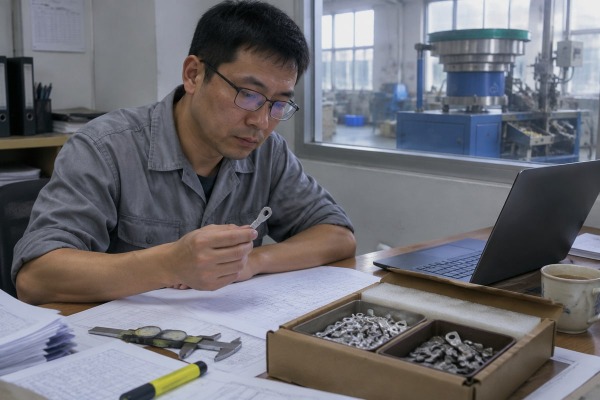
Every week, buyers email our Wenzhou factory asking for an accurate assembly machine quote with only one photo attached. The price they get back can only be a rough guess.
For an accurate assembly machine quote, give suppliers your product drawings and 3D models, physical samples, target cycle time and production volume, quality tolerances, factory layout and utilities, plus clear scope boundaries covering tooling, installation, commissioning, training, and acceptance criteria.
That is the short answer. But each of those items deserves a closer look. Below, I walk through the four categories of information that shape every quote we prepare, and I explain why skipping any one of them leads to price swings, change orders, or the wrong machine on your floor.
Last month a buyer sent us one blurry photo of a terminal lug 1 and asked for pricing. We had to request drawings three times before we could quote anything real.
Share controlled 2D part drawings and 3D models at the current revision level, a component bill of materials, critical tolerances, material specifications, and physical samples — including known out-of-spec rejects — so suppliers can verify feeding, orientation, and tooling before pricing your machine.

The technical file package is the single biggest factor in quote accuracy. Our engineers design every station around the product itself, so vague product data means vague pricing. Outdated drawings are one of the most common sources of quote mistakes, which is why we always ask for the current revision level in writing. If your design team updates a flange radius after we quote, the tooling price changes too.
Physical samples matter as much as digital files. Vibratory bowl feeders are sensitive to burrs, oil films, and surface finish. That is why we ask buyers to ship both good parts and known out-of-spec rejects. We test feeding and orientation reliability with real parts before we commit to a price.
| File or Item | Why the Supplier Needs It |
|---|---|
| 2D drawings with revision number | Confirms critical dimensions and tolerance and precision standards |
| 3D CAD models (STEP/IGES) | Enables station design, gripper design, and interference checks |
| Component bill of materials | Shows every part the machine must feed, orient, and join |
| Physical samples (good + reject) | Verifies bowl feeder behavior and sensor detection |
| Material safety data sheets | Flags coatings, lubricants, or adhesives needing special handling |
Some buyers worry that a detailed RFQ 2 slows procurement. For simple standard equipment, that can be true. But for a custom assembly system, incomplete information delays the project far more than a thorough file package ever does.
There is a real trade-off our engineers weigh on every project: a faster machine costs more to build, while an undersized one chokes your line within a year.
State your target cycle time, required parts per minute, annual production volume forecasts, batch sizes, shifts per day, and uptime expectations. This data lets suppliers size feeders, stations, and drives correctly instead of undersizing or overspeccing the machine.

Cycle time requirements drive almost every engineering decision, and therefore almost every cost line. A machine producing 30 parts per minute needs different feeders, actuators, and control architecture than one producing 60. When we build terminal lug assembly machines, doubling the output target often means adding stations or moving from pneumatic to servo drives. The price difference is significant, so the speed must be confirmed before quoting, not after.
Here is the capacity data we ask every buyer to provide before we prepare a firm proposal:
| Data Point | Example Format | What It Affects |
|---|---|---|
| Target cycle time | 2.0 seconds per part | Station count, drive type, feeder size |
| Output rate | 30 PPM | Bowl feeder capacity, indexing speed |
| Shifts per day | 2 shifts, 6 days/week | Component duty rating, maintenance design |
| Annual volume forecast | 8 million units, growing 15% | Scalability and modular station planning |
| Batch size and changeovers | 50,000 units per run | Quick-change tooling requirements |
| Uptime target | 90% availability | Redundancy, sensor quality, spare parts list |
A common objection I hear is that giving minimal information first speeds up the process. It does produce a fast ballpark number. But that ballpark is a budgetary estimate 3, not a firm proposal, and the two can differ badly. Growth plans matter too. If your production volume forecasts show expansion in two years, we can design in modularity now rather than replacing the machine later.
A procurement manager from the US once told me he assumed our assembly machines came in standard models. They do not. Every unit we build is customized around the product.
Include your automation level requirements, station-by-station process flow, changeover needs, future product variants, PLC and HMI brand preferences, MES or data connectivity, safety standards, and remote access rules. Then ask for itemized pricing that separates the base machine from options and services.

Automatic assembly machines are all custom machines. We design each station and each process step around the product being made. That is why I always tell buyers: talk directly with the supplier’s technical engineers 4 about the functions you need, send drawings and product samples, and confirm the processing speed together before anything is priced. This conversation is not optional. It is where an accurate assembly machine quote actually gets built.
A written functional requirement specification does not need to be long. It needs to cover these points:
Some buyers argue the supplier should do all the engineering, so the buyer need not specify much. We do design the solution. But we still need your process data, output targets, and constraints to quote it correctly. And when comparing quotes, do not chase the lowest headline price. Compare scope, written assumptions, exclusions, lead time, and support terms line by line.
Years ago we shipped a machine that cleared every spec except one: the customer’s workshop door. That painful lesson changed how we collect site information before quoting.
Yes. Send your floor plan, footprint and ceiling limits, power and compressed air capacity, network access, and environmental conditions before requesting a quote. These details affect machine frame design, installation cost, commissioning time, and whether the supplier includes site acceptance testing.

Site conditions are the most commonly forgotten part of an RFQ, yet they hide some of the largest surprise costs. Installation, commissioning, training, crating, and freight can add a meaningful percentage to the total project cost. If these items are not in the quote request, they will not be in the quote, and you will discover them as change orders. When we prepare proposals for buyers in the US, Mexico, or Vietnam, we ask for site data up front so freight, voltage conversion, and commissioning support are priced from day one.
| Site Factor | What to Provide | Why It Matters |
|---|---|---|
| Floor space limitations | Footprint dimensions and ceiling height | Determines frame layout and feeder placement |
| Electrical supply | Voltage, phase, frequency, available amperage | Drives control cabinet and motor selection |
| Compressed air | Pressure and flow capacity | Sizes pneumatic actuators and dryers |
| Network access | Ethernet availability, plant IT rules | Enables MES links and remote diagnostics |
| Environment | Temperature, humidity, dust, vibration | Affects sensor choice and enclosure rating |
| Access route | Door widths, lift capacity, dock type | Prevents delivery and rigging failures |
Acceptance criteria belong here too. Define your factory acceptance test and site acceptance test requirements in the RFQ, including pass metrics, sample quantities, and who supplies test material. When the FAT and SAT handoff is defined up front, the supplier can quote commissioning honestly, and you get a clean, measurable path from purchase order to production.
An accurate assembly machine quote starts with a complete RFQ. Send drawings, samples, cycle time targets, customization details, and site data, and suppliers can price the right machine first time.
