

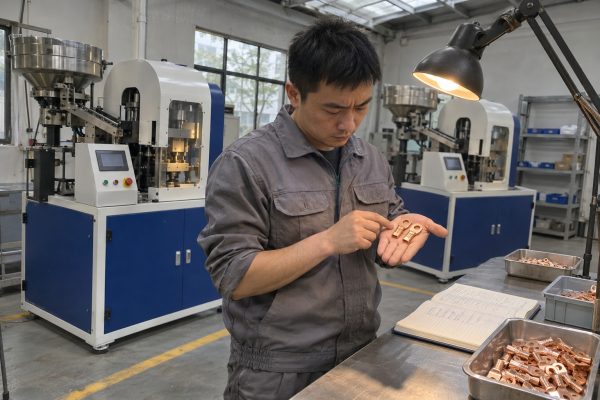
A weak cable lug making machine supplier rarely fails loudly. It fails through late dies, slow support, and drifting crimp quality. Our Wenzhou team uses one framework to decide.
Switch cable lug making machine suppliers only when documented losses from quality drift, downtime, late delivery, and slow after-sales support exceed the full cost of switching, and when a replacement supplier proves equal or better performance through sample runs, acceptance tests, and a phased dual-sourcing pilot.
That rule sounds simple. In practice, most buyers skip the evidence step and jump straight to price. This article walks through the four questions I ask every buyer who tells me they want to leave their current supplier.
Last year a buyer sent us photos of cracked copper barrels from his old press. The crack was not the real problem. The supplier's silence afterward was.
The clearest warning signs are declining machine quality, frequent delivery delays, slower after-sales response, and an inability to meet new processing needs. When these problems repeat over several months and show up in scrap, downtime, and missed shipments, your cable lug making machine supplier is failing you.

My own view is direct. If equipment quality keeps dropping, deliveries slip again and again, after-sales response gets slower, or the machine can no longer handle your new processing requirements, you should start a formal review. One bad week is not a reason. A pattern backed by records is.
I group the signals into four measurable buckets. Each one needs a number, not a feeling.
| Category | What to measure | Question to ask |
|---|---|---|
| Quality drift | Rejection rate, incorrect crimp dimensions, inconsistent hex or indent profiles, cracks, burrs, loose or over-compressed joints | Does the scrap cost now exceed what a new machine would cost per year? |
| Downtime and reliability | Unplanned downtime hours per month, mean time between failures, mean time to repair, repeat failures | Does one breakdown stop the whole line? |
| Delivery and service | Late deliveries, response time to a service ticket, spare parts availability, willingness to share documentation | Is technical response slower than 24 hours on a stopped machine? |
| Capacity and fit | Lug sizes, conductor cross-sections, copper versus aluminum, changeover time, traceability needs | Can the machine process the SKUs you plan to sell next year? |
Hydraulic crimp force repeatability is the first thing I check when a buyer reports loose or over-compressed connections. If the force drifts, crimp dimensions drift, and pull-out results 1 drift with them. Then the parts fail IEC 61238-1 compliance checks 2 or UL 486A customer audits. At that point the supplier problem has become a customer problem.
Every supplier has a bad month, including us. A single late shipment during a port backlog is not a trigger. Three late shipments in two quarters with no explanation is. Keep a simple log. Date, issue, response time, resolution. After a few months, the pattern is obvious.
Before you blame the machine, I suggest checking your own side. Poor maintenance, wrong die selection, unsuitable copper tube stock 3, and operator setup errors all look like supplier faults. When we troubleshoot remotely through our touchscreen logs, roughly half of the "machine" complaints turn out to be setup or material issues. Fix those first. Then judge the supplier on what remains.
"Just quote me a high-speed one." That was the first message from a US procurement manager. I asked for conductor sizes, strand class, and crimp profiles before any price.
Compare suppliers on identical written specifications, not marketing claims. Send every SKU with conductor size, copper tube OD range, plating, and crimp type, then score each candidate on product fit, output, hydraulic crimp force repeatability, tooling flexibility, PLC controls, safety documentation, and after-sales support using a weighted scorecard.

The supplier who asks the most questions before quoting is usually the one worth talking to. A generic request gets a generic machine. That is how specification gaps happen in the first place.
I ask every buyer for one controlled sheet. It lists each SKU with:
A common published range for this equipment is 10 mm² to 400 mm², and a capacity safety margin of about 20% is a sensible rule. But I never let a buyer rely on that. The full minimum-to-maximum range has to be checked against the actual drawings, not one representative part.
Lowest quote wins is a mistake I see too often. This is the weighting I suggest as a starting point. Adjust it if your main pain is downtime rather than quality.
| Criterion | Weight | What proves it |
|---|---|---|
| Technical fit | 25% | Written confirmation per SKU, sample run on your material |
| Quality and repeatability | 20% | Crimp dimension data, pull-out force measurement, cross-section photos, process capability on key dimensions |
| Reliability and maintainability | 15% | Installed-base references, failure modes list, spare parts kit |
| After-sales technical support | 15% | Named escalation contacts, documented response commitment, remote diagnostics |
| Total cost of ownership | 15% | Itemized quote with dies, freight, training, energy, wear parts |
| Delivery and commercial risk | 10% | Lead time, payment milestones tied to acceptance, warranty terms |
Ask for good parts per hour at your exact configuration, not a peak number. Ask for production cycle speed after normal operator intervention and the rejection rate during the test. Some guides suggest targeting cycle times below five seconds for high-volume work. Treat that as an example, not a universal benchmark.
Tooling decides whether a cheap machine stays cheap. Compare the number of dies included, die life, quick-change capability, lead time for replacement dies, and who owns custom tooling. Mold flexibility and customization matter more than most buyers expect, especially if they serve both copper and aluminum markets.
Our machines run on PLC control with a touchscreen 4, recipe management, production counters, and a signal tower for status. Those features help with traceability. Newer options include IoT sensors that watch hydraulic pressure swings to predict die wear, open-architecture PLCs that accept add-on stations like laser marking, and digital twin simulation of new lug designs before cutting steel. These are real advantages. Still, no feature list outweighs weak mechanical reliability or absent support. Also check that ISO 9001 and CE certificates are valid, in scope, and issued for the actual machine model.
Every quote we write forces a trade-off. A lower machine price can hide higher die costs, longer freight, and weaker support. I prefer to show buyers the whole number.
Weigh total cost of ownership, not machine price. Add installation, training, new dies, freight, duties, customer requalification, duplicate inventory, and downtime, then subtract avoidable losses from the incumbent. Switch only if the net annual benefit is positive and the payback period fits your capital plan.

Switching is a capital decision. It is not a search for a cheaper press. The math has to work on paper before anything ships from Wenzhou or anywhere else.
Record what the incumbent machine actually costs you over a full year. Include energy and compressed air, labor per finished lug, die consumption, maintenance and spare parts, scrap and rework, downtime hours, overtime, expedited freight, customer returns, and output per shift. Most buyers who do this are surprised. Downtime and scrap usually dwarf the purchase price difference between two suppliers.
Net benefit of switching equals annual avoidable losses with the incumbent, minus annual operating cost with the new supplier, minus transition costs. Payback period equals total switching investment divided by annual net savings. The numbers are only credible if output, yield, and uptime come from verified tests on your real products.
A full switch is not the only move. I lay out these alternatives for every buyer.
| Option | When it fits | Main risk |
|---|---|---|
| Stay and repair or retrofit | Problem is one subsystem; supplier offers a corrective-action plan | Repeated fixes without root cause |
| Stay and add a second machine | Capacity is the issue, not quality | Doubling exposure to the same supplier |
| Add a backup supplier, keep incumbent | Downtime risk is high; dual sourcing is cheap insurance | Two sets of dies and training |
| Replace machine, keep incumbent for service | Old machine is obsolete but local service is good | Split responsibility when things fail |
| Fully switch supplier | Pattern of failure across quality, delivery, and service | Transition downtime and requalification |
"My current supplier already knows my products." True, and that is worth something. So ask them for a formal corrective-action proposal first. If they decline or stall, that is your answer.
"A new supplier's references won't match my conditions." Correct. That is why I insist on a sample run with your own copper stock and your own inspection protocol, not ours.
"The low quote probably hides costs." Often yes. Indicative automatic-machine prices of roughly $12,000 to $39,000 and lead times of 25 to 50 days appear online, but configuration, tooling, and destination change those figures a lot. Demand an itemized quote that separates machine, dies, testing, freight, installation, training, spare parts, and software.
"Switching might make reliability worse." It can, if you switch before securing spare parts availability and after-sales technical support. So do not switch before those are contractually locked.
The hardest lesson from our export projects is simple. Installation day is never the risky part. The risky part is the first month when operators still reach for old habits.
Run a phased transition: keep the incumbent machine operational, build safety stock, test all critical SKUs on the new machine, lock acceptance criteria and spare parts into the contract, train several operators, then shift volume gradually from about 30% to 70% only after quality and uptime gates are met.

A transition plan protects your customers, not just your budget. Here is the six-phase process I walk through with buyers in the US, Germany, and India before any purchase order is signed.
| Stage | What is checked | Payment link |
|---|---|---|
| Sample run | Cycle time, good-part output, rejection rate, crimp dimensions, pull-out force measurement, changeover time | Before order |
| Factory acceptance test | Approved product list, required output, maximum rejection rate, tolerances, safety checks, training, remedy if failed | Milestone before shipment |
| Site acceptance and pilot | Actual uptime, output by SKU, defect rate, operator learning curve, data integrity, maintenance interventions | Final milestone |
We film under-load tests on the buyer's configuration and send the video before shipping. A documented pre-shipment test, at least a one-year warranty, a spare-parts kit, and a defined technical-response commitment should be standard in any serious quote.
A common transition model moves new-supplier volume from about 30% to 50% and then 70% after each quality gate is passed. Building three to six months of safety stock 5 before the first phase is a sensible guide, adjusted for your demand volatility and replenishment lead time. For a fully automatic production line with a vibratory feeder and automatic feeding, run the pilot at real production speed. Some machines look perfect on samples and struggle at duty cycle.
Any one of these is enough to pause. Two together usually mean walk away.
Supplier pain compounds quietly until a line stops. Measure it, price it, and test the alternative. Then switch with evidence, not frustration. Build your evaluation sheet this week.
1. Global standards organization providing testing methods for mechanical properties and material strength. ↩︎
2. Official site for the international standard governing compression and mechanical connectors for power cables. ↩︎
3. Authoritative resource for copper material standards and technical specifications in electrical applications. ↩︎
4. Reference for programmable logic controller technology used in the machine’s automation and interface. ↩︎
5. Explains the inventory management concept used to mitigate supply chain risks during transitions. ↩︎
