

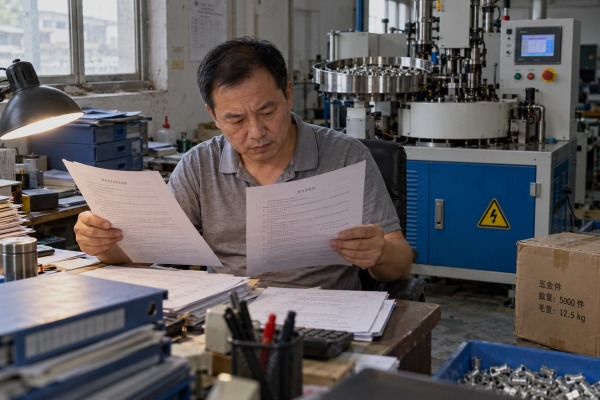
Two cable lug making machine quotes both promise a 12-month warranty contract attachment 1. Our Wenzhou workshop has seen that figure hide wildly different protection. Reading the fine print fixes that.
Warranty policies across cable lug making machine suppliers differ mainly in start date, wear-part coverage, response time, spare parts support, cost allocation, and remedies, not in headline length. Most advertise 12 months, but value depends on whether coverage begins at commissioning and whether dies, labor, and travel are included.
I will walk through the clauses that matter most. I will show you what to ask for, what a typical term looks like, and where the hidden costs sit. The goal is simple. You should be able to put two quotations side by side and know which one really protects your production line.
Last year a German engineering manager sent me two warranty PDFs and asked which one really protected him. Our own terms got a rewrite after that conversation.
Before signing, check six things in a cable lug making machine warranty: the exact start date, a component-by-component coverage schedule, defined wear-part life, response and resolution deadlines, spare parts stocking commitments, and who pays freight, labor, and travel. Get all of it attached to the purchase order.

When I compare warranty policies for lug forming or crimping equipment, I use the same six lenses every time: warranty duration, core component coverage, response and service mechanism, spare parts support, responsibility definition, and value-added services. The table below shows how different supplier types tend to line up on those lenses. Where public terms are not disclosed, I mark the field as "confirm in quotation" rather than guess.
| Supplier type | Advertised length | Start date | Wear parts | Labor and travel | Performance guarantee | Spare parts commitment |
|---|---|---|---|---|---|---|
| Large established manufacturer | 12 months, often 24 on PLC and hydraulic pump | Confirm in quotation | Usually excluded | Often included in premium packages | Confirm in quotation | Regional stock common |
| Specialized cable-processing supplier | 12 months | Negotiable to commissioning | Excluded, but life often defined | Parts included, travel separate | Often tied to FAT/SAT | Factory stock plus critical-spares list |
| Low-cost export manufacturer | 12 months | Usually shipment or invoice | Excluded | Buyer pays labor and travel | Rarely written | Factory only |
| Local distributor | Passes through manufacturer terms | Confirm in quotation | Confirm in quotation | Local labor sometimes included | Confirm in quotation | Depends on manufacturer |
| System integrator | One consolidated warranty | Site acceptance | Varies by subsystem | Confirm in quotation | Line-level targets | Split by subsystem |
A "full machine warranty" is not a coverage schedule. I ask for a line-by-line list. For a lug forming machine like ours, that list should name the frame, hydraulic pump and cylinder 2, servo or drive motor, PLC, touchscreen, inverter, sensors, the vibratory bowl feeder, pneumatic valves, and factory wiring. Dies, cutting blades, and hydraulic seals are almost universally excluded as consumables. That is acceptable only if the contract also states their expected cycle life. A die that cracks far below its rated cycles is a defect, not wear.
A defect warranty says the parts are not faulty. It does not say the machine will make good lugs. Suppliers often push back here. They argue output quality depends on your copper, your lug material, your operator, and your power supply. That objection is fair, but it has a fix. You define an operating envelope in a technical schedule 3: approved cable cross-sections, conductor classes, lug materials, and die profiles. Inside that envelope, the supplier guarantees crimp geometry 4, pull-out force, cycle time, and a maximum defect rate. We tie this to a factory acceptance test and a site acceptance test. IEC 61238-1 is a common reference for compression and electrical performance, and DIN profiles cover many die geometries, but the right standard depends on your market.
Manufacturers now require high-resolution photos, failure videos, and machine logs before authorizing a replacement. That is reasonable. What is not reasonable is an exclusion for "improper use" with no objective test. I push for exclusions that require evidence of overload, contamination, or operation outside the technical schedule.
Modern machines run on smart PLC control. Ask whether you receive the program backup, parameter settings, electrical drawings 5, and administrator passwords. A machine can be mechanically perfect and still sit idle because a failed controller has no backup.
Fourteen months from bill of lading or twelve from commissioning: we weigh that clause on every export order, because sea freight to Mexico eats weeks.
Most suppliers guarantee cable lug making machines for 12 months. Premium manufacturers often extend PLC and hydraulic pump coverage to 24 months. The real variable is the start date: shipment, delivery, or commissioning. A fair structure is 14 months from shipment or 12 from commissioning, whichever comes first.

The number on the quotation is only half of the answer. The other half is when the clock starts. I have seen a machine leave our factory, clear customs, wait for site preparation, and finally run production four months after shipment. If the warranty began at the invoice date, that buyer lost a third of their coverage before the first lug was formed. Here is how the common start-date models compare.
| Start date model | Who it favors | Risk for an importer | My recommendation |
|---|---|---|---|
| Shipment or invoice date | Supplier | Transit, customs, and site delays eat coverage | Avoid, or add a buffer |
| Delivery date | Supplier slightly | Commissioning delays still eat coverage | Acceptable with a buffer |
| Installation date | Balanced | Depends on who controls installation | Good if supplier installs |
| Site acceptance date | Buyer | Requires a formal acceptance protocol | Strongest protection |
| First production date | Buyer | Needs a clear definition of "production" | Good when supplier trains and commissions |
Some suppliers are piloting lifecycle-based warranties. Coverage is calculated on total crimp cycles instead of calendar months. For a line running three shifts, that can be shorter than 12 months. For a low-volume shop, it can be much longer. Connectivity-linked extensions are also appearing. The supplier grants extra months if the machine stays connected to its cloud diagnostic platform. That improves after-sales technical support, but you should ask what happens to coverage if your network goes down or you decline remote access for security reasons.
In our experience exporting to Japan and Germany, buyers there rarely accept a shipment-date start. Buyers in India and Mexico sometimes do, and then regret it. The structure is negotiable. Ask.
A cracked die on a customer's line in India taught us something: the invoice for the die was small, but the week of lost output was not.
After the warranty ends, you pay for replacement parts, labor, technician travel, international freight, customs duties, and all machine downtime costs. Even during the warranty, most standard policies cover parts only. Budget for consumables like dies, blades, and seals from day one, since those are excluded regardless.

The shift from in-warranty to out-of-warranty is less dramatic than most buyers expect. That is because a standard policy already leaves you with a large share of the bill. The table below shows what usually changes and what does not.
| Cost item | During standard warranty | After warranty ends |
|---|---|---|
| Replacement part for a defective component | Supplier | Buyer |
| Consumable dies, blades, seals | Buyer | Buyer |
| International freight for parts | Often buyer | Buyer |
| Customs duties and import taxes | Buyer | Buyer |
| Technician labor | Often buyer | Buyer |
| Technician airfare and accommodation | Buyer, unless on-site service is included | Buyer |
| Remote diagnosis | Supplier | Supplier, sometimes billed |
| Lost production, overtime, scrap | Buyer | Buyer |
Machine downtime costs are the item that hurts. A simple model helps:
Warranty value = avoided repair cost + avoided downtime cost + avoided service and travel cost − warranty premium.
Downtime cost should include lost contribution margin, delayed deliveries, overtime, scrap, and emergency outsourcing. When a procurement manager in the United States tells me a competing machine is cheaper, I ask one question. If the hydraulic pump fails, how many days until a replacement is on your floor? If the answer is three weeks from a single overseas warehouse, the cheaper machine is not cheaper.
Suppliers argue that wear parts cannot be covered indefinitely. Die life depends on copper hardness, press force, alignment, and operator practice. I agree with that. But a wear parts replacement policy should still define expected life in cycles. If a die fails at a small fraction of its rated count, and your machine logs show it ran inside the technical schedule, that is a defect claim, inside or outside the general warranty period. Write the cycle numbers into the contract.
Validity is strictly contingent on documented adherence to maintenance protocols. That means logged lubrication intervals and approved hydraulic oil grades. Keep those records even after the warranty ends. They protect any component-specific extended coverage, and they are the strongest predictor of equipment lifespan and reliability that I have seen on our own machines in the field.
A balanced clause lets you use equivalent third-party dies if they meet documented tolerances and the machine stays within its approved envelope. Ask for that wording. Then ask about a post-warranty service level agreement. On-site maintenance services, annual calibration, and a critical-spares kit stocked at your plant usually cost far less than one unplanned stoppage.
Our final-inspection sheet for every lug forming machine lists the PLC program backup as a line item. That habit started because of a warranty dispute, not a QC rule.
Reliable suppliers put their warranty in writing as a contract attachment, start coverage at commissioning, define wear parts by cycle life, commit to response and resolution deadlines, stock critical spares, and hand over PLC backups. Risky suppliers rely on vague exclusions, sole-discretion repairs, and verbal promises.

I should be honest about the evidence. No dependable public dataset compares warranty duration, claim rates, or service response across a representative sample of cable lug machine suppliers. What follows comes from documented procurement practice 6, broader industrial-equipment guidance, and what we see across our own export markets. Geography alone does not decide quality. A clearly written contract and a stocked spare parts shelf matter more than the supplier's flag.
| Term | Reliable supplier | Risky supplier |
|---|---|---|
| Warranty document | Attached to the purchase order | Line in a quotation or verbal |
| Start date | Commissioning or site acceptance | Invoice or shipment, undefined |
| Wear parts | Excluded but with rated cycle life | Excluded, no definition |
| Exclusions | Tied to objective evidence | "Improper use," "poor maintenance" |
| Response time | Claim acknowledged within one business day | No commitment |
| Resolution | Deadline to restore production | Open-ended |
| Remedy | Escalation after repeated failures | Repair or replace at sole discretion |
| Spare parts availability | Critical-spares list, stock location named | "Available on request" |
| Installation and operator training | Documented, with training records | Not addressed |
| Software | PLC backup, drawings, admin access | Locked, password withheld |
Industry guidance identifies response time as a major source of buyer dissatisfaction, and unresolved claims lasting more than 30 days damage supplier reputation. That finding comes from broader industrial equipment, not a cable-lug-specific study, but it matches what I hear from distributors. A supplier can answer in an hour and still take weeks to ship a pump. Service level agreement terms should separate the two. Ask for acknowledgment, remote diagnosis, parts dispatch, technician arrival, and production restoration, each with its own deadline.
A repair-or-replace remedy at the supplier's sole discretion is commercially standard, and suppliers will say so. For minor components, fine. For a controller that has failed three times, you need more. Ask for a maximum number of repair attempts, a deadline for restoring operation, replacement of unrepairable major components, and a right to a price reduction or termination after material nonconformity. Separate ordinary warranty remedies from remedies for a failed acceptance test.
Three emerging terms deserve a second look. Firmware compliance clauses can void coverage on electronic controls if you miss a mandatory PLC update window. Remote-first service mandates require a guided augmented reality troubleshooting session before a technician is dispatched. Connectivity-linked extensions add months only while the machine stays online. None of these is bad on its own. Each one shifts an obligation to you, so make sure your plant can meet it.
Here is the weighting I suggest as a starting point. Adjust it for how critical the machine is to your output.
Suppliers will say on-site service is too costly to include in the base price. Sometimes that is true. Then ask them to price it as an option and compare the total expected cost of one claim, not the invoice.
A long warranty number is cheap to print. A clear start date, defined wear life, real spare parts support, and enforceable remedies keep your line running. Ask for those.
Interested in sourcing the products mentioned in this article? See details and request a quote here:
1. The International Chamber of Commerce provides resources and standards for international commercial contracts and trade attachments. ↩︎
2. ISO provides international standards for hydraulic fluid power systems and components like pumps and cylinders. ↩︎
3. Wikipedia entry explaining technical specifications and schedules used to define requirements for industrial equipment and systems. ↩︎
4. The IEC provides international standards for the electrical performance and testing of compression connectors and crimp geometries. ↩︎
5. IEEE provides standards for industrial electrical drawings and documentation to ensure safety and interoperability in manufacturing. ↩︎
6. The World Customs Organization provides standards for documented procurement practice and international trade procedures. ↩︎
