

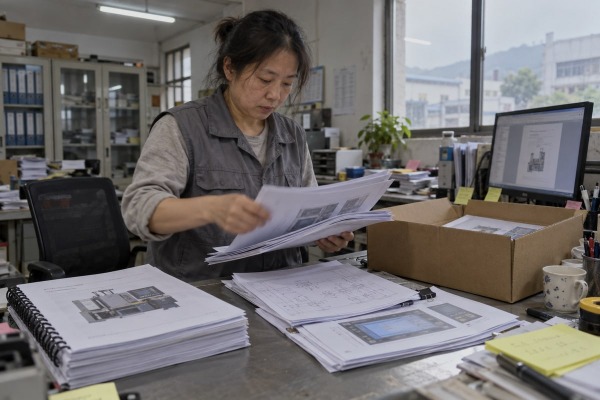
Cable lug making machine manuals often arrive in the wrong language. We have watched our customers’ crews stall for weeks over this. Here is how I prevent it.
Confirm cable lug making machine manuals are in your language by requesting the complete model-specific PDF, HMI screenshots, and electrical drawings before payment, checking revision numbers and translation ownership, and writing the required language, delivery format, and correction responsibility into the purchase contract.
The rest of this article walks through each step. I will show you what to ask, what to request, and what to put in writing. The goal is simple. Your team must be able to operate, maintain, and repair the machine without a dictionary.
A procurement manager in Mexico once asked me a simple question: "Spanish manual, yes or no?" I told him that question was not specific enough to protect his plant.
Check by asking for the exact language of every document for the quoted model: operating instructions, safety warnings, installation, electrical diagrams, maintenance, troubleshooting, parts list, and HMI screens. Request table of contents, revision number, and publication date, then compare them against the quotation.

The phrase "multilingual support" hides a lot. Suppliers use it loosely. So the first step is to define what you are actually being offered. In our export work to Japan, Korea, and Italy, we learned to spell this out line by line in the quotation. It saves everyone time later.
| What the supplier may mean | Is it enough for daily production? |
|---|---|
| Complete printed manual in your language | Yes, if it matches the quoted model |
| PDF translation supplied after purchase | Only if a deadline and cost are fixed in writing |
| Short start-up guide translated, main manual in Chinese or English | No, the maintenance guide and fault tables are missing |
| English manual plus local-language HMI | Partial, operators cope but technicians struggle |
| Labels translated, diagrams untranslated | No, electricians cannot work safely |
| Machine-translated or reseller-translated file | Risky, needs human technical review |
| Phone or video support in your language | Helpful, but not a substitute for documents |
The author's own rule is a good filter. At minimum, your team must be able to read these in order: HMI operation, parameter setting, die change, fault handling, daily maintenance, safety operation, and electrical drawings. If any link in that chain is unreadable, the machine stops when something goes wrong.
Beyond that core list, check the installation and commissioning steps, pneumatic or hydraulic diagrams, crimp-force or pressure-setting procedures, lubrication points, spare-parts catalogue, calibration and quality-control procedures, packing and storage notes, the declaration of conformity tied to CE certification 1, warranty terms, and any training videos. The machine specifications page in a brochure is not technical documentation 2. It is marketing.
A file can contain your language and still fail you. It may be incomplete. It may describe a different die type or feeder. It may skip the safety section. So ask for the table of contents and page count of the original and the translated version. If the translated file is much shorter, ask why. Then compare the diagrams against the product photos and the quoted configuration. If the buttons, sensors, or capacities do not match, the manual belongs to another machine.
Early in our export work, one of our first terminal crimping machine orders shipped with English-only files to a French plant. The night shift could not reset an alarm.
If only Chinese or English manuals exist, decide before payment who translates, who pays, and when delivery happens. Prioritize HMI screens, operating instructions, alarms, die-change steps, and electrical drawings. Use a technically qualified translator, keep the original alongside, and set a pre-shipment deadline.

This situation is common. Many Chinese builders, including small teams like ours, maintain Chinese originals and an English version. A third language is usually a project, not a stock item. That is fine, as long as the project is planned before money moves.
| Path | Who does the work | Main risk | Best for |
|---|---|---|---|
| Supplier translates the full set | Supplier's translator plus their engineer | Delivery slips after payment | EU buyers who need legal compliance |
| Buyer commissions translation locally | Your technical translator using the English file | Terminology drifts from the HMI | Plants with in-house engineering |
| Bilingual bridge | Supplier translates HMI, alarm list, and safety; English covers the rest | Technicians still need English | Multinational sites with English-trained staff |
I hear this objection often, and sometimes it is true. Engineers in a large US or German factory may be fully comfortable with English. But operators, temporary workers, contractors, and emergency personnel often are not. Safety information should not rest on one person's language skill. Local-language files also shorten onboarding and stop three shifts from interpreting the same warning three ways.
A simple pneumatic or hydraulic press machine 3 still stores energy. It has pinch points, electrical hazards, and die-selection rules. A wrong die on a copper lug line produces scrap or a cracked tool. The maintenance steps for that press need to be precise, so the manual needs to be readable.
Do not assume English is legally enough. For machines placed on the EU market, the Machinery Directive 4 requires instructions in the official language or languages of the Member State where the machine is used. It distinguishes "Original instructions" from "Translation of the original instructions," and the original must accompany a translation. Regulation 2023/1230 adds that instructions must be clear, understandable, legible, and in a language users easily understand. Digital delivery is allowed, but the buyer can request paper at the time of purchase. Outside the EU, check your own destination rules and ask your importer who is responsible for the language version.
Machine translation is fast and cheap. It also mangles units, negations, and part names. "Do not" can become "do." So if you accept it at all, limit it to non-safety text and have a native-speaking engineer review the rest.
Every sample translation we prepare costs our small Wenzhou team engineering hours before any deposit arrives. We still do it, because a refused sample costs the buyer far more later.
Yes. Request a sample translation before purchase: the table of contents, several safety pages, one installation page, one die-change page, one troubleshooting page, one electrical diagram, and HMI screenshots in your language. Then have an operator and electrician test whether they can follow it.

A brochure, a screenshot, or a promise is not a sample. You need real pages from the real manual. A supplier may protect proprietary PLC code 5, and that is fair. But confidentiality does not stop them from showing the language, structure, and completeness of the operating manual. If they refuse even a safety or maintenance page before payment, treat that as a documentation risk during equipment sourcing.
| Check | What a problem looks like |
|---|---|
| Terminology | The same component has two or three different names |
| Units | Bar, MPa, and psi mixed without conversion |
| Warnings | Hazard, consequence, or required action is missing |
| Captions | Text refers to a part that is not in the picture |
| Layout | Tables cut off, text overlapping symbols |
| Modal words | "Must," "may," and "do not" blurred together |
| Alarms | Manual wording differs from the HMI screen wording |
| Labels | Component names do not match the plates on the machine |
One practical extra: ask the supplier to record a short demonstration of the machine while pointing to the matching steps in the manual. For an automatic lug former with a vibratory bowl feeder and a PLC panel, this exposes any gap between the written steps and the real sequence. We do this for OEM builds where the HMI layout was customized, because custom screens are exactly where generic manuals go wrong.
During a pre-shipment inspection last year, our QC lead photographed every warning decal on an automatic lug forming machine bound for Germany and matched each one against the manual page.
Ask whether the complete manual, HMI, labels, alarms, and electrical drawings exist in your named language for the exact quoted model; who translated and checked them; when they ship; whether updates stay translated; who corrects errors free; and whether after-sales support speaks your language.

Good supplier communication is not about asking more questions. It is about asking the right ones once, in writing, and getting the answers into the contract. Below is the list I would want a buyer to send me.
Translation promised only after payment. No model number or revision on the sample. Diagrams labelled only in Chinese. A local PDF far shorter than the original. The reseller and the factory giving different answers. No delivery date for the translated set. A refusal to put documentation into the contract.
| Risk level | What you have |
|---|---|
| Low | Complete model-specific manual reviewed before purchase; HMI and labels match |
| Medium | Manual available, but HMI or maintenance documents untranslated |
| High | Translation promised later, generic documents, or no sample provided |
| Very high | Safety instructions missing, contradictory, or impossible to verify |
Add a Documentation Language Clause. A workable version reads: "The supplier shall provide complete, current, model-specific operating, safety, installation, maintenance, troubleshooting, electrical, parts, and control-interface documentation in [language] before shipment or commissioning. The documentation shall correspond to the supplied machine configuration and shall include translated warnings, labels, alarms, and parameter descriptions where applicable. Any translation errors or missing sections identified during acceptance shall be corrected by the supplier at no additional cost."
Then use the pre-shipment inspection to verify decals physically, and ask for a linguistic commissioning step where the installation engineer walks operators through the manual on site. A QR code on the frame linking to a live, version-controlled PDF is a useful extra, but it never replaces the clause.
Untranslated manuals stall production and endanger operators. Confirm language, completeness, HMI, and delivery timing before payment, write it into the contract, and treat documentation as part of machine acceptance.
Interested in sourcing the products mentioned in this article? See details and request a quote here:
1. US government resource explaining the CE marking process and conformity requirements for exporting products to Europe. ↩︎
2. International standard (ISO 20607) for the preparation of instruction handbooks for industrial machinery. ↩︎
3. Overview of hydraulic press mechanisms and safety considerations for industrial pressing equipment. ↩︎
4. Official European Commission page detailing safety and documentation requirements for machinery placed on the EU market. ↩︎
5. Explanation of programmable logic controllers used to automate industrial electromechanical processes. ↩︎
