

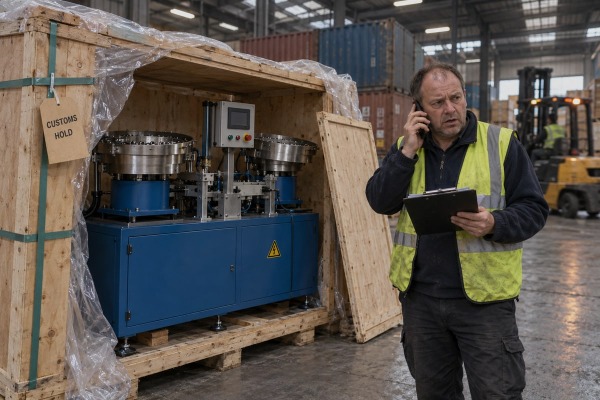
Your assembly machine landed, but customs will not release it and nobody answers. We ship bowl-feeder lines from Wenzhou monthly, so stuck customs clearance is a call we know well.
For stuck customs clearance, contact your freight forwarder first to get the hold reason, declaration number, and demurrage deadline. If the hold is a document problem, contact your Chinese supplier’s sales representative to correct and re-stamp the paperwork. Then send one consistent document pack to the customs broker.
The order of calls matters more than the number of calls. Below, I walk through who can actually release the machine, what to ask each party, and how to stop the fees from piling up. I also share what we do on our side before a machine leaves the workshop.
The hardest lesson our export team learned came from a terminal crimping line held at a Mexican port for over a week. We called the wrong party first and lost days.
Contact your freight forwarder first, because they hold the Bill of Lading, the customs-entry number, and the real reason for the hold. If the forwarder confirms a document problem, contact your supplier's sales representative next. Only call customs after you have the declaration number.

Our rule is simple. Find the forwarder first. If the forwarder says the problem comes from clearance documents, go to the supplier's sales person and fix it there. That rule came from experience, not theory. In the Mexico case, our buyer spent two days emailing our engineers about the machine itself. The real issue was a consignee name on the Bill of Lading that did not match the importer registration. Only the forwarder could see that. Once the buyer called the forwarder, the fix took one afternoon.
The freight forwarder or carrier controls the shipment. They know whether the cargo is still at Ningbo, in transit, or already at the destination terminal. They also know if the "customs hold" is really a customs hold. Many stalls are carrier problems: unpaid freight, a manifest error, a wrong consignee, or a missing Import Security Filing 1 for US-bound cargo. A supplier cannot see any of that. We can only see our own export declaration.
The forwarder also runs the demurrage and detention 2 clocks. They know the free days left on the container and the daily rate after that. Ask for both numbers on the first call.
| Situation | First contact | Second contact | Why |
|---|---|---|---|
| Cargo still at Chinese port or airport | Freight forwarder | Supplier's sales rep, then GACC via the export broker | Export declaration, exporter registration, or port inspection issues sit on the China side |
| Cargo in transit | Freight forwarder | Carrier | Nothing can be cleared yet; confirm paperwork is ready at destination |
| Cargo at destination terminal | Freight forwarder | Customs broker | Import entry, HS Code classification 3, duties, importer of record |
| Forwarder says "documents are wrong" | Supplier's sales rep | Customs broker | Only the exporter can reissue stamped commercial invoice and packing list |
| Forwarder says "customs examination selected" | Customs broker | Terminal operator | Physical inspection needs scheduling and costs money daily |
Ask for five things in writing. The current location of the cargo. The Bill of Lading or airway-bill status. The customs-entry number. The name and phone number of the assigned customs broker. The exact reason for the hold, in the words customs used. Do not accept "it is under customs." That phrase tells you nothing and buys nobody time.
When the forwarder points back to the documents, call the supplier's sales representative, not the factory floor. In our company, the sales engineer who quoted the machine owns the document pack. That person can reissue a stamped commercial invoice within hours. An engineer cannot.
Before every machine leaves our Wenzhou workshop, our sales engineer and the buyer sign off one document pack. That pack is what customs will later compare, line by line.
Ask your supplier for a corrected commercial invoice, packing list, sales contract, certificate of origin, technical datasheet, model and serial list, and wood-packaging treatment proof. Every document must use the same machine name, HS code, weight, and value. Request signed and stamped copies, not plain PDFs.

A customs officer does not know what a ferrule assembly machine is. The officer knows what the paper says. So the paper must say the same thing everywhere. Here is the pack we prepare for a bowl-feeder assembly machine, and what customs uses each item for.
| Document | What customs checks | Common failure we have seen |
|---|---|---|
| Commercial invoice | Declared value, currency, Incoterm, buyer and seller names | Tooling and spare parts listed as "free" with zero value, which triggers a valuation query |
| Packing list | Crate count, gross and net weight, dimensions | Weight differs from the Bill of Lading by more than a few percent |
| Sales contract or PO | Supports declared value and payment terms | Contract value includes installation; invoice value excludes it |
| Certificate of origin | Duty rate and preferential treatment | Not requested at order time, then needed under a trade agreement |
| Technical datasheet and catalogue | HS Code classification, function, power rating | Description reads "automatic machine" with no function stated |
| Model and serial-number list | Matches crate contents during customs examination | Serial plate on the cabinet differs from the list |
| Wood-packaging treatment proof | ISPM 15 heat-treatment mark on crates | Mark painted over or hidden under strapping |
| Export declaration data | Consistency with China-side filing | Different HS code filed at export than at import |
This is the question customs asks most about automation equipment. Our standard unit has a blue powder-coated cabinet, two stainless vibratory bowl feeders, pneumatic fixtures, a control panel with a digital display, and an emergency stop. If the packing list names each bowl feeder, each air cylinder, and each cable separately, the officer may classify it as parts. If the invoice says "one complete assembly machine, Model X, for electrical wire ferrules," the officer classifies one functional unit. Duty rates, permits, and anti-dumping duties checks can all change with that choice. Ask your supplier to state clearly whether the shipment is a complete machine, a partly assembled machine, or a production line, and to list included tooling and control cabinets under the main item.
Destination inspectors often ask for a technical file or a declaration of conformity before releasing industrial machinery. Ask the supplier for the electrical schematic, the rated power, and any safety documentation that matches the destination standard. Note that a China Compulsory Certificate 4 (CCC) covers goods sold inside China. It does not answer a European or North American inspector. If the inspector still doubts the machine, a third-party auditor such as SGS or TÜV can issue an independent safety verification report. We have had buyers request that report before shipment to avoid the question entirely.
If you bought a demonstration or second-hand unit, prepare the manufacture date, maintenance record, a cleaning statement, and photographs. Customs treats used machinery as a contamination and safety risk. The paper proves it is neither.
A distributor in Serbia once emailed us at midnight. His broker had gone silent for four days while our bowl-feeder machine sat in a bonded warehouse 5 racking up fees.
Contact the broker's management first, then the freight forwarder who appointed them, and demand a written status report with the declaration number. If silence continues past the demurrage deadline, appoint a replacement customs broker who reviews the existing entry, and ask the terminal operator to confirm bonded storage rates.

The Serbian case taught me that silence has a price per day. The machine was not lost. The broker was simply overloaded. But the storage meter did not care. Here is the ladder we now give every buyer when a broker goes quiet.
| Charge | Who bills it | When it starts | Who can stop it |
|---|---|---|---|
| Demurrage | Shipping line, via forwarder | After container free days at terminal | Customs release plus pickup |
| Detention | Shipping line | When container leaves terminal, until empty return | Trucker and consignee |
| Terminal storage | Port operator | After terminal free time | Transfer to bonded warehouse |
| Bonded warehouse fee | Warehouse operator | On entry to bonded facility | Final customs release |
| Customs examination fee | Customs or terminal | When inspection is scheduled | Nobody; pay and move on |
The point of this table is simple. Demurrage and detention fees grow faster than bonded warehouse fees. If the broker is slow, move the crate into bond first. Then fix the paperwork.
A new broker needs a fresh power of attorney 6 from the importer of record. Some customs systems also require the first broker to withdraw or amend the entry. Ask the new broker to confirm who the importer of record is before filing anything. We have seen a supplier-appointed broker file under a trading company's name, which left the buyer unable to sign the power of attorney at all.
Keep it factual. Subject: Urgent customs hold, assembly machine, Bill of Lading number. Body: state the port, the declaration number, the attached documents, and three direct questions. What is the exact official reason for the hold? What is the response deadline? Who must take each corrective action? Copy the forwarder and your supplier's sales representative on the same email. One thread, one document version, no confusion.
Every quotation we issue forces a choice: price the machine FOB Ningbo and let the buyer control import, or quote DDP and carry the clearance risk ourselves.
Prevent delays by agreeing the HS code, Incoterm, importer of record, and customs bond before paying a deposit. Have the supplier issue a one-page customs fact sheet, confirm ISPM 15 wood packaging, check anti-dumping duties, and appoint your own customs broker with power of attorney before the machine ships.

Most holds are born at the quotation stage, not at the port. When a buyer in Canada or South Korea asks us for a drawing-based ferrule assembly line, the customs conversation starts in the same email as the cycle-time conversation. Here is the sequence we follow with every order.
| Stage | Action | Who owns it |
|---|---|---|
| Quotation | Agree Incoterm and who is importer of record | Buyer and supplier |
| Quotation | Propose HS code with classification rationale | Supplier, verified by buyer's broker |
| Contract | Check anti-dumping duties and import permits for that HS code and origin | Buyer's customs broker |
| Contract | Confirm customs bond is in place (continuous bond for US importers) | Buyer |
| Before shipment | Issue one-page customs fact sheet: function, model, value, weight, dimensions, origin, components, intended use | Supplier's sales engineer |
| Before shipment | Confirm ISPM 15 heat-treated crates with visible marks | Supplier |
| 24 hours before loading (US) | File Import Security Filing through the forwarder | Buyer's forwarder |
| Before arrival | Broker holds signed power of attorney and full document pack | Buyer |
Buyers often ask us to ship DDP so they never touch customs. I understand the appeal. But DDP can make the seller the importer of record, and a Wenzhou company is not registered to import in Slovakia or Mexico. The entry then runs through a trading agent you did not choose. If that agent is slow, you have no power of attorney and no standing with customs. We will quote DDP when the buyer insists. We prefer FOB or CIF with the buyer's own broker, because then the buyer can escalate directly when something stalls.
Ask the supplier for the proposed HS Code classification and the reason behind it. Our bowl-feeder assembly machine processes small metal and plastic electrical components. We describe its function, the materials it handles, the degree of automation, and the principal modules in the fact sheet. A vague description like "industrial equipment" invites a customs examination. If your machine is unusual, a trade attorney can file a binding ruling request before the first shipment. That ruling settles the classification permanently and removes the dispute from every future order.
Some buyers now run the document pack through an AI-driven compliance platform before loading. These tools flag mismatched weights, missing fields, and inconsistent model numbers. We treat them as a second check, not a replacement for a careful sales engineer. The cheapest fix is always the one made at the desk in Wenzhou, before the crate is sealed.
A stuck machine bleeds money daily. Call the freight forwarder first, fix documents through your supplier's sales rep, and keep one consistent document pack. We build ours before shipping.
Interested in sourcing the products mentioned in this article? See details and request a quote here:
1. Official US Customs and Border Protection page explaining the ISF (10+2) requirement for ocean freight. ↩︎
2. Federal Maritime Commission resource explaining carrier regulations regarding demurrage and detention charges. ↩︎
3. The World Customs Organization’s official overview of the Harmonized System used for global trade classification. ↩︎
4. Official International Trade Administration page detailing China’s standards and the mandatory CCC certification process. ↩︎
5. Wikipedia entry defining the legal and logistical function of bonded warehouses in international trade. ↩︎
6. US Customs and Border Protection guidance on the role and licensing of customs brokers. ↩︎
