

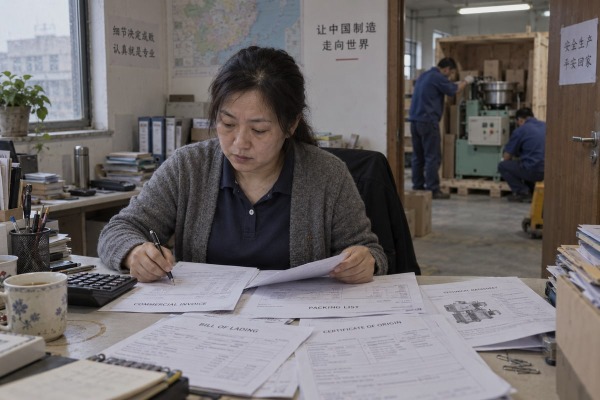
Every cable lug making machine we crate in Wenzhou leaves with a document pack, because one mismatched product name against the customs declaration can freeze a buyer’s production start.
To verify cable lug making machine documents match the customs declaration, compare the commercial invoice, packing list, bill of lading, certificate of origin, and technical datasheet field by field: product description, model, serial number, quantity, weights, value, currency, Incoterm, HS code, and origin. Fix every material contradiction before filing.
I call this four-corner verification. The commercial identity, the physical machine, the legal classification, and the financial value must all describe one transaction. The sections below walk through each corner in the order our export team uses it.
A German buyer once asked me to simply copy the HS code 1 from our last invoice. I asked him to check it against the German tariff first.
Check the HS code by reading the machine's principal function from the technical datasheet, locating that function in the importing country's tariff schedule and chapter notes, then confirming the same code appears on the commercial invoice, packing list, and declaration. Treat the supplier's code as a starting point only.

HS Code classification is a technical and legal exercise. It is not a keyword search. The right code depends on what the machine does, how it does it, and which national tariff schedule 2 applies at the destination. Our terminal-making machines form, cut, and crimp copper or aluminum terminals. Some models work hydraulically. Some use mechanical cold-pressing. Some combine a vibratory bowl feeder, a rotary cutting station, and a PLC-controlled assembly unit on one frame. Each of those facts can affect the classification.
The first six digits of the HS code are harmonized internationally. The digits after that belong to the importing country. So the same machine can carry different full codes in the United States, Germany, India, and Japan. I tell buyers to pull three things before they look at any tariff table: the technical datasheet, the operating principle, and the answer to one question. Does the machine perform one operation or several? A multi-function line is often classified by its main function. An incomplete machine shipped without its feeder may be treated differently from a complete unit.
Here is the buyer objection I hear most. "You have exported this model many times, so your code must be right." It is a fair point. A code that has cleared repeatedly in one market is good evidence. But the importer of record is the party exposed to local customs consequences in most systems. My code can be wrong for your tariff schedule, or out of date after a tariff revision. Use it, then confirm it against the destination tariff database, the section and chapter notes, and any published rulings. For repeat imports, an advance tariff ruling from the destination customs authority turns a guess into a defensible position.
| Input | Where to find it | What it tells customs |
|---|---|---|
| Principal function | Technical datasheet, user manual | Which heading the machine belongs under |
| Operating method | Datasheet, operation video | Hydraulic, pneumatic, or mechanical cold-pressing |
| Material worked | Product literature | Copper, aluminum, or mixed terminals |
| Completeness | Packing list, PO | Complete machine, incomplete machine, or components |
| Chapter and section notes | National tariff schedule | Exclusions and inclusions that override wording |
| Rulings or advance decisions | Customs authority publications | How the destination has classified similar machines |
Never choose a code because it carries lower import duty rates. If the technical facts do not support it, the savings turn into a reassessment, interest, and a possible penalty during a post-clearance audit.
During final QC on our terminal-making line, our engineer photographs the nameplate before the crate lid closes. That photo becomes the anchor for every document that follows.
Compare the purchase order, commercial invoice, packing list, technical datasheet, user manual, conformity documents, and nameplate photographs. Each must show the same brand, model, machine serial number, function, voltage, pressure, weight, and dimensions as the customs declaration. The datasheet and nameplate are the technical reference point.

When I asked myself how to check the product name on my documents against the declared information, I realized the answer is not one document. It is one set of facts repeated across many documents. The physical machine is the truth. Everything else is a description of it. So I start with the nameplate photo and work outward.
Our cable lug equipment rarely ships as a single box. A typical order includes the main forming and crimping unit, a stainless steel vibratory bowl feeder on its own stand, an electrical cabinet with the PLC, standard dies, changeover tooling, a spare parts kit, manuals, and sometimes a conveyor. Each of those items needs a row. Each row needs the same columns. This sheet is the base for every later comparison.
| Crate | Contents | Model / Serial | Net kg | Gross kg | On invoice? | Declared value? |
|---|---|---|---|---|---|---|
| 1 | Main crimping and cutting unit | Model + machine serial number | Yes | Yes | ||
| 2 | Vibratory bowl feeder and stand | Feeder model | Yes | Yes | ||
| 3 | Electrical cabinet, PLC, signal tower | Cabinet ID | Included in main | Included | ||
| 4 | Dies, applicators, changeover tooling | Die set numbers | Must check | Must check | ||
| 5 | Spare parts kit, manuals | Kit reference | Must check | Must check |
The product description is where most buyers in the United States and Europe run into trouble. A line reading "machine" or "industrial equipment" gives customs nothing to classify and nothing to value. A better line names the function, the material, the operating method, the model, and whether the shipment is complete. For example: "Automatic hydraulic cable lug forming and crimping machine for manufacturing copper and aluminum electrical terminals, model ____, serial number ____, with feeder, control cabinet, standard dies, and accessories." The wording must stay factually true. Do not add a feeder the machine does not have.
For shipments to Germany, Italy, and France, buyers also ask for CE certification documents. The model on that conformity file 3 must match the invoice model. A safety certificate that covers a full line while only one module ships creates a question customs will ask. Technical specifications matter beyond classification too. Motor wattage, hydraulic pressure capacity, and control features are the details some importers must check against licensing rules in their market. I do not decide that for buyers. I supply the datasheet and ask them to confirm with their broker.
Finally, keep the documents in the same order the customs clearance procedure will read them: PO, invoice, packing list, transport document, origin certificate, technical file, declaration. Any field that does not line up across that chain is a flag.
Itemizing every spare die on the invoice takes our team longer, but a single lumped line hides value and quantity problems that surface at the port.
Get the final commercial invoice and packing list before the crates close, then run a three-way match against the purchase order and declaration. Check seller, buyer, description, model, quantity, unit price, currency, Incoterm, package count, net and gross weight, and whether dies, spare parts, and free items carry a value.

Timing is the whole point of this section. Documents prepared after the vessel leaves are documents written from memory. We issue a draft invoice and packing list before packing starts, then a final version after weighing the sealed crates. Buyers like William, a procurement manager we work with in the United States, approve the final pack on WhatsApp before the truck is booked. That approval step is cheap. A port hold is not.
The declared customs value is often not the invoice subtotal. It depends on what the price already includes and what the destination valuation rules require you to add.
| Incoterm | What the machine price covers | What the importer may need to add for customs value | Risk if ignored |
|---|---|---|---|
| EXW | Machine at our Wenzhou factory door | Inland haulage, export handling, freight, insurance | Undervaluation |
| FOB | Machine loaded at the Chinese port | Ocean or air freight, insurance | Undervaluation |
| CIF | Machine, freight, and insurance to destination port | Usually little; check local rules on insurance | Double counting |
| DAP | Delivered to the named place, duties unpaid | Separate out freight already included, per local rules | Overvaluation |
Installation, commissioning, training, and software licenses should sit on separate lines. Their treatment differs by country. Keep the machine price, tooling price, spare parts, and services visible so the broker can apply the correct rule to each.
The hardest lesson I learned about export paperwork is simple: a corrected invoice does not fix a declaration that has already been filed.
Stop and classify the discrepancy first. Minor formatting differences can be noted and explained. Material errors in model, serial number, quantity, value, currency, origin, or HS code must be corrected by the supplier and your customs broker through the proper amendment or disclosure procedure, never by informal edits.

Some buyers want every document to use identical wording. That standard creates work without adding safety. The better standard is consistent commercial meaning and matching material facts. "Terminal crimping machine" on the Bill of Lading and "automatic hydraulic cable lug forming and crimping machine" on the invoice describe the same goods. A different model number does not. So the first job is sorting.
| Field | Invoice | Packing list | Transport doc | Certificate of Origin 6 | Declaration | Status | Action | Owner |
|---|---|---|---|---|---|---|---|---|
| Model and serial | n/a | Match / Material | ||||||
| Quantity and units | ||||||||
| Gross weight | n/a | |||||||
| Value and currency | n/a | n/a | ||||||
| Incoterm | n/a | n/a | ||||||
| Country of origin | ||||||||
| HS code | n/a | |||||||
| Accessories and dies |
Status labels we use: Match, Minor formatting difference, Requires broker confirmation, Material discrepancy, Correct before filing. Anything in the last two columns stops the shipment from filing.
Wrong model or machine serial number. Wrong quantity. Wrong seller or importer. Incorrect country of origin, including a Certificate of Origin that names a different manufacturer or invoice number. A different machine function. Missing accessories of real value. Wrong currency or total. Weight differences nobody can explain. Misclassification. A complete machine declared when the shipment is incomplete, or the reverse.
Post-clearance audits mean consistency matters after release, not only at the border. Electronic filing makes mismatches easy for customs analytics to catch across invoices, transport records, and historical imports. Matching documents does not guarantee release. Customs can still inspect, X-ray, or request evidence. But clean documents remove the easy reasons to stop your machine.
Verifying cable lug making machine documents against the customs declaration is a controlled reconciliation, not final proofreading. Match function, identity, value, and origin before shipment.
Interested in sourcing the products mentioned in this article? See details and request a quote here:
1. The WCO maintains the Harmonized System used globally for product classification and customs coding. ↩︎
2. The WTO oversees the application of national tariff schedules and international trade agreements between member nations. ↩︎
3. Official European Commission portal explaining CE marking and required technical conformity documentation for machinery. ↩︎
4. UNCTAD provides authoritative resources on international transport documents and maritime trade logistics. ↩︎
5. The IPPC sets the ISPM-15 international standard for regulating wood packaging material in international trade. ↩︎
6. The ICC provides the international standards and framework for issuing Certificates of Origin in trade. ↩︎
