

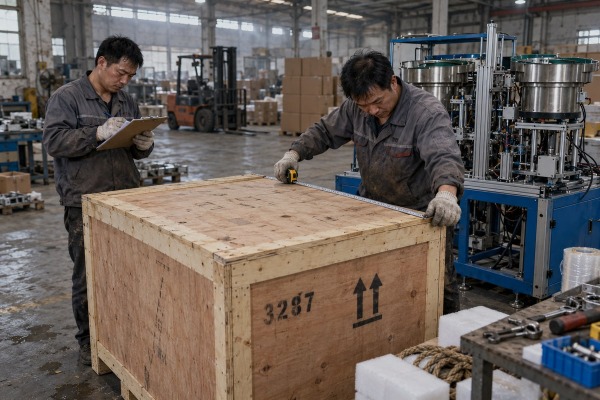
Import taxes and port charges can push a USD 100,000 assembly machine from our Wenzhou workshop past budget marine insurance 1. That gap hurts cash flow. So I estimate every line before shipment.
To estimate import taxes and port charges on an assembly machine from China, calculate crate volume and weight, get a freight forwarder quote, confirm the HS code and duty rate at destination, then add import VAT, customs brokerage fees, terminal handling, and inland delivery to the machine price.
The machine price is only the starting point. Below I walk through each cost layer in the order it hits your bank account. I use a ferrule assembly cell with two vibratory bowl feeders as the running example, because that is the kind of equipment we crate and ship most often.
A Mexican buyer asked me for "the tax number" on a terminal assembly line. I could not give one. Duty and VAT depend on his tariff schedule, not our invoice.
Calculate import duty as customs value (usually CIF: machine price plus freight and insurance) multiplied by the destination duty rate for your HS code. Then calculate Value Added Tax or GST on customs value plus duty. Add any China-specific surcharges such as Section 301 tariffs.

The formula looks simple. The inputs are where people go wrong. Let me break it into three steps.
Most customs authorities tax the CIF value 2, not the EXW price. That means freight and marine insurance become part of the taxable base. Customs may also add assists, tooling you supplied, design work, royalties, or packing costs. A low invoice does not lower the duty. Officers compare declared values against the machine specification, market prices, and earlier imports. Keep the quotation, purchase contract, commercial invoice, payment records, and packing list together as one file.
One legal way to reduce the base is to separate intangibles. Software licenses, engineering design fees, and operator training are often non-dutiable when invoiced separately from the physical machine. We issue these as separate lines when the buyer's broker asks for it.
General machinery duty rates 3 in many markets fall between 0% and 15%. Broader heavy-equipment examples range from 0% to 35%. These are illustrative ranges, not your rate. For the United States, add Section 301 tariffs on China-origin goods, which can add a 25% surcharge on top of the ordinary rate for some machinery categories.
Value Added Tax is charged on customs value plus duty, and in some countries on port charges too. Rates commonly fall around 10% to 18%. One market applies 11% import VAT. The exact base must be confirmed per country.
| Line item | Amount (USD) | Note |
|---|---|---|
| Machine price | 100,000 | EXW or FOB basis |
| Export packing and origin charges | 3,000 | Crating, trucking, export declaration |
| Freight and insurance | 8,000 | Forwarder quote |
| Customs value | 108,000 | Price + freight + insurance |
| Duty at 5% | 5,400 | Illustrative rate |
| VAT base | 113,400 | Customs value + duty |
| VAT at 15% | 17,010 | Illustrative rate |
| Broker and port charges | 3,500 | Destination local fees |
| Inland delivery | 4,000 | Port to plant |
| Cash outlay before installation | 140,910 | Model only |
Two objections come up here. First, "duty is the biggest expense." In this model, VAT is more than three times the duty. Second, "import VAT is not a real cost." For a VAT-registered business it is recoverable, but it still ties up USD 17,010 until the refund arrives. If registration or documents are defective, it becomes a permanent cost. I track three totals: pre-tax landed cost, total cash at import, and net cost after VAT recovery.
One lesson from shipping bowl-feeder assembly cells to Canada: the CIF quote ends at the quay. Everything that happens after the crane lift is a separate bill.
Budget for Terminal Handling Charges, destination documentation and delivery-order fees, customs brokerage fees, examination handling, customs bond or guarantee fees, storage, and a demurrage and detention reserve. In the United States also add Merchandise Processing Fee and Harbor Maintenance Fee. Request a written local-charge sheet from your forwarder.

My own method is simple. I calculate the estimated crate volume and gross weight first. Then I send those numbers to the freight forwarder and ask for a line-by-line quote covering origin, ocean, and destination charges. The forwarder cannot quote without dimensions, and a guess at this stage produces a wrong budget later.
| Charge | What it covers | Typical payer under CIF |
|---|---|---|
| Terminal Handling Charges | Crane and yard moves at destination port | Buyer |
| Delivery order / container release fee | Carrier paperwork to release cargo | Buyer |
| Destination documentation fee | Forwarder or line admin fee | Buyer |
| Wharfage and port security | Port authority levies | Buyer |
| Lift-on/lift-off | Moving container to truck | Buyer |
| Customs examination handling | Moving cargo to inspection station | Buyer |
| CFS devanning | Unloading LCL cargo at a warehouse | Buyer |
| Customs bond or guarantee fee | Security required by customs (common in the US) | Buyer |
| Customs brokerage fees | Entry filing, classification, duty disbursement | Buyer |
| MPF and HMF (US only) | Percentage-of-value federal fees on ocean imports | Buyer |
Ask the forwarder which items are prepaid, which are collect, and which must be paid before release. Also ask whether the broker quote covers one customs entry or several. A line shipped in three consignments can mean three entries and three sets of customs brokerage fees.
Large machinery attracts inspection. Customs may ask for technical documents, valuation evidence, or a physical check. Free time at many ports runs three to seven days. After that, storage and demurrage start, and detention follows if the empty container is returned late. Daily charges range from roughly USD 50 to several hundred dollars depending on port and equipment type. I treat this as a budget line, not an accident. A contingency of a few percent and a document pack prepared before the vessel sails are the two best defenses.
A bowl-feeder assembly cell often fits inside one 20-foot container with room to spare. I still prefer FCL. LCL adds consolidation fees, CFS handling, and extra transfers that put a crated machine at risk. An FCL container that is half empty is often cheaper and safer than LCL.
When we quote a ferrule crimping-and-assembly cell, I weigh shipping it as one unit against splitting modules into separate crates. That choice can change the HS code.
Your HS Code classification sets the base duty rate in the destination Harmonized Tariff Schedule, decides whether Section 301 tariffs or anti-dumping duties apply, and determines permit and safety requirements. Many complete assembly machines fall under heading 8479.89, but the eight- or ten-digit national line fixes the actual rate.

"Automatic assembly machine" is a sales description. It is not a customs category. The six-digit HS system is harmonized worldwide, but each country adds two or four digits, and those extra digits carry the duty rate. The same ferrule assembly cell can land under different national lines in India, Slovakia, and the United States.
| Question | Why it matters |
|---|---|
| Dedicated assembly machine or general machine tool? | Different headings, different duty rates |
| Assembles only, or also tests, inspects, or packs? | Multi-function machines are classified by principal function |
| Shipped as one line or as separate modules? | Separate consignments may be classified as parts |
| Robot arms, cameras, PLCs included? | Can trigger electrical, radio, or cybersecurity rules |
| Spare parts in the same crate? | Parts may carry their own rates |
| New, used, or refurbished? | Some countries restrict or surcharge used machinery |
This is the risk I worry about most. If customs decides a shipment is a "collection of parts" rather than one functional machine 4, each part gets its own code. Tapered roller bearings and certain steel fasteners from China face anti-dumping duties in several markets. A single functional unit under 8479.89 avoids that. A box of loose sub-assemblies may not. So when we split a line into multiple containers for transport, we document that the consignments form one complete machine and ask the buyer's broker to confirm the destination authority will treat them that way.
We supply a proposed HS code with every quote. I still tell buyers not to rely on it. The destination customs authority controls classification. Your broker should confirm the code against the national Harmonized Tariff Schedule, and for high-value lines a binding ruling is worth the time.
If the machine will produce goods for re-export, Inward Processing Relief 5 can suspend or refund duty and VAT. For EU-bound equipment, the Carbon Border Adjustment Mechanism may require reporting on the steel and aluminum in the frame. Both depend on the classification being right first.
During sample testing of a bootlace ferrule assembly machine, our team measures the crated footprint and gross weight. That data goes straight to the forwarder for a freight quote.
Yes. An experienced manufacturer cannot change your duty rate, but it can supply accurate crate dimensions and weights, a complete commercial invoice and packing list, a proposed HS code, separated software and training invoices, correct wooden packaging treatment, and clear Incoterms, which prevent most surprise customs and port costs.

Most surprise costs trace back to missing information, not to tariff rates. A forwarder quoting without dimensions guesses. A broker filing without a technical specification guesses. Customs then asks questions, and the container sits. Here is what I see as the manufacturer's real contribution.
| Incoterm | Seller handles | Buyer handles | My view |
|---|---|---|---|
| EXW | Hands goods over at factory | Everything else | Full control, hard without China export experience |
| FOB | Export clearance, loading on vessel | Freight, insurance, import, port, inland | Good for buyers with their own forwarder |
| CIF | Freight and insurance to destination port | Import clearance, duty, VAT, THC, inland | Simple to compare, check insurance limits |
| DAP | Delivery to named place | Import clearance, duty, VAT | Simplifies transport, keeps customs with buyer |
| DDP | Delivery plus import clearance and taxes | Little | Only if seller has a compliant importer of record |
Two objections deserve a direct answer. "DDP is always easiest." It is easiest only when the seller can legally act as importer of record in your country. If not, someone else's name goes on the entry, and liability for a wrong declaration becomes unclear. "FOB is always better than CIF." For a buyer shipping one machine a year, our forwarder's consolidated rates and single point of contact are often cheaper than a one-off FOB booking. For a distributor moving ten machines a year, FOB with their own forwarder usually wins.
Before the balance payment, we send one file: commercial invoice, packing list with crate dimensions and gross weight, purchase contract, technical specification with voltage and air supply, proposed HS code, country-of-origin statement, serial number, fumigation or heat-treatment mark on wooden crates, tooling and spare parts list, and installation scope. The buyer's broker gets this before the machine leaves Wenzhou. That timing is what keeps the container inside free time.
Duty rates and China-origin surcharges can change between contract signing and customs entry. I recommend a clause that states which party absorbs tariff changes after a defined date. We also recheck the destination tariff schedule close to shipment.
Machine price is never the landed cost. Measure the crates, get forwarder and broker quotes, confirm HS code and duty, then model VAT, port charges, and delays before paying.
Interested in sourcing the products mentioned in this article? See details and request a quote here:
1. The WTO sets global trade rules, including the valuation of goods and the inclusion of insurance in customs value. ↩︎
2. U.S. Customs and Border Protection provides the official regulatory standards for customs valuation and CIF-based duty assessments. ↩︎
3. The International Trade Administration provides authoritative data on global tariff schedules and machinery duty rates for importers. ↩︎
4. The World Customs Organization maintains the Harmonized System and provides guidance on the classification of functional machinery units. ↩︎
5. The European Commission’s official portal details customs procedures for Inward Processing Relief and duty suspension for re-exported goods. ↩︎
