

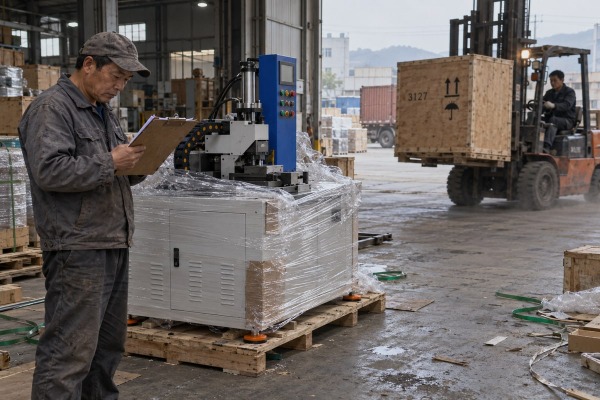
Buyers benchmarking our Wenzhou-built machines ask about import tariffs on pipe cutting machines from Europe. A low factory quote hides duty, VAT, and certification costs. Here is how we check.
Import tariffs on pipe cutting machines from Europe depend on HS code, true origin, customs value, and destination. No single rate exists. US, Canadian, UK, and Mercosur rates differ, and trade agreements like CETA or the EU–UK TCA can cut duty to 0% for qualifying machines.
Below, I walk through the four questions I ask before any machine crosses a border. Each one changes the number on your landed-cost sheet. None of them can be skipped.
A US distributor sent me a German quote to compare against our machine and asked for one duty percentage. I said we first needed the cutting method and HTS line.
To calculate the exact import tariff rate, classify the machine under the Harmonized Tariff Schedule—usually 8461.50, 8456.11, or 8462.59—confirm its origin, look up the base duty, add any Section 232 or reciprocal surcharges, and apply the rate to the customs value, then add MPF and import VAT.

Product descriptions are not enough. Customs officers look at the principal function, the cutting technology, numerical control, and whether the machine performs several operations. Our own automatic pipe cutting machines use a saw blade with hydraulic clamping and a coolant nozzle. So we declare them under 8461 50 as sawing or cutting-off machines 1. A CNC Laser Tube Cutting system is a different animal. So is a tube processing center that cuts, deburrs, and bends in one cycle.
| Likely code | What it covers | Typical trigger |
|---|---|---|
| 8461.50 | Sawing or cutting-off machines that remove metal | Circular saw, band saw, or abrasive disc pipe cutters |
| 8456.11 | Laser-operated machines | Fiber or CO2 CNC laser tube cutters |
| 8462.59 | Machines for working tubes, pipes, hollow sections, and bars | Cutting combined with bending, shearing, punching, or forming |
Each line carries different Customs Duty Rates in each destination. For imports into the EU, 8461 50 shows a 1.7% third-country rate. That is the rate our machines face in Germany or Italy. It is an example only. It tells you nothing about a laser cutter landing in Ohio.
Duty is charged on customs value 2. Normally this is the transaction value plus additions such as assists, buyer-supplied tooling, royalties, packing, and commissions. Incoterms matter here. An EXW quote excludes freight. A CIF quote already includes it, and some countries value goods on a CIF basis while the US uses an FOB-type value. Software licenses and post-installation service contracts can sometimes be invoiced separately so they are not dutiable. But the split must be genuine and documented. Customs challenges artificial unbundling.
Here is the formula I use with buyers:
Landed cost = machine price + freight and insurance + customs duty + additional tariffs + Import VAT or sales tax + brokerage and port charges.
For a US entry, add the Merchandise Processing Fee and, for sea freight, the Harbor Maintenance Fee 3. Then stack any reciprocal or Section 232 surcharge on top of the column-one rate. If the duty difference between two codes is material, request a binding ruling before shipment. I ask our EU buyers to do the same whenever a machine has a mixed function.
Preparing origin paperwork for our shipments into South Korea under preferential trade status taught me this: a trade deal on paper and zero duty at the port are two different things.
EU trade agreements can lower duties on pipe cutting machines in the UK (TCA), Canada (CETA), Japan, South Korea, Switzerland, Australia, and Mercosur. The EU had 44 preferential agreements covering 76 partners at end-2025, but 0% applies only if the machine meets the Rules of Origin with valid proof.

| Destination | Agreement | Machinery duty picture | Watch for |
|---|---|---|---|
| United Kingdom | EU–UK TCA | 0% for qualifying EU-origin goods | Full customs declaration still required; origin statement |
| Canada | CETA | 0% for qualifying machinery | Origin declaration on the invoice |
| Japan | EU–Japan EPA | Reduced or zero | Staging by tariff line |
| South Korea | EU–Korea FTA | Reduced or zero | Approved exporter status above value thresholds |
| Switzerland / EEA | Bilateral and EEA rules | Near-frictionless | Origin proof; VAT at the border |
| Australia | EU–Australia agreement | Tariffs up to 14% to be eliminated | Entry-into-force date and staging category |
| Mercosur | EU–Mercosur | Historic 14%–20% machinery duties, phased cuts | Ratification per country; tariff line |
| United States | No FTA | MFN plus additional measures | Reciprocal and Section 232 layers |
| Other markets | None | Normal MFN rate | Anti-Dumping Duties on specific lines |
Australia and Mercosur show the two ends of the scale. Australia removes duties of up to 14% on EU machinery, but only according to the agreement’s schedule. Mercosur markets historically charged 14% to 20% on machinery, so preferential access is commercially huge there. Yet staging categories and country-level implementation decide whether a given pipe cutting machine enters duty-free on your shipment date. “Agreement signed” and “zero duty available today” are different statements.
Origin depends on where the last substantial transformation happened, not the port of departure. I see buyers confuse five things: the exporting country, the country of manufacture, preferential origin, non-preferential origin, and the country printed on the invoice. A European dealer reselling an Asian-built machine, including machines like ours with a dealer label, does not create EU origin. A machine assembled in Europe from imported modules may or may not qualify. It depends on the product-specific rule in the agreement. Ask the exporter for bills of materials, supplier declarations, and processing records.
Proof of origin takes different forms. Depending on the agreement and shipment value, you may need an origin declaration on the invoice, a registered-exporter statement, an approved exporter declaration, or a formal certificate.
Some buyers tell me European machinery is automatically competitive because of these agreements. Others say the savings are hype. Both are half right. If the machine passes the origin test and the tariff line is already at zero, the saving is real. If it fails origin, sits in a staging category, or faces an extra measure, the saving vanishes. Import VAT is usually recoverable for registered importers, but duty is a sunk cost. So run the origin test first, then compare the duty saving against inland delivery and installation.
Before each pipe cutting machine leaves our Wenzhou workshop, our QC team photographs the nameplate, serial number, and safety labels, because customs brokers ask for exactly those.
Yes. Customs clearance for European pipe cutting machines needs a commercial invoice, packing list, bill of lading, correct HS code, origin proof, technical sheet, and an EORI number for EU-side export. CE marking helps but does not replace destination rules like FDA CDRH laser reports, OSHA, or local electrical approval.

| Document | Who prepares it | Why the border cares |
|---|---|---|
| Commercial invoice with Incoterms | Exporter | Sets the transaction value for duty |
| Packing list | Exporter | Matches crates to the declaration |
| Bill of lading or air waybill | Carrier | Proves shipment and arrival |
| Import declaration with HS/HTS code | Broker or importer | Determines the duty line |
| Country-of-origin statement and preferential proof | Exporter | Unlocks or denies reduced duty |
| Technical specification sheet | Manufacturer | Supports classification and valuation |
| Serial number and model data | Manufacturer | Links the machine to safety files |
| Conformity documents and test reports | Manufacturer | Required for release or for later installation |
| Manuals and warning labels in the destination language | Manufacturer | Often checked at installation, sometimes at import |
The EU exporter needs an EORI Number to file the export declaration. The importer needs its own identifier on the other side, such as an EORI in the UK or an importer number in the US. I include destination-language manuals and label sets with every machine we ship to Japan and Mexico. It saves weeks later.
A machine can clear customs and still sit idle on the shop floor. CE Marking Compliance supports the sale in Europe, but it does not satisfy destination-country rules by itself. A US buyer may still need to evaluate OSHA guarding rules, electrical and electromagnetic-compatibility requirements, and state-level inspections. Laser-based pipe cutting systems face a specific hurdle in the US: FDA CDRH radiation safety standards and an accession report. Skip that and the machine is a very expensive crate.
There are also controls before shipment. High-precision CNC or laser tube cutters can fall under EU dual-use rules in Regulation 2021/821. The European supplier may need an export license 4 before the machine leaves. Ask early, because this can add weeks.
One emerging item is CBAM. Carbon border rules in Europe are starting to require embedded-emissions data for steel inputs 5. Today this mainly affects steel entering the EU, but buyers are already asking machinery makers for component sourcing records. Keep the bill of materials clean. It helps with origin, with steel-content questions, and with these new reporting demands at the same time.
Every quote we issue forces a choice: price EXW and let the buyer carry tariff risk, or price DDP and absorb it ourselves. Neither option removes the need to verify.
Avoid surprise tariff costs by verifying the HTS code, origin, and duty stack on the shipment date, requesting a binding ruling when codes conflict, fixing Incoterms and tariff-change clauses in the contract, budgeting Section 232 and MPF layers, and modeling total landed cost before signing the purchase order.

US buyers are the ones most often surprised, because the duty is layered rather than single.
| Layer | What it is | How to verify |
|---|---|---|
| Column-one HTS duty | Ordinary rate for the subheading | Current Harmonized Tariff Schedule text |
| Reciprocal or framework tariff | Rates on EU-origin goods have moved between 10% and a 15% ceiling under the changing US–EU framework; a 2026 Supreme Court ruling on IEEPA-based tariffs reportedly opened CBP CAPE refund claims | Federal Register notices and CBP guidance on the entry date |
| Section 232 derivative duties | 15% to 25% tied to steel or aluminum content by weight, often triggered by heavy frames | Check whether the article or component is within the legal scope |
| Merchandise Processing Fee | Ad valorem entry fee | Broker entry summary |
| Harbor Maintenance Fee | Sea freight only | Broker entry summary |
| Anti-Dumping Duties | Rare on complete machine tools but possible on specific components | Check active orders for the HTS line |
A steel tariff does not apply just because the machine contains steel. It applies only if the imported article or a covered component falls within the measure. That distinction is worth a formal check.
The importer of record owns the accuracy of the entry, even when the supplier typed the HS code. So I push for a joint review by manufacturer, importer, and broker before the deposit is paid. Agree on Incoterms, state who files, and add a clause allocating any tariff introduced between order and arrival. Aggressive classification under a broader, cheaper heading can save money for one shipment and then cost back duties, interest, and penalties later. Equipment typically makes up around 65%–80% of a project budget and shipping 10%–20%, so duty, brokerage, and compliance can swing the final decision. This is exactly why import tariffs on pipe cutting machines from Europe deserve a worksheet, not a guess.
One tariff rate never tells the whole story. Check HS code, origin, agreement, Import VAT, valuation, and compliance, and a European quote stops hiding surprises. Need a benchmark? Ask us.
Interested in sourcing the products mentioned in this article? See details and request a quote here:
