

Booking freight forwarding and inland transport for a cable lug machine separately is how buyers lose weeks at port. Our Wenzhou team has watched it happen more than once.
To coordinate freight forwarding and inland transport for a cable lug machine, treat the move as one door-to-door project. Give the forwarder exact weights, dimensions and photos, fix Incoterms and customs roles early, book trucking before the vessel sails, and confirm site unloading before arrival.
The question we hear most from buyers is simple. When I purchase a cable lug making machine, how do I line up the forwarder and the inland carrier so the machine arrives at my factory floor, not just at a port? This article answers that question step by step.
A procurement manager in the US once messaged us on WhatsApp asking for a freight quote for one machine. We asked for the crate drawing first. That request surprised him.
Before booking freight for a cable lug machine, check packed dimensions, gross weight, center of gravity, number of packages, ISPM-15 timber compliance, HS code, Incoterms, origin loading equipment, destination road access, and unloading capacity. Then request an all-in quote that lists every accessorial charge.

A freight quote is only as good as the data behind it. "One machine" tells a forwarder nothing. Our automatic terminal machines ship as a main cabinet on leveling feet, a separate vibratory bowl feeder on its own stand, a control box, dies, spare parts, and a commissioning kit. That is often three to five packages, not one.
So before we ask any forwarder for a price, we send them a dimensioned packing list 1, photos of each crate, lifting points, and the center of gravity. We also flag anything regulated. Hydraulic oil, lubricants, and batteries in the control system all need a declaration. If the destination grid does not match the machine, we ship the voltage transformer or phase converter in the same consignment. Buying it later means a second shipment and a second customs entry.
Precise gross weight and packed L/W/H also decide the trailer type at both ends. If a crate turns out taller than declared, the container becomes out-of-gauge and the booking gets rejected. OOG rebooking fees and a missed vessel are the usual result.
| Option | Best for | Protection | Cost pattern | Main risk |
|---|---|---|---|---|
| FCL (20GP or 40HC) | Full lines, machines needing bracing | High, loaded and sealed at factory | Higher fixed cost | Underused container space |
| LCL | Small bench units, spare dies | Medium, extra warehouse handling | Lower for small volume | Impact, moisture, mix-ups, delay |
| Air freight | Urgent control parts, replacement tooling | High | Very high per kg | Uneconomic for full machines |
| Flat rack or open top | Units that cannot fit a container | Depends on lashing | Engineering plus handling fees | Permits, weather, vessel acceptance |
Buyers often push for LCL to save money. I understand the instinct. But a cable lug machine carries a touchscreen, sensors, a rotary cutting head, and precision dies. Every extra forklift touch at a consolidation warehouse is a chance for damage. If the machine fills a meaningful share of a 40HC, FCL with fixed bracing is cheaper once you count risk. If the machine can be partially disassembled, a standard 40HC usually beats a flat rack on both cost and protection.
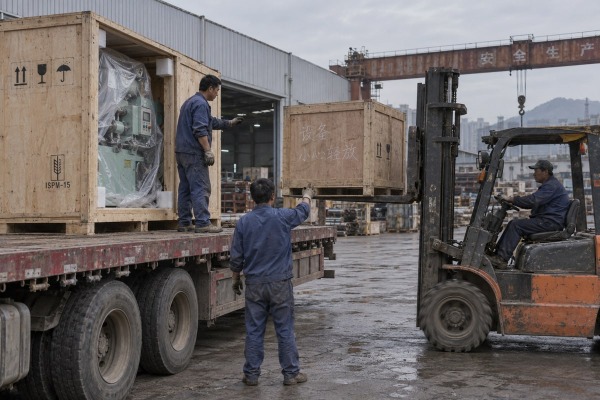
We use heat-treated plywood and timber with the ISPM-15 mark 2, because untreated wood is stopped at the border in most of our markets. Inside the crate, the machine is bolted to the skid, moving parts are locked, casters are blocked, and the whole unit sits in a vacuum-sealed VCI bag with desiccant sized for the crate volume. Removable items like the bowl feeder, LED work lamp, and signal tower come off and ship in their own boxes. Forklift pockets and sling points are marked on the outside.
Vague paperwork taught us an early lesson: an invoice line reading machine parts triggered a port inspection. Now every invoice we issue names the machine precisely.
Coordinate customs clearance with inland delivery by filing documents before the vessel arrives, confirming the HS code or a binding ruling in advance, agreeing Incoterms 2020 responsibilities, and having the customs broker release the cargo while the drayage truck is already scheduled.

Customs delays for heavy machinery shipping almost always start with paperwork that does not match. The commercial invoice, packing list, and Bill of Lading 3 must describe the same machine, the same serial numbers, the same package count, and the same weight. If one says automatic terminal making machine and another says equipment, expect questions.
The full package we send to the destination customs brokerage before departure includes:
On HS codes, do not rely on an informal code from a supplier, including us. Cable crimping, cutting, stripping, and terminal-making machines can land in different headings depending on primary function. For high-value or repeat shipments, a Customs Binding Ruling 5 locks in the classification and valuation before the machine sails. It is the single best way to skip the manual examinations that specialized equipment attracts.
Incoterms 2020 define who books, who pays, and where risk passes. They do not define unloading, installation, or site access.
| Incoterm | Seller responsibility ends | Buyer must arrange | Fit for a cable lug machine |
|---|---|---|---|
| EXW | Goods available at our factory | Pickup, export clearance, everything after | Only with a strong buyer forwarder in China |
| FOB | Goods loaded on vessel at origin port | Ocean freight, insurance, import, inland | Common and clear |
| CIF | Ocean freight and insurance to destination port | Import clearance, port drayage, final delivery | Clear, but buyer still owns the inland side |
| DAP | Delivery to named place, not unloaded | Import duties, unloading, installation | Good when buyer has customs expertise |
| DDP | Delivered, duties paid | Unloading and installation | Simplest, but legally awkward in some markets |
Buyers sometimes ask us to quote EXW because it looks cheapest. I always point out the trade-off. EXW hands them export formalities in China and a factory pickup they cannot supervise. Others ask for DDP so they can forget about customs. In the US and Germany, DDP can require tax registration we do not hold. The clearest allocation is usually a split scope: we handle export-ready crating, container loading at our Wenzhou plant, and export declarations, while the buyer's forwarder controls the ocean leg, import clearance, and last mile delivery. One party owns each handoff.
The practical sequence that avoids storage charges is this. First, the broker pre-files the entry using documents sent during transit. Second, the forwarder tracks the arrival notice and confirms free time at the terminal. Third, the drayage truck is booked for the first available day inside that free time. Fourth, duties are paid and the delivery order is issued the day the container discharges. Fifth, the truck pulls the box. If any step waits for the previous one to finish before it begins, demurrage starts counting.
Every destination truck booking forces us to weigh two things: the cheapest standard chassis against the trailer that can actually unload safely at the buyer's door.
For most cable lug machines, port drayage on a standard container chassis works best when the site can receive a full container. If not, transload to a flatbed, liftgate truck, or lowboy with crane or forklift unloading, based on weight, access, and a route survey.

| Inland option | When it fits | Equipment needed at site | Watch out for |
|---|---|---|---|
| Direct container drayage to door | Site has a dock or forklift, truck can turn | Forklift rated above crate weight, dock or ramp | Container door height, chassis wait time |
| Transload at port warehouse to flatbed | Site cannot take a container | Forklift or crane for side unloading | Extra handling, warehouse fees |
| LTL with liftgate | Small LCL crates, spare dies | Pallet jack | Crate too heavy for liftgate limit |
| Lowboy or multi-axle trailer | Crate exceeds normal height or weight | Crane and rigging crew | Permits, escorts, restricted hours |
Intermodal freight transport works well for our machines because the container stays sealed from our factory to the buyer's yard. But that only holds if the destination can receive it. A production plant with a loading dock, a forklift above the crate weight, and a flat yard can take the container directly. A rented unit in an industrial park with a narrow driveway often cannot.
A standard cable lug machine in a 40HC is normally road-legal. The problem comes when a buyer orders an integrated line, or when the machine, crate, container, chassis, and tractor add up. In the United States, interstate limits 6 commonly cited are 80,000 pounds gross vehicle weight, 20,000 pounds on a single axle, 34,000 pounds on a tandem axle, and a 102-inch vehicle width. Anything above those needs state permits. Similar permit systems exist in Germany, Italy, Mexico, and India, and each one has its own thresholds.
So when a shipment approaches those numbers, the inland carrier runs a route survey. The survey checks bridge capacity, low clearances, weight-restricted roads, tight turns, utility lines, and travel-hour restrictions. A crate that is legal on the highway can still require a permit or an escort on the county road to the plant.
The costliest inland failure is a truck that arrives and cannot unload. Before dispatch, we ask the buyer to confirm delivery hours, appointment rules, whether a rigging crew is needed, and whether crate removal and disposal are included. Our machines sit on casters and leveling feet, so once uncrated they can be rolled, but the crate itself needs a forklift or crane.
Some buyers now go further. They take our machine drawings and run a 3D simulation of the move through the factory doorway, down the production aisle, and into position. It sounds excessive until a bowl feeder stand gets stuck in a corridor. A ten-minute clearance check beats a machine parked in a warehouse while a wall is modified.
Our packing team photographs each crate at seven stages, from bare machine to delivery site. Those photos have settled more than one argument about where damage happened.
Avoid delays when combining freight forwarding and inland logistics by running one milestone schedule, booking the destination truck before sailing, pre-filing customs, carrying All Risks marine cargo insurance, building buffers for inspections and holidays, and never promising a delivery date until cargo is released.

Good logistics coordination means every party sees the same timeline. This is the sequence we share with the buyer's forwarder on every cable lug machine order:
Step 7 is where most buyers slip. They book the vessel and wait. We ask them to book the destination truck at the same time, even as a provisional slot. Chassis shortages and appointment backlogs at busy ports mean a truck booked after arrival may be a week out.
| Delay cause | Typical buffer we suggest | How to reduce it |
|---|---|---|
| Customs examination | 3 to 7 days | Precise description, binding ruling, matched documents |
| Port congestion or vessel slide | 5 to 10 days | Track schedules, avoid fixed promises to your plant |
| Public holidays at origin or destination | Check both calendars | Avoid Chinese New Year and destination holiday weeks |
| Permit processing for oversize loads | 1 to 3 weeks | Start route survey when crate dimensions are final |
| Failed delivery attempt | Redelivery plus storage | Site survey and confirmed unloading equipment |
Carrier liability is not insurance. A trucker's standard liability may pay a small fraction of a damaged machine's value. We advise every buyer to hold All Risks marine cargo insurance covering invoice value, freight, and duties, and to confirm in writing that the policy extends to the last mile unloading and rigging at the plant. Many policies stop at the delivery address and exclude the crane lift that follows. Read the exclusions for inadequate packaging and corrosion too, and keep the packing photos to prove the crate was sound.
Buyers under production pressure want the machine energized the same afternoon it arrives. I push back on this every time. A machine that crossed the Pacific in winter is cold inside. Open the crate in a warm plant and condensation forms on the controller, the sensors, and the precision dies. We ask for a 48-hour thermal acclimatization period with the machine still wrapped, until it matches ambient temperature. Then a technician checks insulation, lubrication, pneumatic lines, and connections before the first cycle. Two days of waiting prevents a far longer commissioning delay.
A cheap freight rate that strands your cable lug machine at port costs more than it saves. Plan freight forwarding and inland transport as one project, and delivery stays predictable.
Interested in sourcing the products mentioned in this article? See details and request a quote here:
1. Official US government resource for international trade documentation and export compliance requirements. ↩︎
2. International standard for phytosanitary measures regarding wood packaging materials in global trade. ↩︎
3. Comprehensive overview of the legal and logistical functions of a bill of lading. ↩︎
4. Detailed explanation of marine insurance principles covering cargo loss or damage during transit. ↩︎
5. Official US Customs and Border Protection portal for obtaining definitive cargo classification rulings. ↩︎
6. Authoritative US government data on federal vehicle size and weight standards for interstate transport. ↩︎
