

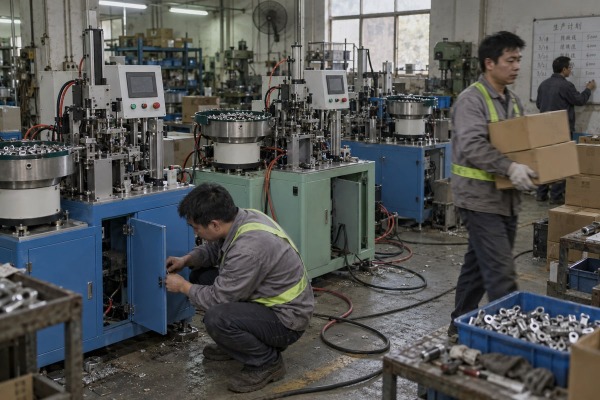
Supplier capacity delays on a cable lug making machine 1 can stall a whole harness line. I have seen it from our Wenzhou workshop. The cure is verification, not hope.
To avoid supplier capacity delays when buying a cable lug making machine, verify real factory capacity before ordering, lock a production slot ahead of peak season, freeze specifications and dedicated dies early, approve samples in advance, and tie milestone payments and contract remedies to measurable delivery dates.
Most buyers only look at the ship date. I look at everything that has to happen before the machine can even be built electrical resistance 2. The four sections below follow that order, from capacity checks to contract wording.
Two winters ago, our assembly bay held three terminal machines at once, and I learned exactly how fast a small shop's capacity fills up.
Verify real production capacity by requesting the current production queue and planned start date, confirming the quoted machine's actual stock status with dated photos or live video, auditing in-house versus outsourced work, checking long-lead component inventory, and calling references for comparable cable lug machines.

My first rule is simple. Before I ask a supplier for a date, I ask when their busiest months are. Every workshop has a peak. For shops in our region, the crunch usually lands before the Lunar New Year shutdown and again before the autumn export rush. If your order enters the queue during that window, it competes with every other order on the floor. So I reverse-engineer the peak. I find out which months are overloaded, and then I aim to lock a slot before that period starts. Ordering just before peak season is not the same as locking capacity before peak season. The first puts you at the back of a crowded line. The second gives you a reserved place in it.
A factory audit does not always need a plane ticket. A structured call, a live video walk-through, and a few direct questions reveal most of what you need. This is the factory audit checklist I would expect a serious buyer to run on us.
| Question to ask | Answer that reassures me | Answer that worries me |
|---|---|---|
| How many machines of this model shipped in the last 12 months? | A specific number with recent examples | "Many" with no detail |
| How many are in production right now? | A count plus their planned ship dates | No clear answer |
| Which operations are in-house and which are outsourced? | Clear list: frame, cabinet, tooling, software | "We make everything" |
| Are PLCs, servo drives, hydraulic valves, and sensors already in stock? | Yes, with photos or purchase records | "We order when the deposit arrives" |
| Who are your Tier 2 suppliers for dies and tooling steel? | Named partners and backup options | Refusal to say |
| What is your current utilization? | An honest percentage and the next open slot | "We can start immediately" during peak season |
| How many technicians handle commissioning? | A count and their export experience | One person who also runs sales |
Production throughput matters less than control over the parts that gate it. A supplier can own a large hall and still wait weeks for a servo drive. Capacity has to be judged at the component level, not by floor area.
When a quote says in stock, I ask which of these six states applies:
Then I ask for a dated photo or a live call. I want to see the actual machine, its job number, the electrical cabinet, and the die set. A generic factory video proves nothing about this order. Suppliers who use modular assembly can build frame, cabinet, and feeder sections in parallel, which shortens the critical path. That is worth asking about too. All of this is basic OEM supplier verification, and it takes one afternoon.
Every quote we issue forces a trade-off I weigh daily: promise the shortest date and win the order, or state a realistic milestone plan and risk losing it.
Request a lead time guarantee that defines when the clock starts, lists dated milestones from drawing release to factory acceptance testing, confirms dies and long-lead parts are included, states ex-works versus delivered dates, and fixes a production schedule lock point after which the slot cannot be reassigned.

Good lead time management starts with honest numbers. The ranges below are planning benchmarks. They are not guarantees, and they often exclude engineering approval, tooling, testing, export documents, transit, customs, and installation.
| Machine type | Typical planning range | What the quoted number often leaves out |
|---|---|---|
| In-stock standard unit | 7–15 days | Whether "in stock" means tested and complete |
| Standard or lightly customized | 15–30 days | Die sets for your conductor range |
| Hydraulic cable lug equipment | 15–25 days | Hydraulic press specifications sign-off |
| Automated system with feeder and PLC | 25–50 days | Programming, sensors, integration |
| Double-station or high-speed line | 30–45 days | Trial production and cycle testing |
| Custom machine | 31–60 days | Drawing approval rounds |
| Heavily engineered system | 8–16 weeks or longer | Everything above plus commissioning |
Many listings advertise roughly 10–35 working days after the down payment arrives. Notice the trigger. The clock starts at payment, not at the first email. If your drawings arrive late, the date moves with them, and that delay belongs to you.
"Delivery in 30 days" is not a schedule. A real schedule assigns a date to each of these steps:
Milestones make slippage visible in week two instead of week six. That is the whole point.
This is the clause I push hardest. I ask the supplier to name a lock point. It is a calendar date by which the specification is frozen, the dedicated dies are confirmed, and the deposit is received. After that date, the slot is mine. The supplier cannot reassign it to a bigger customer, and I cannot add changes without an agreed reset. If you are buying terminal manufacturing equipment for a busy quarter, set the lock point before the regional peak and before holidays like Lunar New Year or Golden Week. Those shutdowns can remove a month from any plan. One buyer objection I hear often is that the shortest quoted lead time should win. My answer is that the shortest promise usually expands later. A longer but documented plan rarely does.
A US procurement manager once messaged me on WhatsApp asking why a rival's quote beat ours by two weeks. I asked if it included dies. It did not.
Red flags include a lead time quoted without a milestone schedule, vague answers about the production queue, generic factory videos instead of the actual machine, customization accepted without a timeline reset, dies and PLC components not yet sourced, and no plan for holiday shutdowns or component shortages.

Warning signs rarely look like refusals. They look like easy yeses. Here is how I would read them.
| Red flag | What it usually means | What to ask next |
|---|---|---|
| Any change is accepted with no new date | Customization has not been priced into time | "Which milestone moves, and by how long?" |
| Generic factory video, no job number | The quoted machine may not exist yet | "Show me this unit on a live call" |
| No answer on current queue | The slot is not reserved | "Which week does my frame go on the floor?" |
| Dies "will be ordered later" | Tooling is not on the critical path yet | "When is heat treatment scheduled?" |
| PLC or servo "available soon" | Long-lead part not in stock | "Send the purchase record" |
| Lead time starts "after confirmation" | Undefined trigger | "Confirmation of what, by whom?" |
| No mention of holidays | Shutdown not built into the plan | "Which weeks is the factory closed?" |
Cable lug equipment depends on dies matched to your conductor range, lug profile, and crimp method. Custom dies need design approval, machining, heat treatment, and testing. Tooling and die fabrication is often the slowest single item on the whole order. A machine can be mechanically complete and still fail acceptance because the correct die is not ready. That is why I insist on confirming dedicated dies early, ideally at the lock point. If a supplier treats tooling as an afterthought, the ship date is already at risk.
Sample testing is not only a quality step. It is a capacity step. When I run samples on your actual cable and lugs before the busy season, I catch problems while the floor is still calm. We check crimp geometry 4, pull-force results, electrical resistance, lug deformation, surface damage, changeover time between sizes, and jam frequency. We also test the edges of the size range, not just the middle. Whether the machine uses hydraulic pressing 5 or cold forging technology, a sample that fails in March is cheap to fix. The same failure in the middle of peak season is expensive. For automated lines with feeders and PLC logic, a virtual commissioning run before physical assembly can also shorten late troubleshooting.
Another objection I hear is that a standard machine avoids all of this. A standard unit reduces engineering time, but only if its conductor range, crimp force, and safety guarding actually match your parts. Otherwise the standard machine arrives fast and then sits idle.
The hardest lesson from our export work was simple: a contract that only names a ship date protects nobody, because nobody agreed what that date includes.
Protective contract terms include a defined lead time start trigger, dated milestones, a capacity reservation clause, milestone-based payments released after verified progress, included tooling and spare dies, Incoterms that separate production from transit, a time-is-of-the-essence clause with tiered remedies, and pre-shipment inspection rights.

A capacity reservation agreement is the contract version of my lock point. It secures a production week and a labor allocation months ahead, sometimes before the final PO is issued. For buyers who know their peak season, this is the single most useful clause. It converts "we will try" into "this week is yours."
Money should follow verified progress. The percentages are negotiable. The structure is not.
| Payment stage | Trigger | Evidence I provide |
|---|---|---|
| Deposit | Contract signed, specification frozen, dies confirmed | Signed spec sheet and die drawings |
| Progress payment | Mechanical and electrical assembly complete | Dated photos with job number |
| Balance | Factory acceptance test passed on buyer's materials | Test records, samples, video |
| Retention | Installation or site acceptance | Commissioning report |
Factory acceptance should use your cable and lugs where possible. The record should list machine settings, cycle times, alarms, rejected parts, and photos. If you cannot attend, a third-party pre-shipment inspection or a live remote session keeps the gate honest. Clear quality control standards in the contract, such as pull-force or crimp-height limits, make the gate objective.
Most delays become arguments over definitions. The contract should state: the date the lead time clock starts; which tooling and accessories are included; the Incoterm, so ex-works completion is not confused with arrival; permitted reasons for extension; notice requirements when a milestone slips; and the warranty start date. A time-is-of-the-essence clause 6 with tiered remedies gives the supplier a reason to flag trouble early. Smaller suppliers may resist cash penalties, and that is fair. Practical remedies work just as well: expedited freight at the supplier's cost, extra spare dies, extended warranty, or a partial credit.
One objection deserves a direct answer. Penalties cannot create a missing servo drive. They encourage discipline, but milestone visibility, early design freeze, and backup planning prevent more delays than penalties do. A second objection is that buying locally removes all risk. Local sourcing can simplify service, but it can also mean fewer tooling options and lower capacity. International sourcing works when inspection, documents, and Incoterms are managed properly.
Supply chain risk mitigation is not the supplier's job alone. I tell buyers not to compress their whole plan into our delivery date. Keep the old machine running until the new one passes site acceptance. Order critical dies in duplicate. Hold a small safety stock of finished lugs. Identify a second supplier before the PO. Schedule installation before your customer's peak, not during it. A cheaper cable lug making machine stops being cheap when one month of delay interrupts a major contract.
Capacity delays kill schedules quietly. Waiting until peak season to order invites them. Verify, lock a slot, freeze dies, test samples, and keep a buffer—then the date holds.
Interested in sourcing the products mentioned in this article? See details and request a quote here:
1. Authoritative government resource for international trade regulations and manufacturing industry oversight. ↩︎
2. Technical standards for measuring electrical properties and conductivity in industrial components. ↩︎
3. International standards for quality management and industrial testing procedures. ↩︎
4. Authoritative technical standards for mechanical engineering quality control and precision measurement. ↩︎
5. Authoritative OSHA resource providing safety standards and operational guidelines for hydraulic and mechanical power presses. ↩︎
6. Legal explanation of contract clauses regarding strict performance deadlines and delivery obligations. ↩︎
